


If you’ve been paying attention to the components that make up your computer, such as motherboards, SSDs, or GPUs, you’ve probably heard of the different versions of PCIe. The latest and most powerful is PCIe 5.0, but interestingly it is still not considered important by most people. To summarize: very few technology products can saturate the extra bandwidth of PCIe 4.0, let alone PCIe 5.0. We summarized that there are four main reasons for today’s situation.
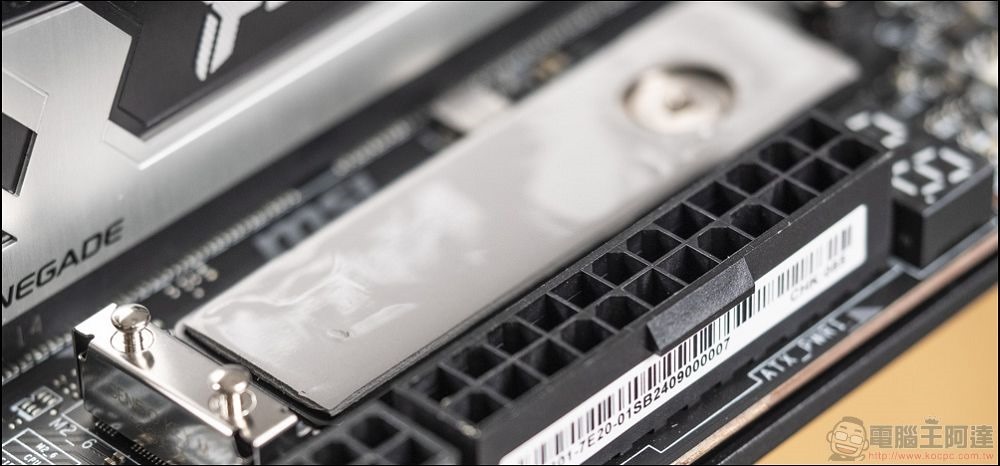
Why is PCIe 5.0 still not that important to most people?
1. GPUs don’t even use PCIe 5.0
If you already own a GeForce RTX 4090, you might be surprised to know that it doesn’t even use PCIe 5.0. It is built to 4.0 standards but can even run in 3.0 sockets. Best of all, you won’t even really see any negative effects of running it in a 3.0 socket.
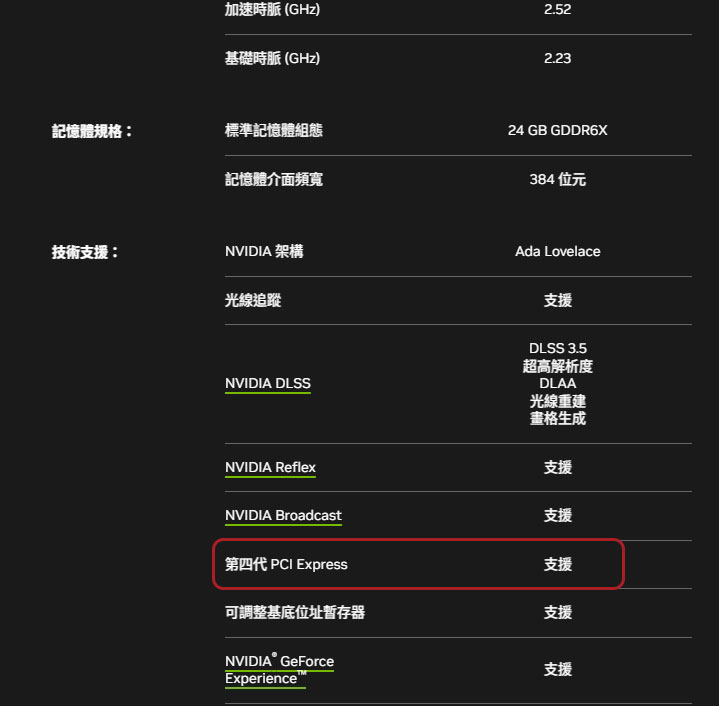
This occurs because PCIe 4.0 transfers at about 2GB/s per lane, while PCIe 5.0 transfers at about 4GB/s per lane, so a card running in PCIe 4.0 with 16 lanes will be able to transfer 32GB/s in each direction. That’s an incredible amount of data transfer, and even when running the RTX 4090 in a PCIe 4.0 slot with 8 lanes (or a PCIe 3.0 slot with 16 lanes), there’s a slight but almost negligible performance drop.
All in all, the biggest reason why PCIe 5.0 isn’t important is that PCIe 3.0, currently with 16 lanes, will provide the same bandwidth to the GPU that many people get with an 8-lane configuration in PCIe 4.0, which is likely to happen especially if your motherboard shares a PCIe lane with an M2 SSD.
2. Limited storage advantages
If you’ve looked at the PCIe 5.0 SSD specs in detail, incredible read speeds like 12,000MB/s will likely catch your attention. However, these dazzling numbers are not practical because they don’t really bring any real performance improvements, because at some point, the CPU and GPU will become the bottleneck in processing this data.
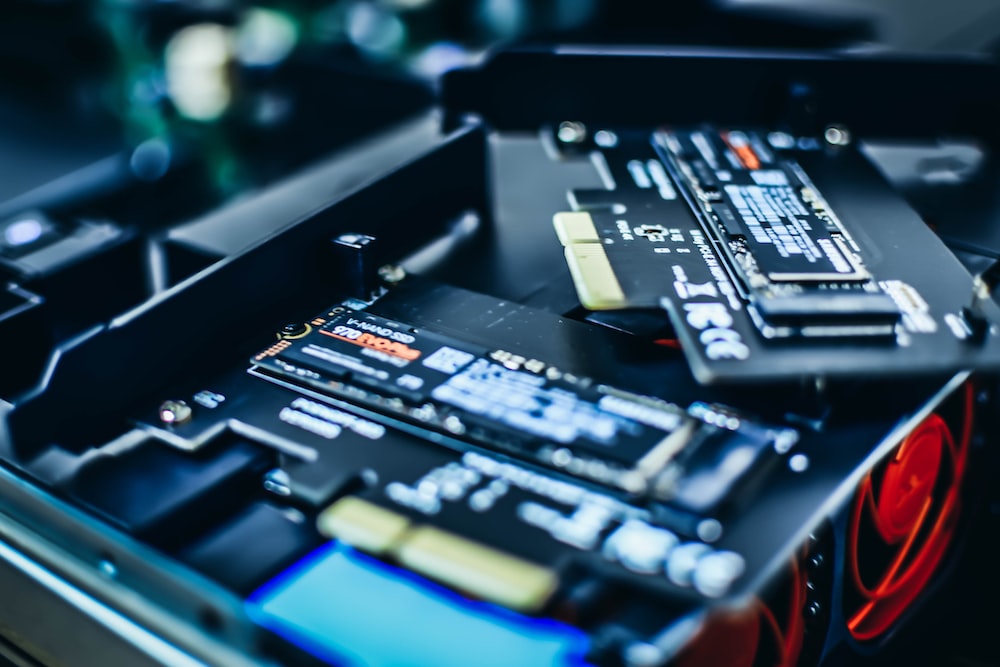
In addition, PCIe 5.0 SSD operates very hot, consumes a lot of power, is much more expensive, and its random write and read speeds are more in line with PCIe 4.0. It might be worth thinking about whether they are worth buying, and in some cases you might even need to buy a heatsink for your PCIe 5.0 M2 SSD.
3. PCIe appears to be evolving much faster than the technologies that utilize it
PCIe has come a long way as a standard over the years, but it’s clear that its benefits don’t really translate into the hardware released today. Even then, like SSDs, there are some drawbacks that made the previous generation quite attractive. For example, the waste heat issue mentioned earlier means that unless you have a system in place to cool your SSDs, they can easily put you at risk of overheating if they use PCIe 5.0.
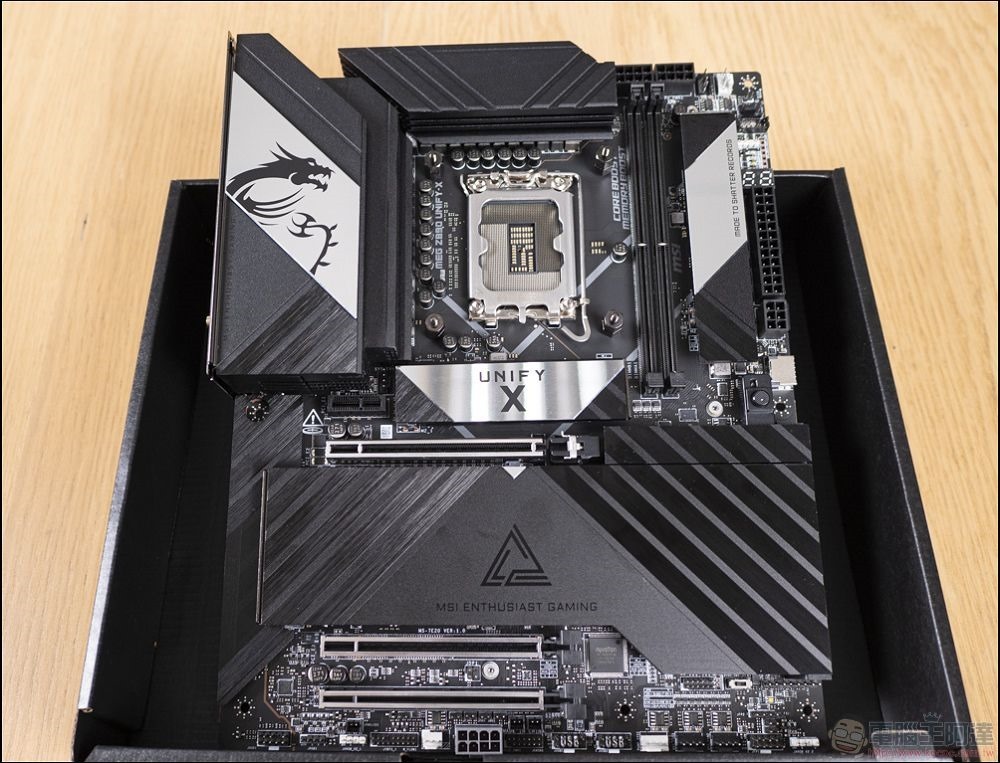
On top of that, PCIe 5.0 has higher power requirements than 4.0, not by much, but it’s another disadvantage of an upgrade that isn’t as cost-effective.
4. Servers benefit more from the advancement of PCIe
If you thought the 24 available lanes of PCIe 5.0 in modern CPUs like the AMD Ryzen 7 9800X3D or the Intel Core Ultra 9285K are a lot, look again at 128 lanes. AMD EPYC 9005 series processors support 128 PCIe 5.0 lanes in single-socket configurations and 160 lanes in dual-socket configurations. This many PCIe 5.0 lanes may seem unbelievable, but are quite necessary for enterprises.
For example, Compute Express Link (CXL) devices such as SmartNICs and accelerators will actually utilize PCIe 5.0 lanes. NIC stands for Network Interface Card, and SmartNICs can do things like load balancing and telemetry, and even manage things like firewalls, offloading some processing from the CPU. Nvidia’s latest ConnectX-7 SmartNIC accelerates custom software-defined network stacks, provides powerful security features such as inline encryption and decryption, and enables firewalling and hardware trust root for the secure boot process.
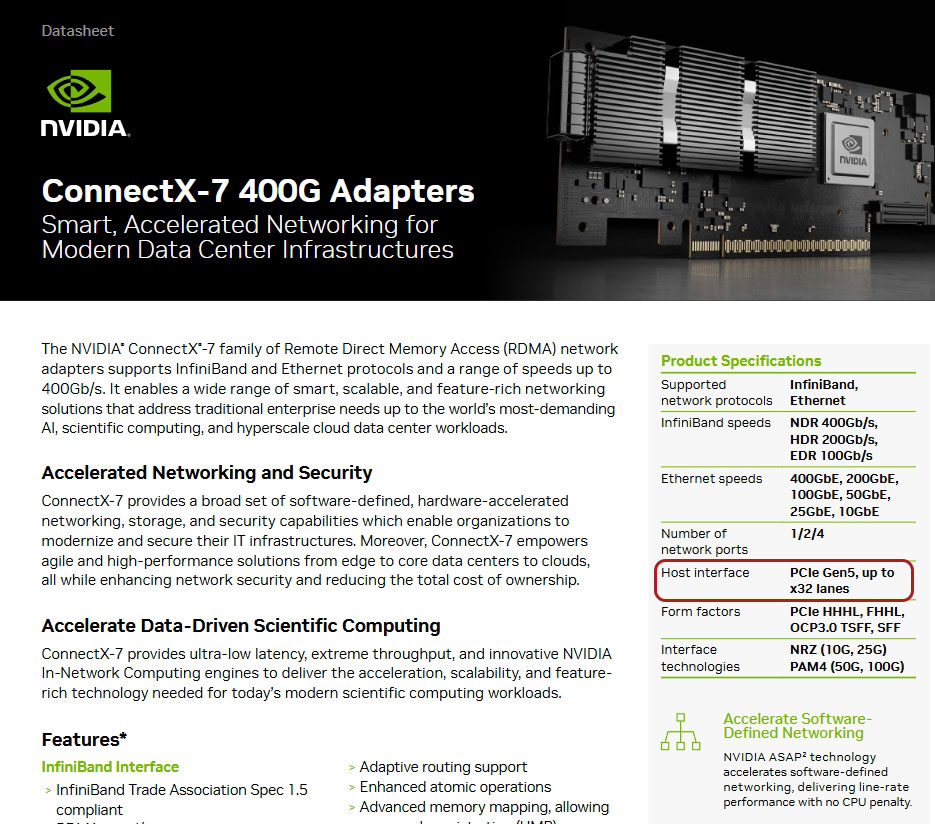
In addition, they also support basic security protocols such as TLS, IP security (IPsec), and MAC security (MACsec). On the storage side, they manage protocols such as RoCE, GPUDirect Storage, NVMe, and TCP, and can also improve the performance of virtualized data centers because they provide support for single I/O virtualization (SR-IOV) and virtual switching and routing functions.
Source: KOCPC Chinese