


Google officially announced that it will shut down its two major health applications, Google Fit and Fitbit, and use the new “Google Health” as a unified platform to integrate health tracking, AI personalized guidance and new hardware products. This change is not just a brand adjustment, but a key step in Google’s reorganization of the health ecosystem. The official even emphasized that existing users will receive “significant upgrades” rather than a simple interface update.
“Google Health” is coming soon, replacing Google Fit and Fitbit apps
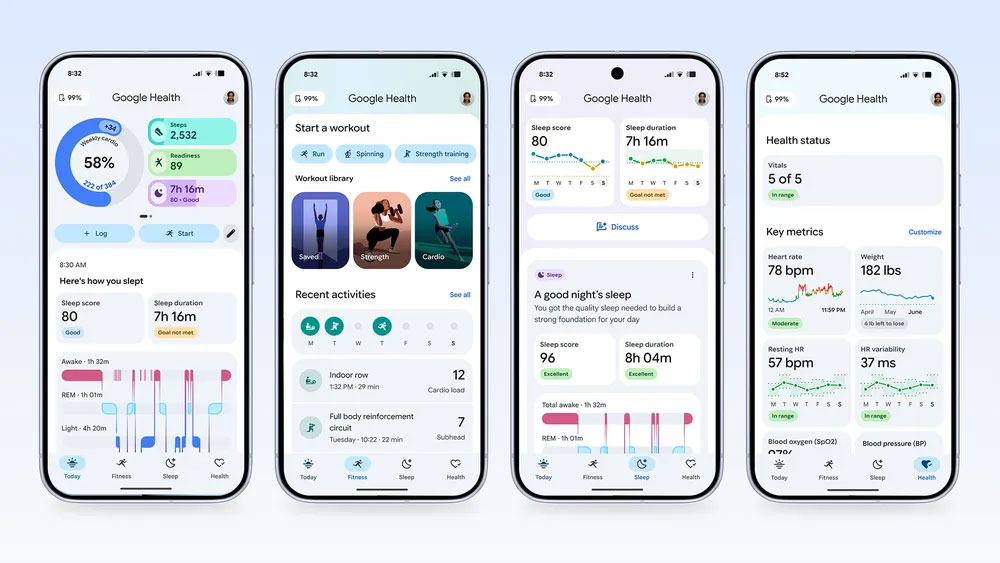
The most obvious change to Google Health is a completely revamped application architecture. The new interface is centered on the four tabs of “Today”, “Fitness”, “Sleep” and “Health”, allowing users to find the information they need more quickly. This design allows information that was originally scattered on different pages or even different applications to be presented in a consistent manner on a single platform.
- “Fitness”: Integrating weekly exercise plans, training suggestions and activity statistics, it is the sports center of the entire platform.
- “Today” and “Health”: Both provide customizable dashboards that allow users to arrange the most important health indicators according to personal needs, such as heart rate, step count, stress, calorie intake, etc.
- “Sleep”: Specially presents sleep stage, quality and trend analysis, and is deeply connected with AI coaching.
Google also emphasized that Google Health is not just an extension of Fitbit, but a cross-platform health data center. Through Health Connect, Apple Health and Google Health APIs, users can integrate data from hundreds of devices and services into a single interface. This means you can see both in Google Health:
- Peloton training records
- MyFitnessPal Diet Tracking
- Body fat data from smart scale
- Heart rate and sleep information from smart watches
In addition, Google has also relaunched an expanded version of the friend rankings, allowing users to compete with friends on step count or aerobic exercise load, rediscovering the fun of Fitbit’s social features.
Another core highlight of Google Health is the AI health coach that fully imports the Gemini model. This coach not only provides suggestions, but also actively interprets your health data and adjusts training and sleep plans according to your status. For U.S. users, AI can even read and summarize uploaded medical records to provide more personalized health recommendations, making Google Health no longer just a tracking tool, but moving towards a true AI health assistant.
AI Coach supports multiple input methods:
- Text or voice conversation
- Take photos of food to record your diet
- Capture fitness equipment screens to automatically identify training content

Google said that Google Health will be pushed directly through the Fitbit app update, and users do not need to download an additional new app. The update will be available OTA to all Fitbit users starting on May 19. As for Google Fit, users will receive notifications later this year and receive an official data migration tool to assist in transferring complete historical records to Google Health.
In addition to software integration, Google also launched a new fitness wearable device “Fitbit Air”, clearly targeting competing products such as Whoop and Oura that focus on long-term health monitoring. The positioning of this product is very clear: it provides all-weather, low-interference health monitoring and is deeply integrated with Google Health’s AI coach to form a health management experience integrating software and hardware.
Fitbit Air features include:
- Screen-less design, focus on background tracking
- Ultra-lightweight sensor of only 5.2 grams
- Up to 7 days of battery life
- 5 minutes of fast charging gives you a full day of use

From closing Google Fit, integrating Fitbit, to launching Google Health and Fitbit Air, Google’s strategy has been very clear: to create a health ecosystem with AI as the core, cross-platform integration, and support from its own hardware. This isn’t just an update, it’s Google’s declaration of a fresh start in health technology. Next, whether Google Health can truly challenge Whoop, Oura, and even Apple Health will become one of the most noteworthy technology battlefields in 2026.
Source: KOCPC Chinese