


The global mobile phone industry is facing an unprecedented “perfect storm”: memory prices are soaring due to the AI craze, and supply chains are tight due to unrest in the Middle East. As a result, MediaTek and Qualcomm have to significantly reduce the production of 4nm and 5nm chips at TSMC. However, while mobile phone chip manufacturers are complaining, AMD CEO Lisa Su took advantage of the situation and quietly took over the vacated production capacity. At the latest quarterly press conference, she confirmed that AMD is in a “strong growth period driven by shipments.”
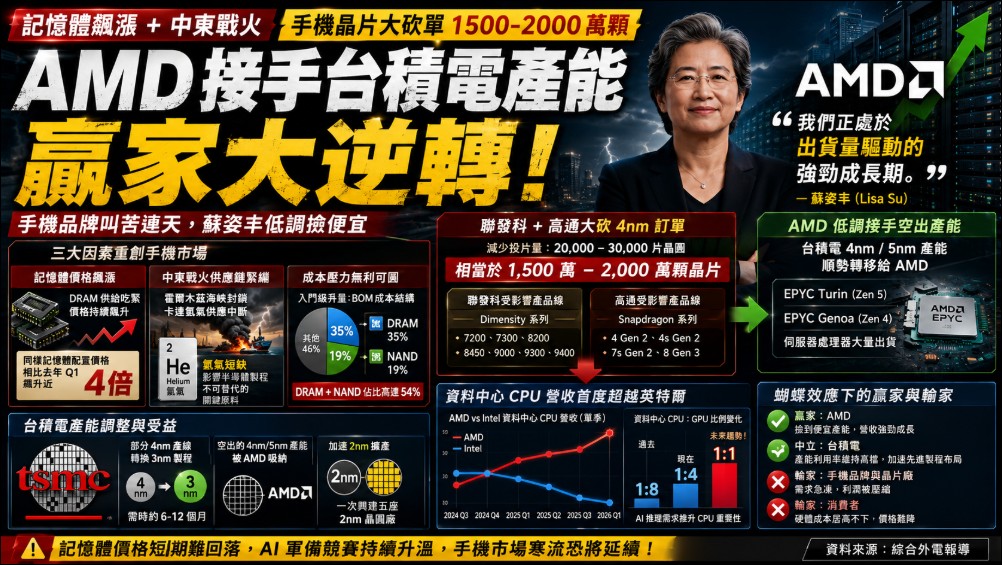
Memory price increase “destroys demand”, mobile phone chip orders cut by 15-20 million units
The source of this wave of chain effects comes from the huge demand for high-bandwidth memory (HBM) in the AI field. As a large amount of global DRAM production capacity is directed to HBM production, traditional DRAM supply is tight and prices continue to soar, directly impacting the mid-to-low-end smartphone market, which is extremely cost-sensitive.
DRAM now accounts for 35% of the bill of materials (BOM) cost of an entry-level phone, and NAND flash memory accounts for another 19%, bringing the two together to a whopping 54% of the BOM cost. this meansNearly two-thirds of the cost of an affordable mobile phone is eaten up by memory, the dilemma of almost no profit margins directly reduces the willingness of mobile phone brand manufacturers to purchase high-end processors.
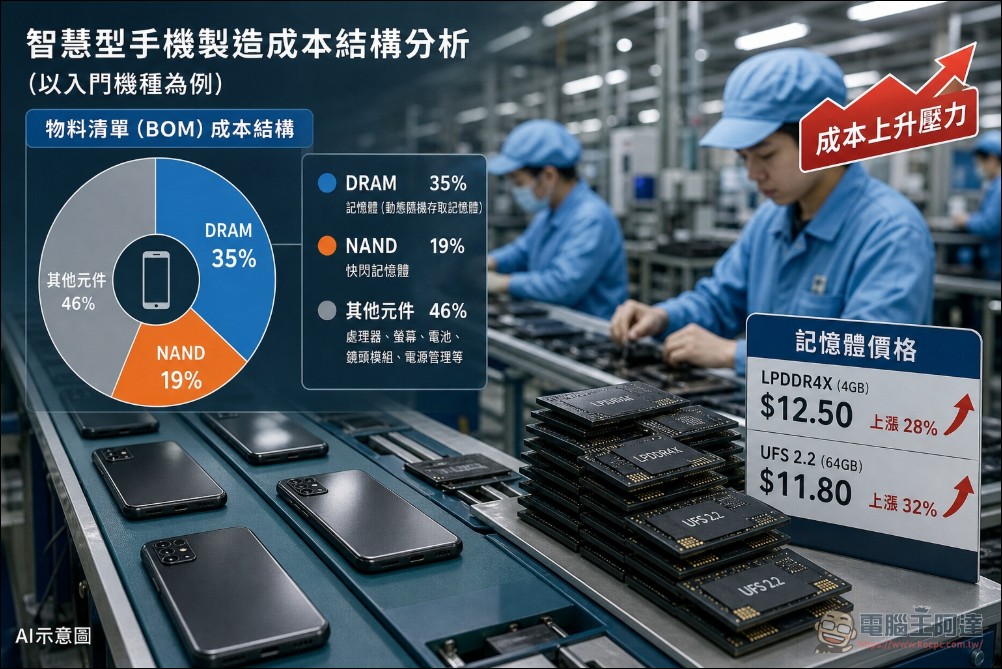
Xiaomi President Lu Weibing previously lamented on the X platform: “This round of memory price increases has indeed far exceeded expectations. The price of the same memory configuration has soared nearly four times compared to the first quarter of last year.” Such an increase is undoubtedly a wake-up call for brands that focus on cost-effectiveness.
Against this background, MediaTek and Qualcomm have both slashed their 4nm chip orders from TSMC. According to reports, the reduced wafer production volume of the two companies is equivalent to approximately 20,000 to 30,000 wafers, which is equivalent to a production capacity of 15 million to 20 million mobile phone chips. MediaTek’s affected product lines include the Dimensity 7200, 7300, 8200, 8450, 9000, 9300 and 9400 series; Qualcomm’s main chips include Snapdragon 4 Gen 2, 4s Gen 2, 7s Gen 2 and Snapdragon 8 Gen 3.
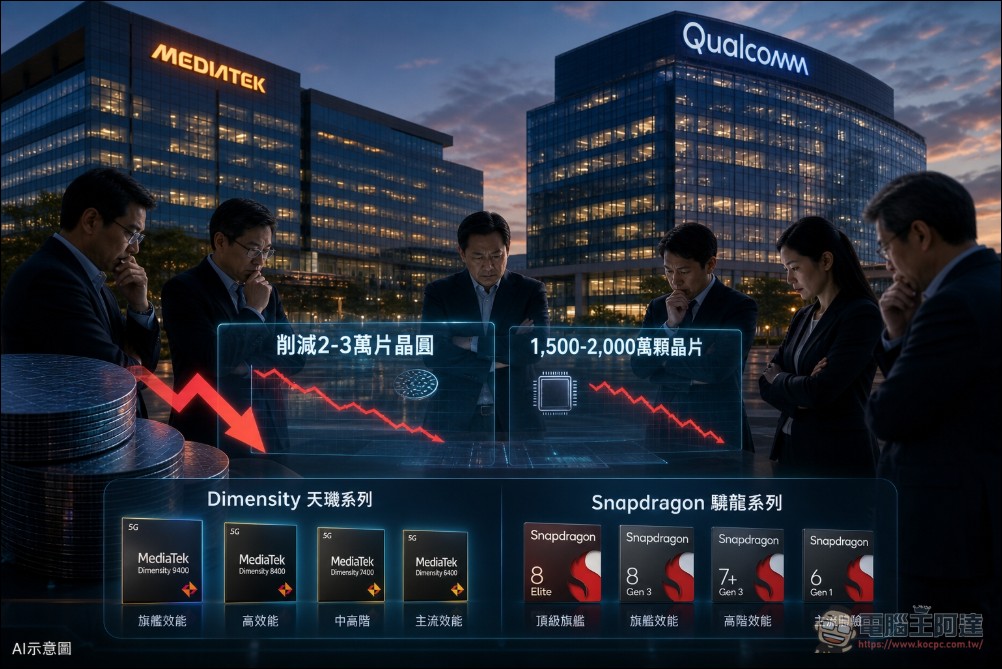
In addition, in addition to rising memory prices, the global helium shortage caused by the war in Iran in the Middle East has further worsened the semiconductor supply chain. Qatar’s northern gas field is one of the world’s main sources of helium. However, due to the blockade of the Strait of Hormuz by Iran, the supply has been interrupted. Helium is used for cryogenic cooling and high-purity cleaning in the semiconductor manufacturing process and is an irreplaceable key raw material.
AMD keeps a low profile and picks up bargains, while TSMC’s production capacity is seamlessly transferred
Just as mobile phone chip manufacturers are shrinking their hands, AMD is showing a completely different momentum. As the demand for AI agents (Agentic AI) and data centers continues to soar, AMD has huge demand for mature and stable 4nm and 5nm processes. Its EPYC Turin (Zen 5 architecture) and EPYC Genoa (Zen 4 architecture) server processors are mass-produced using these nodes.
Faced with a sharp drop in 4nm orders for mobile phones, TSMC has gradually converted some of its 4nm production lines to the 3nm process (which takes about 6 to 12 months). However, at the same time, the vacated 4nm and 5nm production capacity has been absorbed by AMD.
At AMD’s latest quarterly press conference, Su Zifeng did not mince words about this. She clearly pointed out that AMD’s growth in the first quarter was “much more unit-driven” and added: “We are shipping far more CPUs than ever before, not only the high-end Turin family, but we actually also ship a lot of Genoa, which is the Zen core family of products.”
These remarks directly confirm that AMD is taking up the 4nm/5nm production capacity ceded by MediaTek and Qualcomm on a large scale.
Data center CPU revenue surpasses Intel for first time
The direct results of this wave of AMD’s capacity expansion are also reflected in the financial report numbers. It is reported that AMD’s data center CPU revenue surpassed Intel for the first time in the first quarter of 2026. In fact, AMD has surpassed Intel in overall data center performance since the third quarter of 2025, but in terms of data center revenue in a single quarter, this is a historic first.
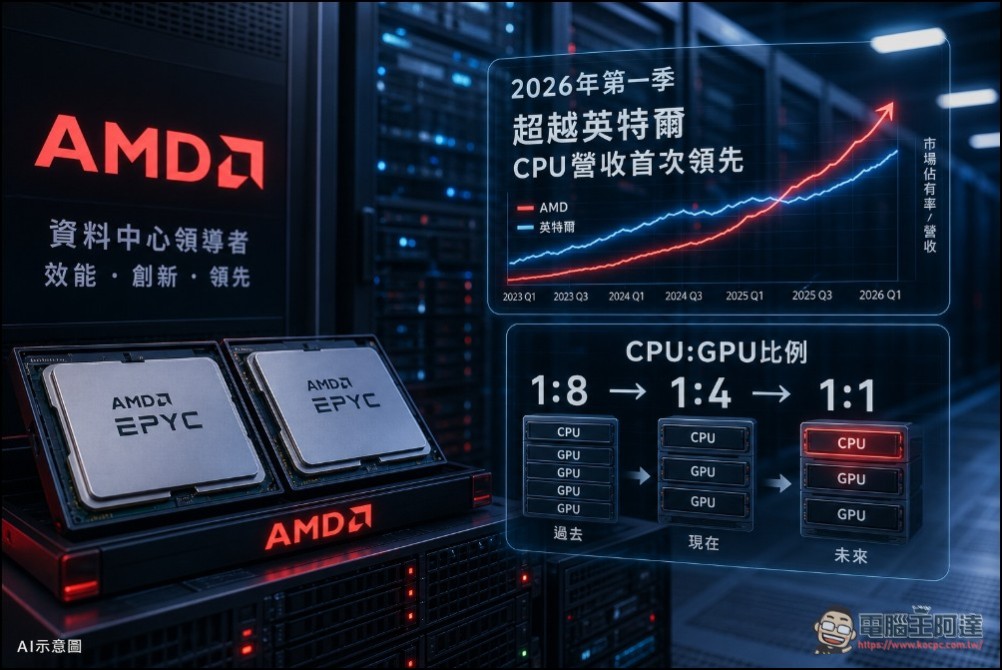
The driving force behind this comes from the significant increase in dependence on CPU for AI inference (Inference) requirements. The report pointed out that the ratio of CPU to GPU in data centers has rapidly increased from 1:8 in the past to 1:4, and is heading towards 1:1. This means that every 4 GPUs need to be paired with 1 CPU, and in the future, each GPU may require a dedicated CPU to correspond to it.
This change in structural demand also explains why AMD is eager to acquire more TSMC production capacity. It is even reported that AMD is negotiating with Samsung to introduce the 2nm process as a backup plan to alleviate the supply pressure on TSMC.
Winners and losers under the butterfly effect
Overall, this wave of industry chain chain effects caused by the skyrocketing memory prices has formed a very interesting game: mobile phone brands and chip manufacturers have become the biggest victims, and the mid-to-low-end mobile phone market is facing a freeze in demand; although memory manufacturers have benefited from the AI-driven price increase in the short term, if terminal demand continues to be sluggish, it will eventually backfire; and AMD has become the biggest beneficiary of the cold wave in the mobile phone industry.
TSMC’s role is relatively neutral. Decreasing orders from mobile phone customers is certainly not a good thing, but the shift of production lines to high-end nodes, coupled with strong demand from high-performance computing customers such as AMD, NVIDIA and Broadcom, has allowed its overall capacity utilization to be maintained at a high level. In fact, TSMC is accelerating 2nm mass production and building five 2nm fabs at the same time, demonstrating its full confidence in the demand for advanced processes.
For consumers, this story sends an unpleasant message: Memory prices may not fall significantly in the short term. As long as the AI arms race continues to heat up, HBM’s squeeze on DRAM production capacity will not stop, and the hardware costs of mobile phones, laptops, and other consumer electronics will continue to remain high. Perhaps this is also the most realistic portrayal of the “butterfly effect” in the semiconductor industry: a sigh in the mobile phone market turned into a spring breeze for AMD’s revenue growth.
Source: KOCPC Chinese