


What does a person do when he really wants to get rid of Internet addiction? A South Korean netizen’s decision may have surprised everyone: he spent time sorting out 1,119 “dangerous websites” banned by the government, and added them to the block list one by one, determined to cut off temptation. However, this block list, which was originally used for self-discipline, turned into a new Internet indicator for people to pilgrimage after he put it on GitHub.
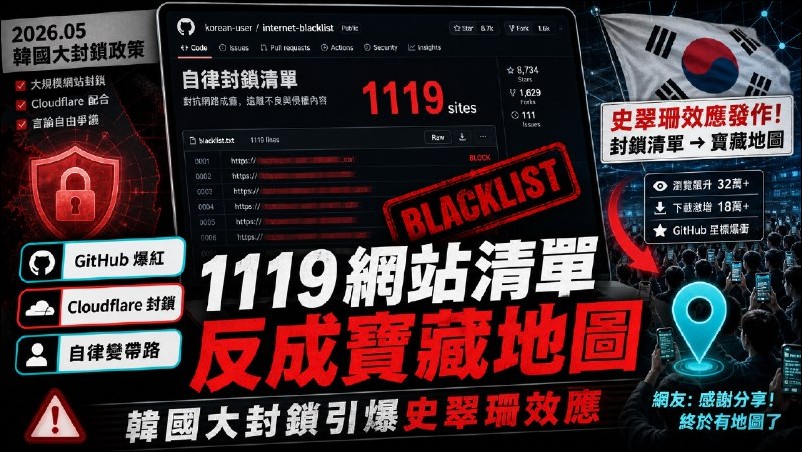
The original intention was self-discipline, but unexpectedly became the “leading party”
The cause of this incident was that the South Korean government officially launched a large-scale website blocking mechanism on May 1 this year. This netizen’s personal self-discipline list, which was originally just a self-discipline list, unexpectedly became a “reverse navigation map” for netizens around the world to study the current situation of Internet censorship in South Korea. According to rumors on social media, this Korean netizen personally added 1,119 websites deemed “dangerous” to the blocked list in order to get rid of the temptation of adult content.
韩国某哥们为了戒网瘾,把1119个”危险网站”全拉黑,结果这份名单一上GitHub,直接变成了全网最热宝藏导航——
这操作属实绷不住😂
想冲的自取:
🔗 https://t.co/TzpualvHuL pic.twitter.com/MLilrFSHUT— 鸟哥 | 蓝鸟会🕊️ (@NFTCPS) May 14, 2026
However, this list somehow spread to GitHub as “blocked-sites-in-south-korea” is the name of the project. The original author wpzzz listed the 1119 domain names one by one and stored them in list.txt File, a total of 15.9 KB of plain text files. (I suggest you don’t click in to read it.)
Things start to sour from here.
This project on GitHub quickly accumulated more than 3,000 stars, becoming one of the most watched open source projects in recent times. But netizens did not come to appreciate this Korean friend’s self-discipline. Instead, netizens regarded this list as a “treasure guide” and clicked on it one by one to “study” it.
This is typicalstreisand effect(Streisand Effect): The more you try to hide something, the more people will arouse curiosity.

Background of South Korea’s Internet Censorship: The “Great Blockade” in May 2026
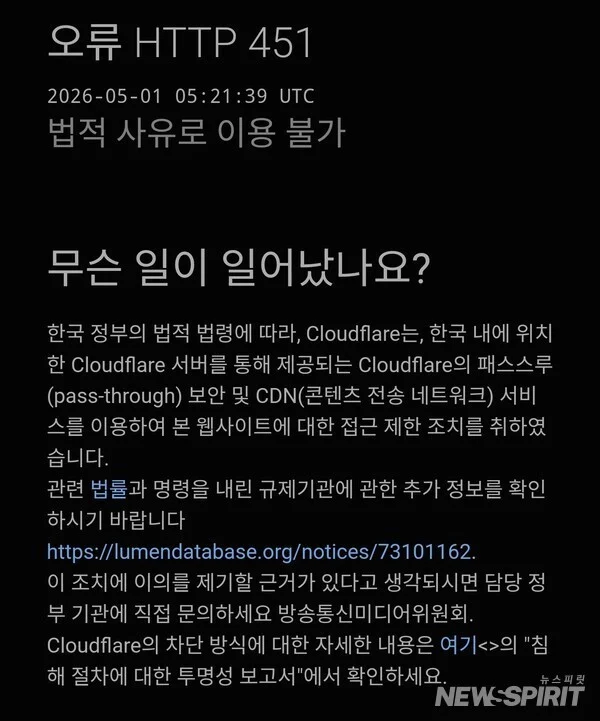
To understand why this list has attracted so much attention, it’s important to understand South Korea’s recent changes to online censorship. On May 1, 2026 (local time), South Korea officially implemented a large-scale website blocking policy. This policy is promoted by the Korea Media and Communications Commission (KMCC) and is coordinated by global Internet infrastructure giant Cloudflare.
Specifically, this blockade targets the following categories of websites:
- illegal adult content: Especially adult videos shot without consent (i.e., the issue of “clandestine images” that is of great concern to Korean society)
- Adult gaming sites:A platform for distributing illegal adult game content
- Infringing content platform: Websites that spread infringing content on a large scale
When users try to access a blocked URL, Cloudflare redirects them to a notification page citing the Korean Internet Law.
This policy was not implemented suddenly. KMCC officially made a request to Cloudflare as early as September 2025, and after about 8 months of technical preparation, it was officially launched on May 1, 2026. More specifically, from May 11, the blocking system will be further upgraded to be able to instantly identify and block new infringing websites, rather than just relying on a pre-listed domain name.
Bipolar reactions in Korean society
Regarding this large-scale blockade, Korean netizens’ reactions were obviously polarized.
SupportersIt is believed that South Korea has faced a serious circulation problem of secretly filmed images in recent years. The faces and identities of many victims have been publicly disseminated online. Blocking these websites is a necessary protective measure. In fact, many Korean netizens welcomed this crackdown on illegal adult content.
OppositionThey are worried that freedom of speech will be infringed upon. The U.S. State Department has expressed “serious concern”. Critics say the law’s definition of “false and manipulated information” is too vague and could lead to arbitrary interpretation, limiting free speech and encouraging self-censorship.
In addition, some analysts believe that intensified censorship will prompt users to migrate to overseas platforms (such as X/Twitter), which may actually reduce the actual effect of domestic information control.
The “Reverse Amway” Effect of GitHub’s Block List
Back to the original Korean netizen. He originally just wanted to discipline himself, but he didn’t expect that this list would trigger an unexpected chain reaction on GitHub. Based on discussions on social media, this list of blocked websites has been nicknamed by netizens as “the hottest project of the year.” Someone commented: “I originally wanted to seal off temptation, but ended up becoming the strongest leader on the entire network.”
This reflects a broader phenomenon: In the Internet age, any attempt to hide information often has the opposite effect. When a website is labeled “blocked,” it acquires a certain taboo appeal.
This is not the first time South Korea has caused controversy over online censorship. according toWikipedia records, South Korea’s Internet censorship covers many levels, including the blocking of pro-North Korean websites, restrictions on adult content, and recently expanded control of copyright infringement content.
Technical aspect: the eternal tug of war between blockade and counter-blockade
From a technical perspective, South Korea’s blockade has several noteworthy features:
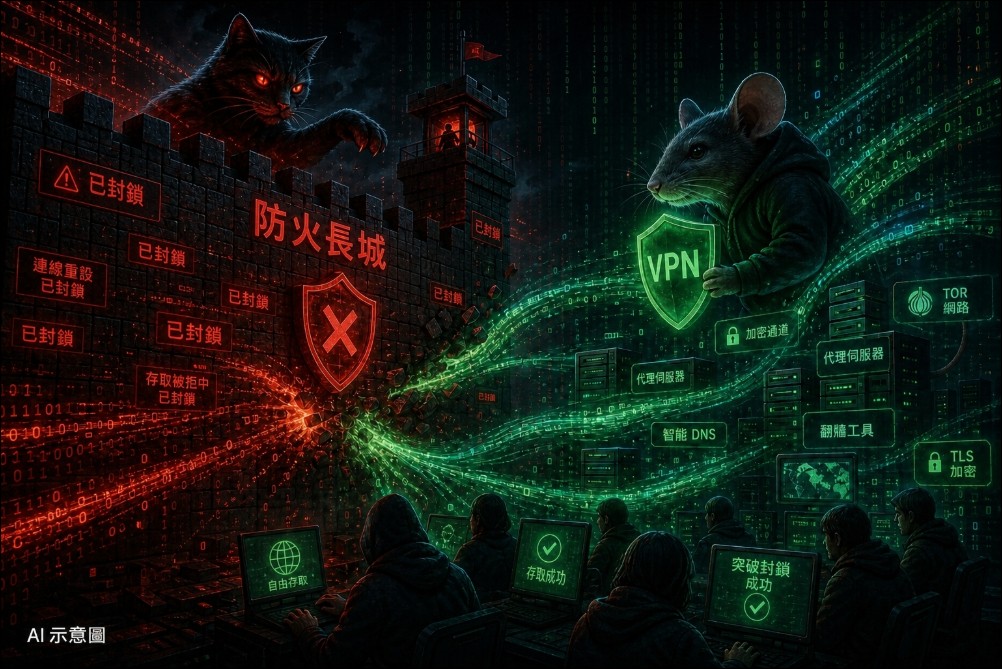
Cloudflare’s direct involvement: In the past, Internet censorship in many countries mainly relied on DNS pollution or IP blocking, but this time South Korea chose to cooperate with Cloudflare to implement blocking directly at the infrastructure level. This means that even if a user changes their DNS server, they may still be unable to access blocked websites.
AI-assisted review: According to community discussions, South Korea’s upgraded censorship system has introduced AI technology to automatically identify and block new illegal content. This makes traditional evasion methods (such as changing domain names) less effective.
Avoid tool failure: Reports that free circumvention tools such as GoodByeDPI no longer work properly in the face of South Korea’s new censorship system have further fueled demand for VPN services.
Conclusion
This Korean netizen’s experience is, to put it bluntly, a modern version of “Don’t press this button.” The more you tell people not to watch, the more they want to watch. The list of 1,119 websites on GitHub was originally just a product of personal self-discipline, but after it was made public, it became a “reverse navigation map” that was hotly discussed throughout the Internet.
Looking more deeply, this incident reflects the core contradiction of South Korea’s Internet censorship controversy in 2026: On the one hand, society does need to crack down on illegal candid images and infringing content; on the other hand, will large-scale blocking mechanisms overextend and thereby compress freedom of speech? This question probably cannot be answered by any block list. As for the Korean netizen, if he knew that his self-discipline list had become a “treasure catalog” for netizens around the world, he would probably only have a wry smile.
Source: KOCPC Chinese