


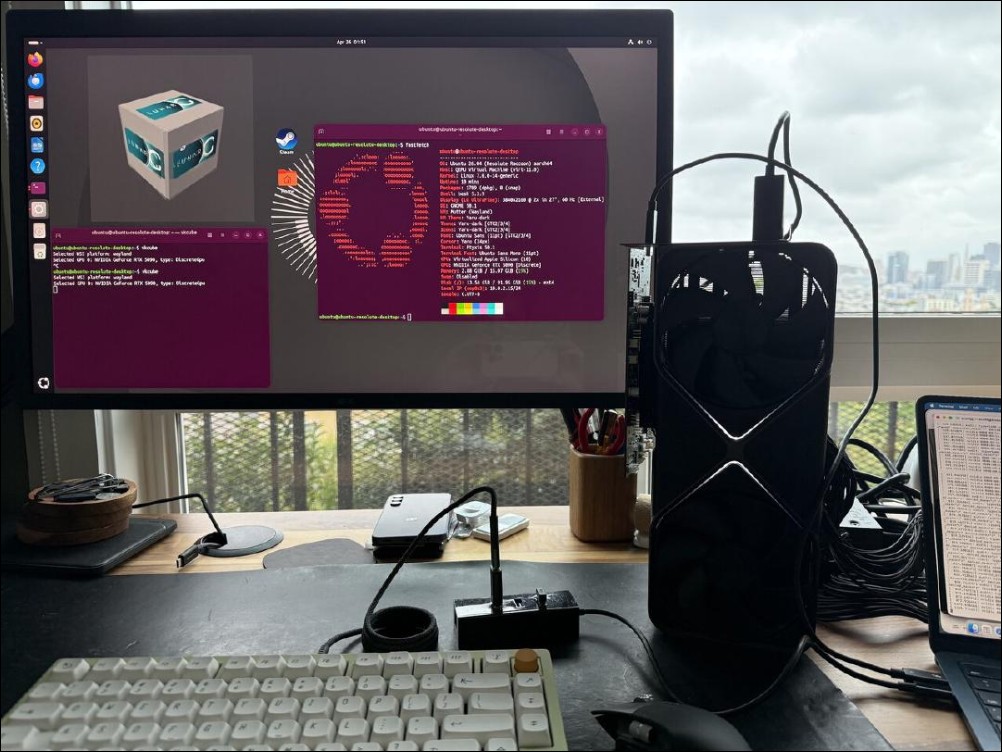
Software engineer Scott Goldman recently completed a rather counterintuitive hardware experiment: connecting NVIDIA’s most powerful desktop-level graphics card today, the GeForce RTX 5090, to a MacBook Air equipped with an M4 chip through an external graphics card expansion box (eGPU). The craziest thing is that he not only succeeded, but also made this fanless thin and light notebook run smooth 4K gaming performance in actual gaming tests, even though the power consumption of this GPU (600W) is almost 30 times that of the entire MacBook Air (22W).
AI says it’s impossible, but he insists on doing it
Goldman admitted in the article that his first step was to explore ChatGPT: “Is it possible for the Linux VM running on the M4 MacBook Air to connect to the eGPU and achieve PCI passthrough? There is currently no support, but if you are a software developer, do you think there is a way to make it work?”
ChatGPT poured cold water on it unceremoniously: “It’s impossible. At least in a practical sense, it’s impossible. Even if it’s ‘maybe a chance’, it’s only at a very in-depth research level and has almost no practicality.”
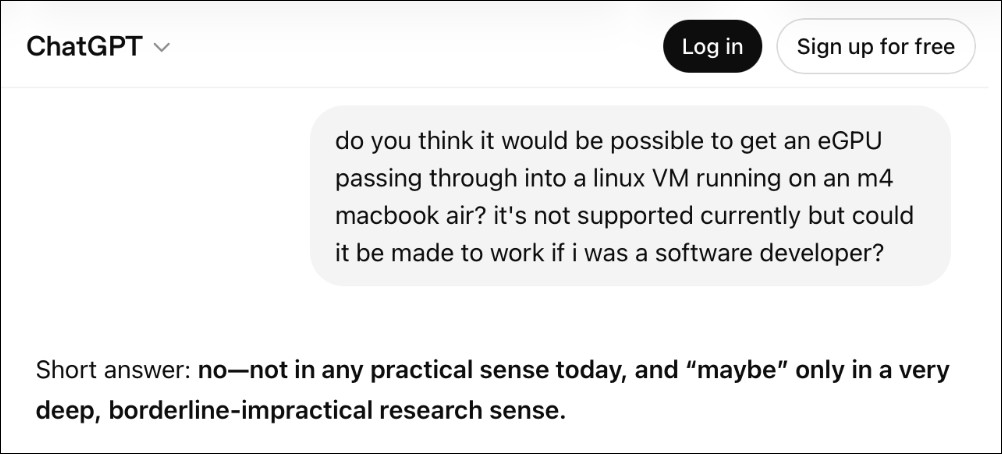
But Goldman is clearly not one to be dissuaded by AI. His response was simple and clear: “borderline-impractical is kind of my thing” (just on the edge of impracticality is my style), and he decided to verify it himself.
Thunderbolt 4 is the critical bridge
To connect the RTX 5090 to your MacBook Air, the first step is to physically connect it. Goldman used a Thunderbolt 4 external graphics card expansion box (eGPU enclosure), connected via USB-C. Thunderbolt 4 provides 4 PCIe lanes, up to 40Gbps Although there will be a small performance loss due to tunneling, this is at least a theoretically feasible path for PCIe devices.
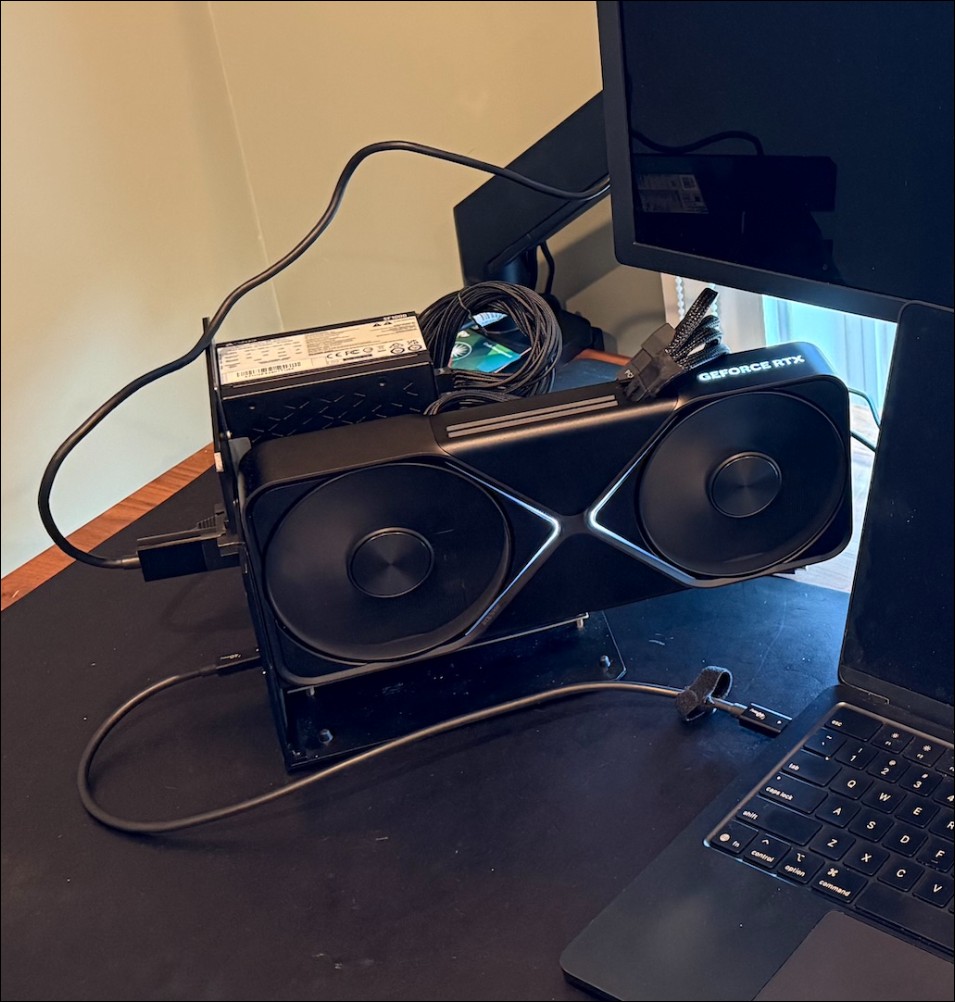
However, it is worth mentioning that an RTX 5090 is connected through PCIe 5.0 x16 on a normal desktop computer, with a bandwidth of up to About 64GB/s; And Thunderbolt 4’s 40Gbps is only about 5GB/s, the bandwidth difference is as high as More than 12 times. This also paved the way for subsequent performance test results.
In addition, the USB4 specification also includes the same PCIe lane functionality as an option, so some “non-Thunderbolt” USB4 ports can theoretically do the same thing.
Three-layer technology overlay: virtualization × Passthrough × Translation
Physical connection is just the simplest step. The real difficulty lies at the software level:
- first wall: macOS does not offer any NVIDIA or AMD third-party GPU drivers on Apple Silicon
- second wall: Although Asahi Linux allows Linux to run natively on Apple Silicon Macs, the Linux kernel currently does not support Apple Silicon’s Thunderbolt controller at all.
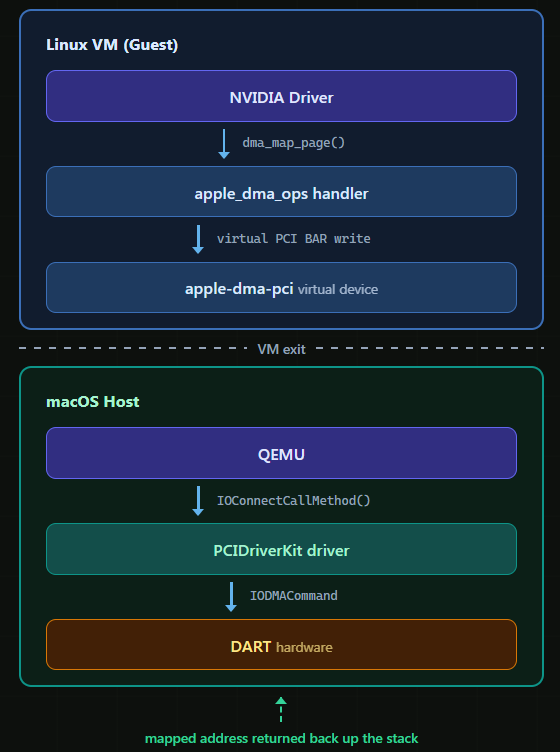
Goldman’s solution can be called a clever “detour” strategy:Running ARM64 Linux virtual machine on macOS. macOS itself is responsible for handling the I/O of the Thunderbolt device, while the Linux VM is responsible for the NVIDIA driver and GPU computing, and the GPU is directly assigned to the VM through PCI passthrough.
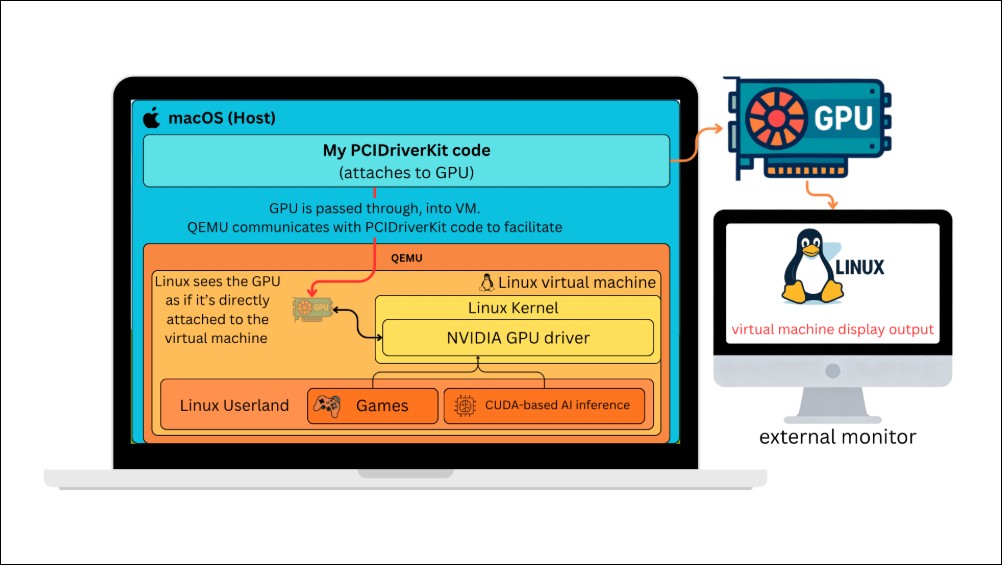
But the road is also full of thorns. macOS’s Hypervisor.framework was not originally designed to have a PCI passthrough function. Goldman had to create this mechanism himself, from memory mapping of PCI BAR (base address register), DMA (direct memory access) enablement, to thread scheduling optimization of the QEMU virtual machine. QEMU alone has a big pitfall: by default, CPU affinity and priority are not set for vCPU threads, resulting in dramatic fluctuations in running scores, and the source code must be manually patched to stabilize it.
Finally, add the most troublesome layer: the games he wants to play are all x86-based Windows games, and running x86 programs on ARM64 Linux requires a translation layer. What is used here is FEX-Emu, a set of x86 emulators designed specifically for ARM64 Linux, used with Steam + Proton to run Windows games.
The entire technology stack looks like this:
- macOS Sequoia (main system, handles Thunderbolt I/O and USB-C connections)
- Hypervisor.framework + QEMU (executing ARM64 Linux VM)
- PCI Passthrough (homemade patch to assign RTX 5090 to VM)
- Linux + NVIDIA proprietary driver (drives the GPU within the VM for drawing operations)
- FEX-Emu (on-the-fly translation of x86 instructions to ARM64 on ARM64 Linux)
- Steam + Proton (Windows Game Compatibility Layer)
Goldman specifically emphasized that there is no NVIDIA driver on ARM64 Windows, which is why he chose Linux instead of Windows VM.
Actual performance measurement: 720p overturns, 4K reverses
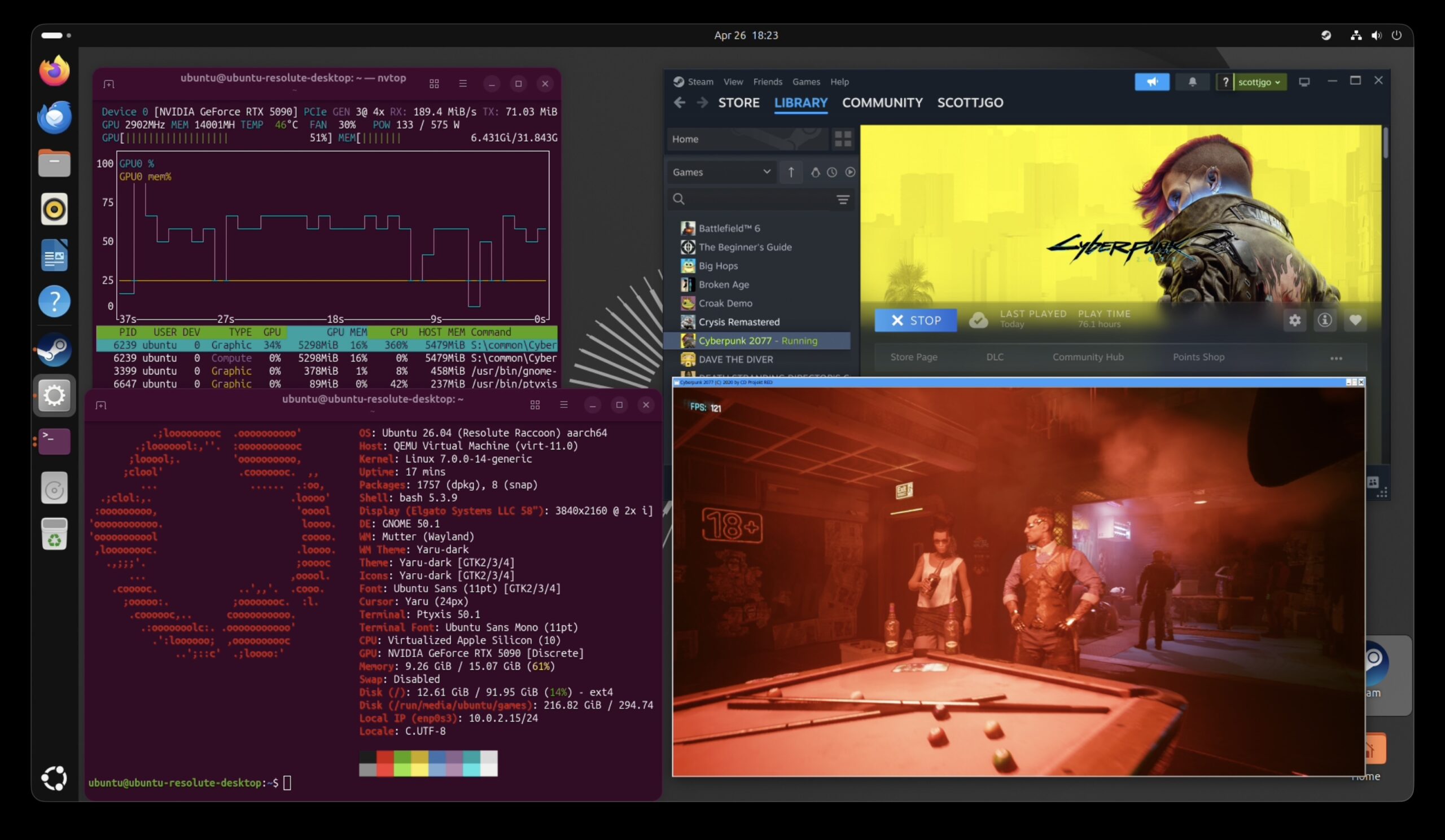
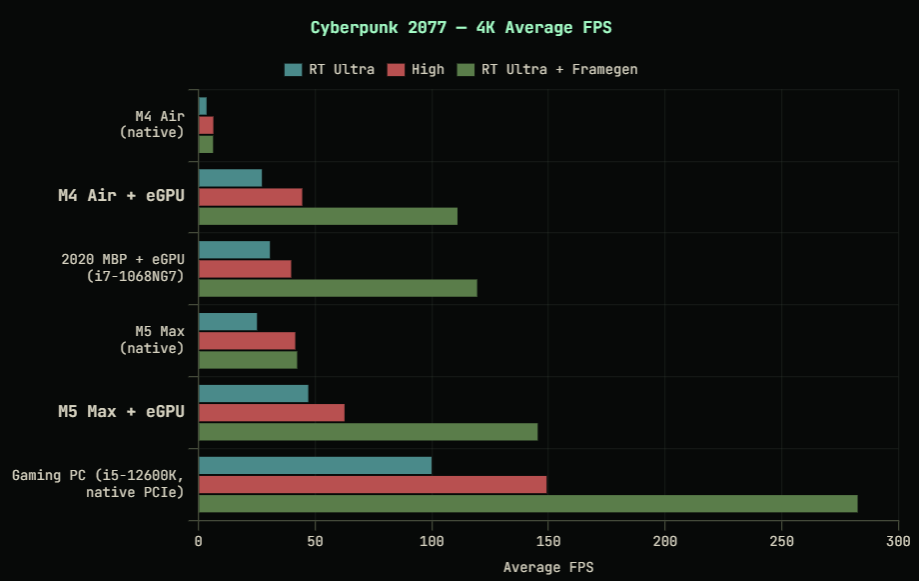
In order to verify the gaming prowess of this ridiculous combination, Goldman directly used the graphics card killer “Cyberpunk 2077” to run benchmark tests, comparing as many as six different platform combinations: from M4 MacBook Air native performance, to M5 Max MacBook Pro with the same eGPU solution, 2020 Intel MacBook Pro, and i5-12600K traditional desktop.
CPU performance (Geekbench 6):
The FEX-Emu translation layer has a catastrophic impact on CPU performance. M4 MacBook Air under the combination of Linux VM + FEX,Effectiveness cut by almost 50%, single-core and multi-core scores are even lower than the 2020 Intel MacBook Pro. On the other hand, the performance degradation of the M5 Max MacBook Pro under the same solution is much smaller, showing that the M5 series has more headroom in virtualization and translation scenarios.
“Dynasty 2077” game test (three resolutions):
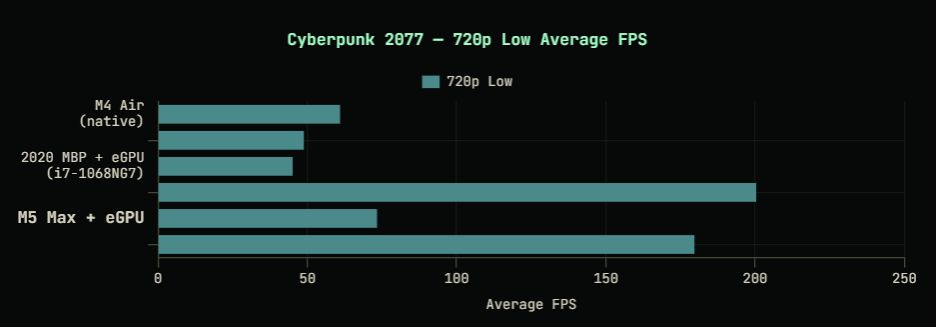
- 720p low resolution: The performance of the RTX 5090 eGPU is worse than the M4 native GPU. Because there is almost no load on the GPU at low resolution, the bottleneck is completely stuck in the CPU and FEX translation layer, and there is no use for the GPU no matter how powerful it is.
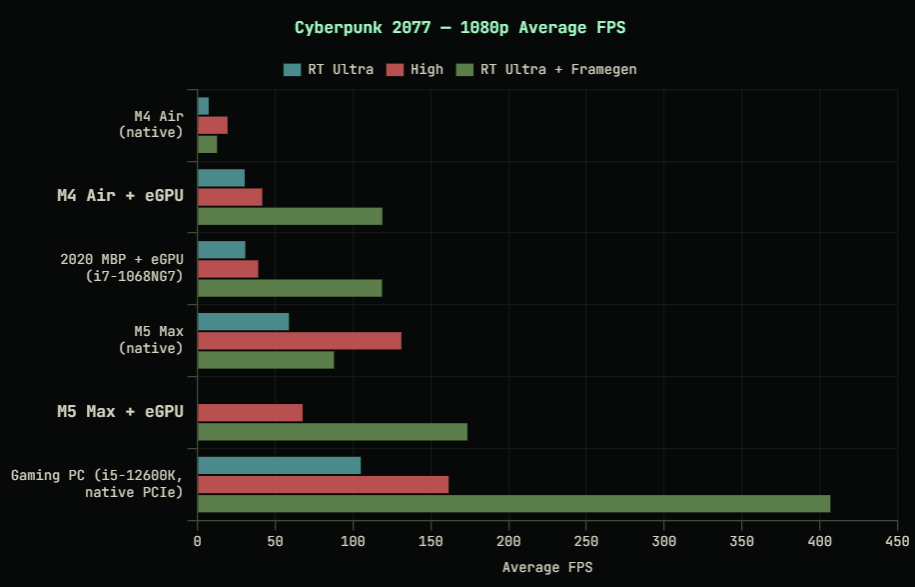
- 1080p: RTX 5090 begins to show its value, with average FPS significantly surpassing the M4 and M5 Max native GPUs. As the GPU load increases, the computing advantages of eGPU gradually outweigh the virtualization overhead.
- 4K:Complete reversal. The M5 Max MacBook Pro natively runs 4K “Dynasty 2077” and can only barely reach the playable FPS edge (about 30-40 FPS); once connected to the RTX 5090 eGPU, the frame rate directly doubles, and the gaming experience becomes stable and smooth. After turning on DLSS and frame generation technology, M5 Max can even achieve breakthroughs in ray tracing Ultra settings 100 FPS
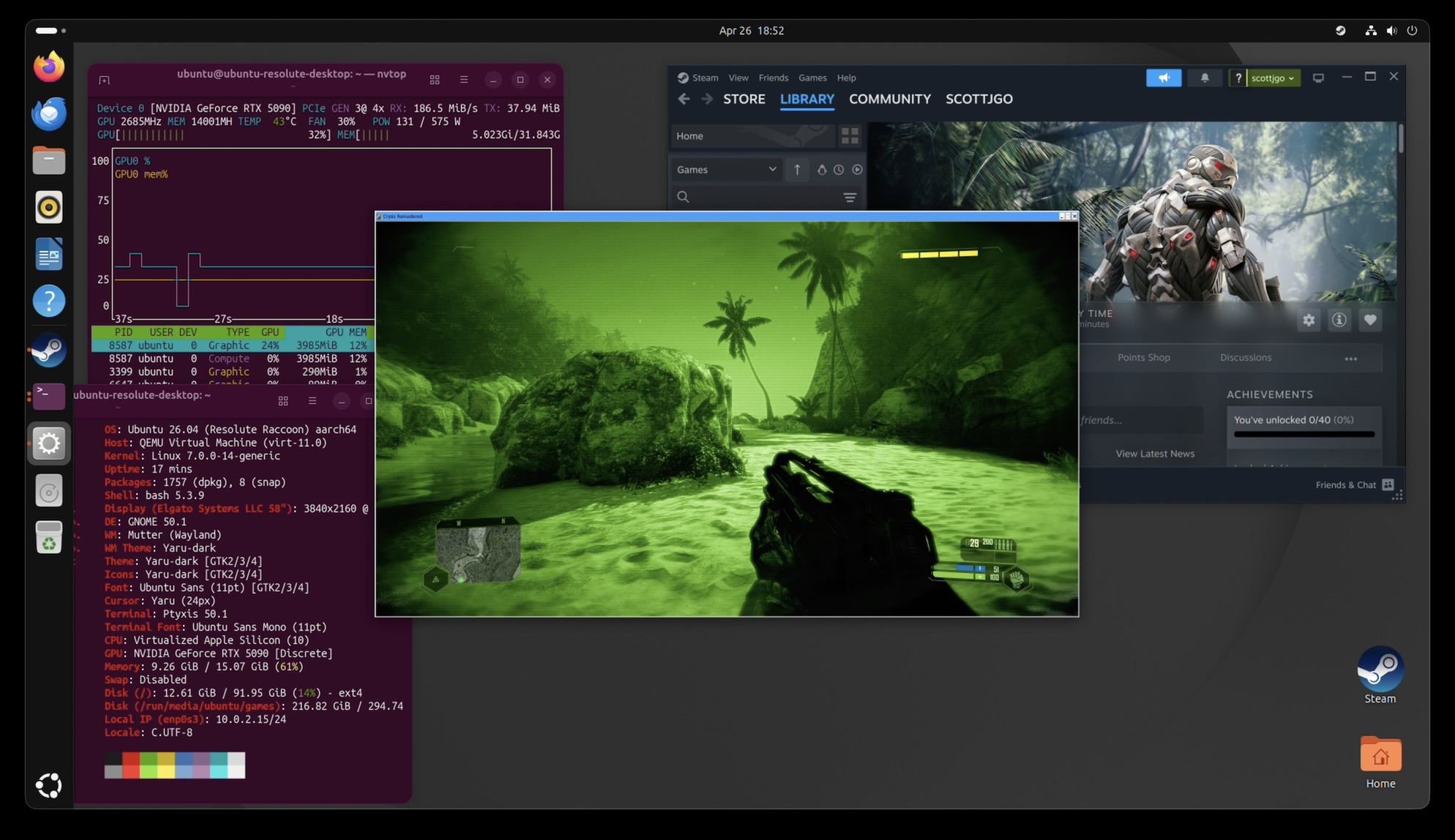
Goldman also tested “Crysis Remastered” and the classic “DOOM”, and they can also be played smoothly with the combination of M4 MacBook Air + RTX 5090.
The gap with regular gaming PCs: 2 to 4 times the performance gap
In order to make the data more objective, Goldman moved out a traditional desktop equipped with Intel i5-12600K and inserted the same RTX 5090 for comparison. The result is exactly as expected:The game performance of a regular PC is 2 to 4 times that of a Mac solution。
After all, Mac is burdened with three layers of structural losses:
- Thunderbolt bandwidth bottleneck(PCIe 5.0 x16 → Thunderbolt 4 equivalent PCIe 4.0 x4, less than 1/12 of the bandwidth remaining)
- Virtualization overhead(Context switching loss of Hypervisor.framework + QEMU)
- FEX instruction translation(On-the-fly translation from x86 → ARM64 cuts CPU performance in half)
At 4K resolution, since the GPU becomes the main bottleneck, the impact of the above-mentioned losses is relatively reduced. Therefore, the performance of the RTX 5090 eGPU solution on Mac is closest to the desktop level, but it is only “relatively close” and far from the same level.
Not just for playing games: macOS + RTX 5090’s attempts at AI applications
Interestingly, just one month before Goldman’s experiment (April 2026), the well-known AI YouTuber Alex Ziskind had just demonstrated the open source macOS eGPU driver released by Tiny Corp, allowing the RTX 5090 to successfully light up the screen on the Mac mini M4 Pro through an external box. However, this driver is only used by the tinygrad AI framework, and the AI inference speed is approximately slower than native Metal. 10 times, does not yet have universal display output or game support capabilities.
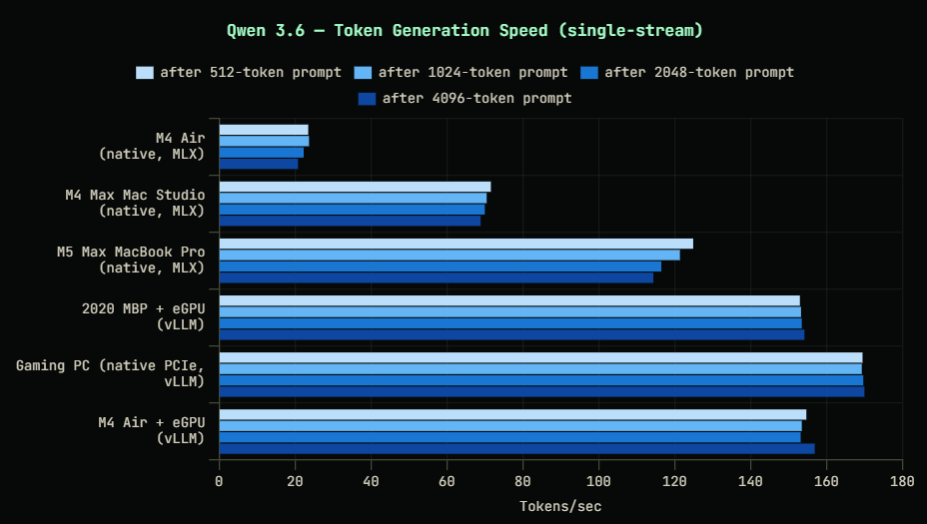
However, Goldman took a completely different path. He first bypassed the macOS driver restrictions and used the virtualization layer to take over the NVIDIA Linux driver. Although the engineering complexity was higher, at least it achieved substantial results that could actually run commercial games. Moreover, the performance of Qwen 3.6 is also impressive and will not lose to native gaming computers:
Conclusion: Proof of concept is greater than practical value
In summary, this planExtremely technical difficulty(You need to make your own macOS PCI passthrough, manually patch the QEMU source code, and set up a complete Linux game environment),Huge performance loss(The CPU performance is cut in half, and the overall game performance is 2-4 times slower than that of the desktop), andThe cost is ridiculous:The RTX 5090 alone currently costs more than NT$140,000. With the addition of an eGPU external box (about NT$5,000-10,000) and an M4 MacBook Air (starting at about NT$35,900), the total cost easily exceeds NT$100,000. However, the game performance you buy is not even as good as a Windows gaming laptop that costs less than NT$60,000.
But that’s what’s so fascinating about this experiment. It proves that even if the entire industry, from Apple to NVIDIA to Linux core maintainers, says that it is impossible for Apple Silicon to connect to NVIDIA graphics cards, a crazy enough engineer can still find a way to make the impossible possible. Regarding the current situation where the macOS game ecosystem has been weak for a long time and there is a serious lack of 3A masterpieces, this “technical proof” (proof of concept) at least allows people to see another possibility. Of course, if you just want to play video games, buy a Windows desktop or a gaming laptop. It will save you a lot of trouble.
Source: KOCPC Chinese