


As M5 Launched, for those planning to purchase new Mac and want to run it locally LLM Apple users of language models will surely think about whether to choose the currently cheaper option. M4, or the latest M5? Is there a big difference between the two when running LLM? Recently Apple A new article posted on the blog has the answer for you: real-world tests show that the M5 runs LLMs locally far faster than the M4, with the biggest gap reaching 4.1 times. That means no hesitation needed—you should go with the M5.
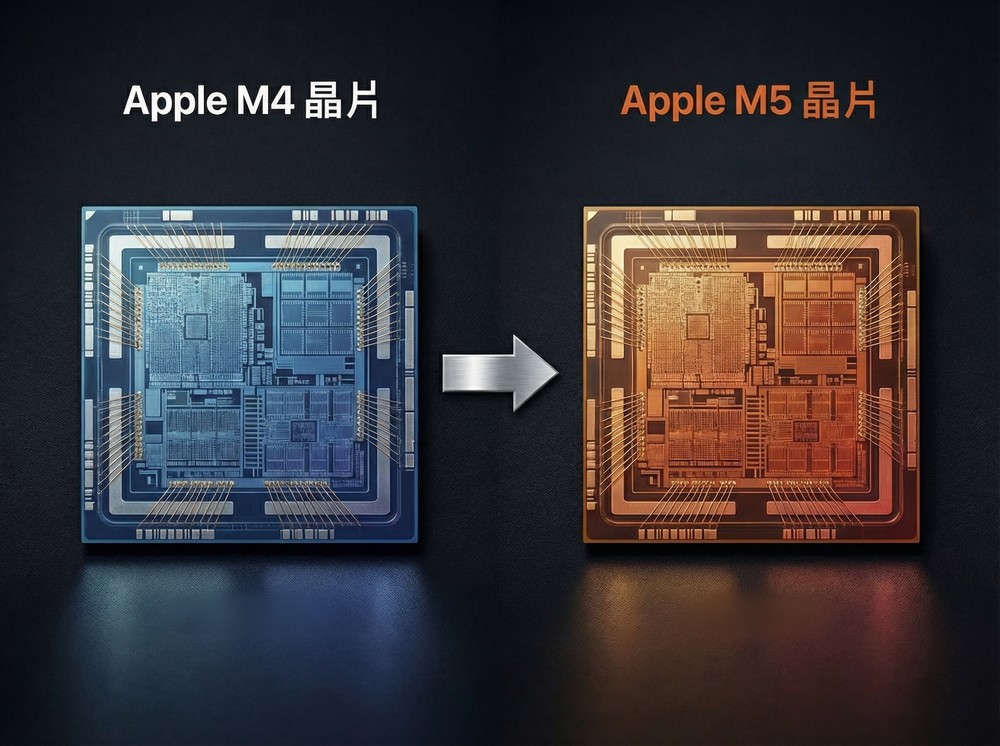
Apple shares real-world speed test results comparing M5 vs. M4 for running LLMs locally — M5 delivers up to 4.1x improvement.
At the beginning of the article, Apple once again emphasizes the advantages of MLX. MLX is an open-source array computing framework optimized for Apple Silicon, offering high efficiency, flexibility, and versatility. Core advantages include:
- Unified Memory Architecture: CPU and GPU can share memory, eliminating the need to manually move data during computation.
- NumPy-like API: familiar syntax, flexible, and easy to use.
- Advanced neural networks and optimization tools: built-in automatic differentiation and computational graph optimization.
Installing MLX on a Mac is also simple, just use the pip install mlx command, and then you can use MLX LM to run most LLMs provided by Hugging Face.
In addition, the new GPU neural accelerator in the M5 chip significantly improves inference performance. To demonstrate the difference, Apple compared the time required for multiple open-source models to generate the first token, including:
- Qwen 1.7B, 8B (BF16 precision)
- Qwen 8B, 14B (4-bit quantization)
- Mixture of Experts (MoE): Qwen 30B (3B active / 4-bit), GPT OSS 20B (MXFP4 precision)
As can be seen from the figure below, the M5 delivers a 3.3× to 4.1× performance improvement across all models. TTFT is a highly compute-intensive task, so the M5 neural accelerator can bring significant improvements:
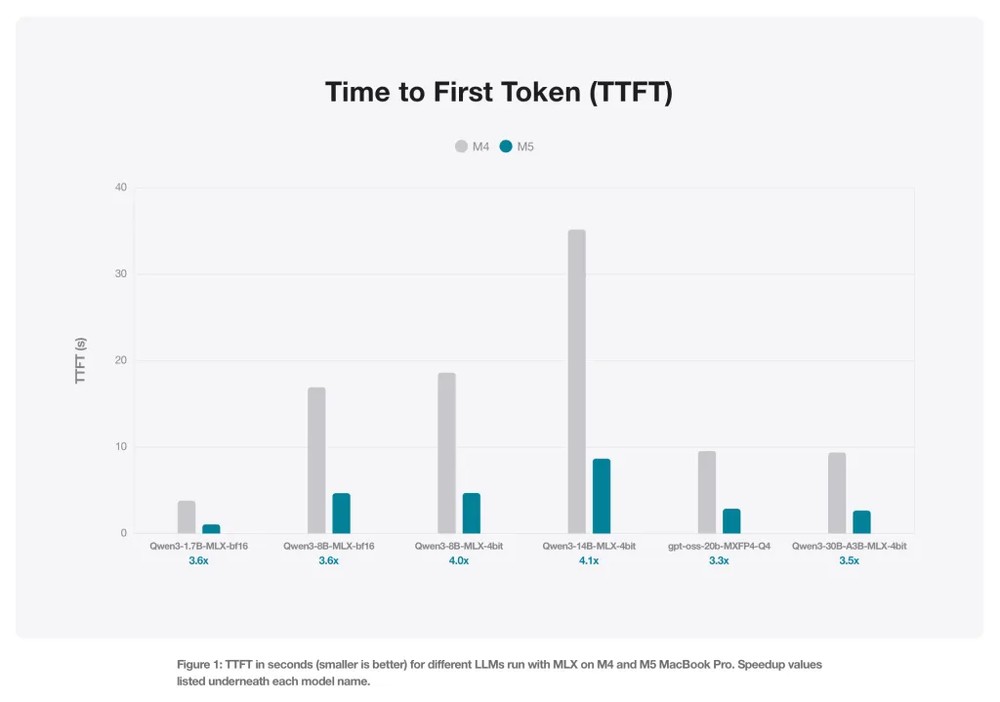
This shows the actual TTFT difference in seconds for each model, the former being M4 and the latter M5 (lower is better):
- Qwen3-1.7B:3.79s → 1.06s
- Qwen3-8B:16.92s → 4.67s
- Qwen3-8B 4bit:18.6s → 4.69s
- Qwen3-14B 4bit:35.15s → 8.66s
- GPT-OSS-20B:9.54s → 2.87s
- Qwen3-30B MoE:9.37s → 2.66s
The following are the test scores for the M5:
| Model | TTFT speedup ratio | Generate speedup ratio | Memory (GB) |
|---|---|---|---|
| Qwen3-1.7B-MLX-bf16 | 3.57 | 1.27 | 4.40 |
| Qwen3-8B-MLX-bf16 | 3.62 | 1.24 | 17.46 |
| Qwen3-8B-MLX-4bit | 3.97 | 1.24 | 5.61 |
| Qwen3-14B-MLX-4bit | 4.06 | 1.19 | 9.16 |
| gpt-oss-20b-MXFP4-Q4 | 3.33 | 1.24 | 12.08 |
| Qwen3-30B-A3B-MLX-4bit | 3.52 | 1.25 | 17.31 |
From this, it is evident that the M5 is currently the best Mac platform for running LLMs (large language models) locally, and the additional GPU neural accelerator greatly improves inference speed.
This article also demonstrates other aspects of M5 testing. Those interested can visit Apple Original TextRead.
Source: KOCPC Chinese