


Apple and Intel, partners who worked closely together in the PC era but were estranged for many years after Apple switched to its own Apple Silicon, are now shaking hands again in the field of Intel’s 18A-P advanced process. Tianfeng International Securities analyst Ming-Chi Kuo recently published a long article on the X platform, in-depth analysis of the changes in the industrial structure behind this cooperation, as well as the subtle game between TSMC, Intel and Apple.
Ming-Chi Kuo’s in-depth analysis, Apple bets on Intel 18A-P
Apple has officially opened a case on Intel 18A-P
Ming-Chi Kuo pointed out in the latest industry survey that Apple has officially launched a project launch plan for low-end or older iPhone, iPad and Mac processors on Intel’s 18A-P series process (using Foveros advanced packaging technology). This is not just a tentative order. Ming-Chi Kuo emphasized that Apple is launching three major product lines at Intel at the same time, and the wafer production ratio is roughly consistent with the sales structure of terminal devices, of which iPhone chips account for about 80%, and the remaining 20% are iPad and Mac chips.
From a timetable perspective, this cooperation will follow the rolling advancement of the technology life cycle of the 18A-P process: small-scale testing in 2026, formal mass production in 2027 (expected to be the basic M7 chip), continued growth in 2028 (possibly expanded to the A21 series of chips), and gradually decreasing after 2029. In addition, Apple is also simultaneously evaluating Intel’s more advanced 14A and 14A-P processes to pave the way for long-term cooperation.
Apple’s calculation: Rebalancing the supply chain in the AI era
Ming-Chi Kuo’s analysis pointed out that the strategic significance of Apple’s move goes far beyond general considerations such as “reducing the risk of exclusive supply” or “increasing bargaining power.” The core key is: Apple has clearly realized that the gap between AI and high-performance computing (HPC) in TSMC’s revenue contribution will continue to widen with mobile phones.
As orders from AI chip giants such as NVIDIA continue to pour into TSMC, advanced process production capacity has become a scarce resource. Apple must cultivate a second supplier with mass production standards as soon as possible while it still retains a certain bargaining power. Ming-Chi Kuo described Apple’s approach as “systematically cultivating Intel so that it has the ability to become a key supplier in the long term.” It first uses the complete 18A-P series generation to optimize mass production and collaboration processes, rather than just staying at the lowest-risk trial order stage. Apple had already begun negotiations with Intel before the issue of limited TSMC’s advanced process capacity came to the fore. This shows that Apple’s supply chain diversification is not a passive reaction, but a strategic layout that has been brewing for a long time.
Intel: A once-in-a-lifetime opportunity vs. a daunting challenge
For Intel, the strategic significance of this order cannot be overstated. Ming-Chi Kuo bluntly stated that the vast majority of advanced process orders in the next few years will still be concentrated in TSMC, so Apple is Intel’s “nearly the only and most complete foundry training opportunity.”
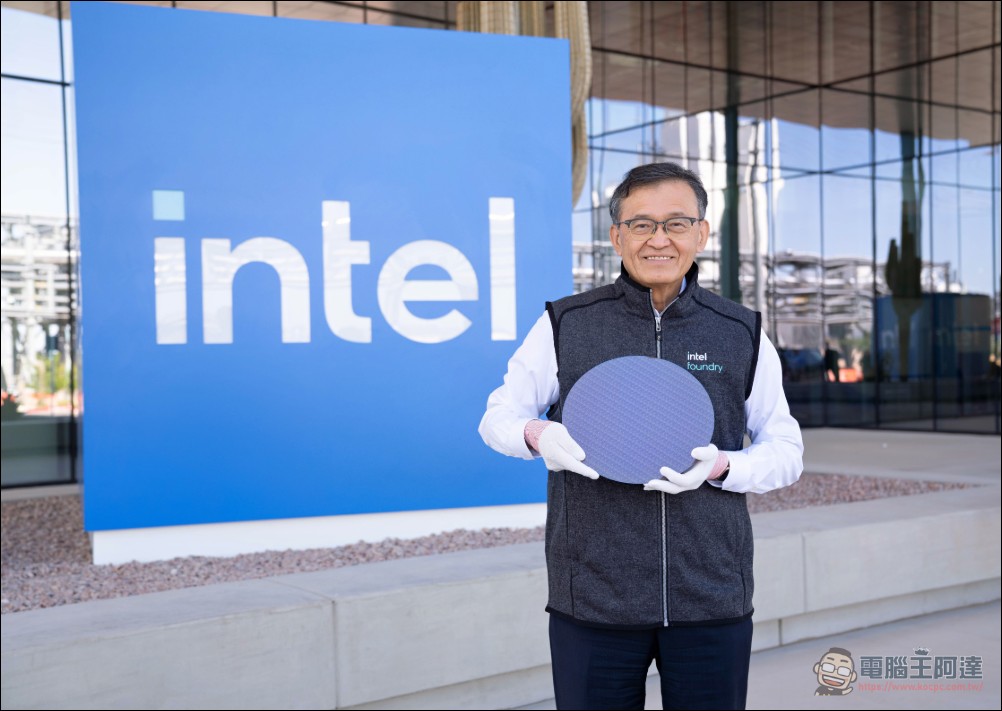
This order covers Apple’s entire product line, is large enough, and requires dynamic adjustment of design and production rhythms with market changes. For Intel, which is in the rebuilding stage of its foundry business, it is the most ideal practical training ground. According to reports, Intel’s current goal is to stabilize the 18A-P process yield rate at 50% to 60% in 2027.
However, the challenges cannot be underestimated. Apple has always been known for its strict supply chain management. Its high standards and Intel’s strategy of taking orders from other customers at the same time will amplify the difficulty of rebuilding its advanced process wafer foundry business. Ming-Chi Kuo believes that Intel’s own efforts, geopolitical dividends and customer hedging needs have jointly opened a “golden window for reconstruction once in a lifetime” for Intel, but whether it can be realized depends entirely on execution.
Market news also pointed out that Apple has obtained Intel’s PDK (Process Design Kit) to evaluate the performance of 18A-P, and the industry predicts that Apple’s ASIC chip (code-named Baltra) expected to be launched in 2027 or 2028 will also use Intel’s EMIB packaging technology.
TSMC: Seemingly passive, but actually at the center of the storm
In this three-party game, TSMC’s role is the most intriguing. Ming-Chi Kuo pointed out that although TSMC will remain Apple’s main supplier in the next few years, with a supply ratio of more than 90%, its leading position has become “the focus of risk hedging for all parties.”
Specifically, Apple cultivates Intel, the U.S. government uses a series of semiconductor policies to exert influence, and Samsung uses huge profits from its memory business to support investment in advanced manufacturing processes. All key players are hedging risks against TSMC. In contrast, TSMC currently relies mainly on excellent execution, which is equivalent to betting its competitive advantage on the assumption that “execution will continue to lead.”
Ming-Chi Kuo further analyzed that TSMC’s hedging tool options are actually quite limited, which is due to structural reasons: Geopolitically, the United States is TSMC’s key market and technical cooperation partner, but it is also the largest source of policy pressure, while China, the European Union, and Japan are unable or incapable of effective hedging; in terms of market strategy, the marginal utility of external hedging strategies such as business diversification, dispersed customer structure, technology licensing, and supply chain localization has also continued to decrease due to TSMC’s leading position.
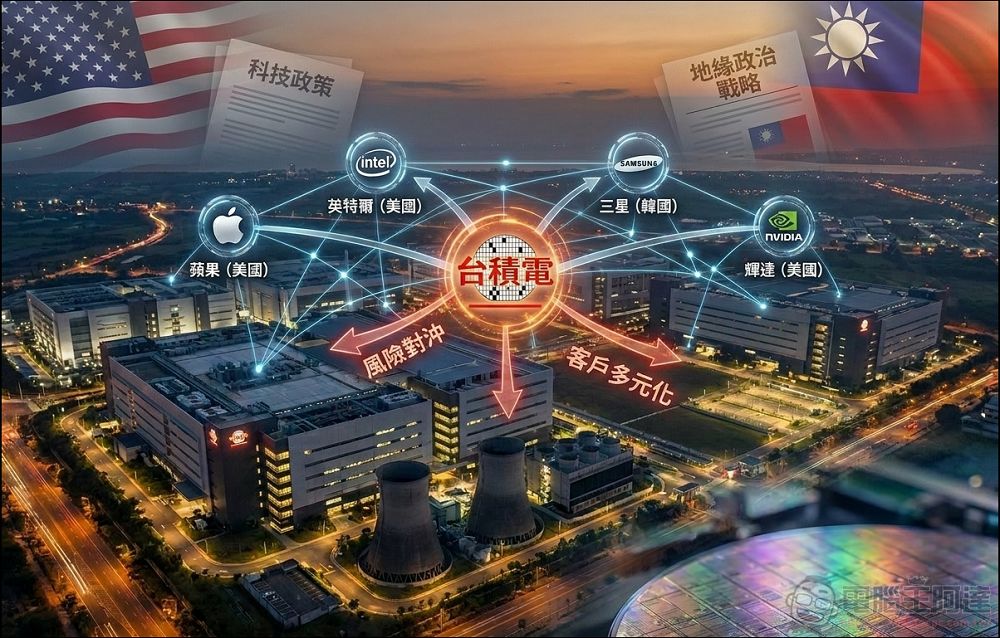
Therefore, Ming-Chi Kuo believes that “accelerating the accumulation of internal capital” should be TSMC’s most pragmatic approach, and the source of internal capital is the pricing power of advanced processes. This not only comes from reasonable profits, but also requires pricing future risks, which means TSMC can adopt a more flexible pricing strategy than it does now.
Ming-Chi Kuo used Intel as a specific case to illustrate: When Intel places an order for its own products to TSMC to free up production capacity to train with Apple, this is no longer a general order for TSMC, but an order that brings potential competitive risks. If TSMC decides to trade with Intel, it should take the competitive relationship derived from geopolitics and customer portfolio restructuring into consideration in risk pricing and production capacity allocation.
Industrial Impact: The semiconductor supply chain is being restructured
This cooperation will not only affect the three companies, but may also rewrite the global semiconductor supply chain pattern. In the past few years, TSMC has almost formed an oligopoly in the field of advanced manufacturing processes, but the capacity-crowding effect brought about by the AI boom is forcing major customers to rethink their supply chain layout. In addition to Apple turning to Intel, there are also reports on the market that hyperscalers such as Amazon and Google areEvaluate alternatives。
For U.S. semiconductor policy, the cooperation between Apple and Intel is undoubtedly an important milestone. If Intel can successfully mass-produce Apple chips, it will not only prove the feasibility of its foundry business, but also represent that the United States has made substantial progress in localized production of advanced processes.
However, TSMC’s leading position remains difficult to shake in the short term. The industry generally believes that even if Intel successfully mass-produces M7 chips in 2027, its effect on improving the single-quarter loss of IFS (Intel Foundry Services) will still be limited. The real test will come after 2028, when the A21 series chips begin to be allocated between Intel and TSMC, and the outcome of this three-way game will gradually become clear.
Summarize
This analysis by Ming-Chi Kuo provides a rare in-depth perspective of the industry: AI is not only changing terminal applications, but also fundamentally reshaping the power structure of semiconductor manufacturing. The re-joining of Apple and Intel is on the surface a diversification of the supply chain, but in essence it is a strategic layout centered on the scarcity of advanced processes. For Apple, this is a necessary investment to ensure long-term supply stability; for Intel, it is a life and death battle to rebuild its foundry business; for TSMC, it is the structural challenge of “when you stand on the top of the mountain, everyone is trying to get around you.”
Source: KOCPC Chinese