


In recent years, Apple has kept highlighting the AI capabilities of its in-house chips. With the M4 generation in particular, Apple officially describes the Neural Engine as “Apple’s most powerful neural engine,” boasting up to 38 TOPS of AI compute power. Under normal circumstances, this neural engine mostly runs in the background to accelerate features such as photos, videos, speech recognition, and Apple Intelligence, and developers cannot use official APIs to do full AI model training with it like they can with a GPU.
However, developers have recently used reverse engineering to successfully bypass Apple’s software restrictions on the M4 Neural Engine, directly invoking Apple’s undisclosed private APIs so the ANE can fully execute both inference and training workflows for AI models. This unlocks 15.8 TFLOPS of floating-point performance and gives the neural engine the real ability to train AI models.
Apple M4 Neural Engine reverse-engineered and unlocked: developers prove it can not only run AI inference, but also train small models
The M4 is a chip Apple introduced in 2024. Built on a second-generation 3nm process, it features up to a 10-core CPU, a 10-core GPU, and a 16-core Neural Engine. According to Apple, the M4’s Neural Engine can deliver up to 38 trillion operations per second, or 38 TOPS, making it 60 times faster than the first-generation Neural Engine in the A11 Bionic.
At the time, nearly all the features Apple demonstrated were on-device AI applications, such as Live Captions for real-time subtitles, Visual Look Up for image recognition, Final Cut Pro for one-click 4K video background removal, and StaffPad for real-time sheet music generation—these all fall under AI “inference.”
Recently, an overseas developer @0x0SojalSec shared on X that, building on the maderix/ANE project on GitHub, they conducted further research and used reverse engineering to successfully bypass Apple’s software restrictions on the M4 Neural Engine (ANE), enabling ANE to fully execute AI model training workflows.
Instead of going through Core ML, Metal, or the GPU, it directly calls Apple’s undisclosed private APIs to interact with the ANE hardware.
He even completed the full Transformer training pipeline, including core operations such as the forward pass, backward pass, and attention, enabling the M4’s ANE to deliver approximately 15.8 TFLOPS of FP32 floating-point performance for AI model training.
@0x0SojalSec stated that the M4 unlock process this time did not write to NAND flash memory at all, since that would be slower. Because everything was written to RAM, it was very fast.
The author of the maderix/ANE project is at Substack Part 2 They also specifically noted that ANE’s biggest advantage is not absolute computing speed, but energy efficiency.
Based on his tests with the M4 Mac mini, the ANE reaches approximately 19 TFLOPS at peak FP16 performance with a power consumption of about 2.8W, translating to an energy efficiency of roughly 6.6 TFLOPS/W. The author also notes that the ANE uses a hard power gating design, allowing it to almost completely cut off power when idle, so standby power consumption is nearly zero:
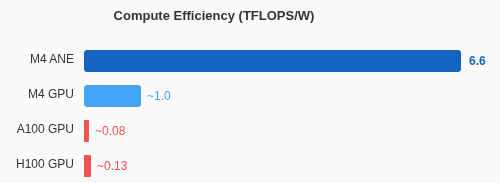
Image source: Substack Part 2
However, it’s important to note that this doesn’t mean Macs will be able to train large AI models directly in the future. The GitHub README states that this work remains a research project for now, not a production-ready framework, and is not a replacement for Core ML, MLX, or llama.cpp.
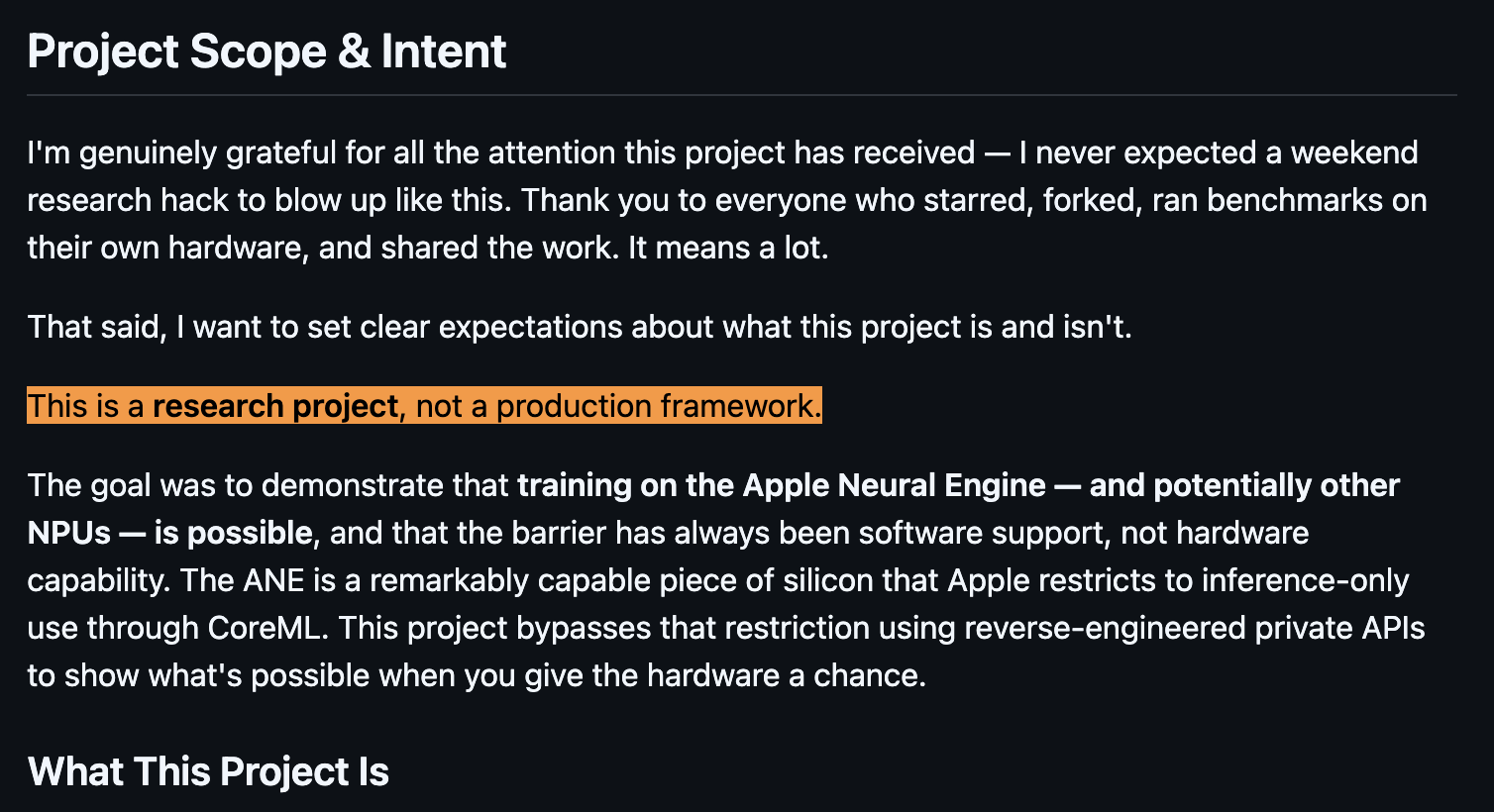
Although AI model training is already feasible today, ANE utilization is only about 5–9%, and many computations still fall back to the CPU, so it is still a way off from replacing GPUs. For now, it remains primarily suitable for research on small AI models.
Source: KOCPC Chinese