


As AI translation becomes more powerful, I believe many people are no longer using Google Translate. However, Google Translate has finally received an AI upgrade recently, so it’s time to consider going back to try it out. Earlier, Google announced on its official blog that Google Translate has officially added “AI real-time translation” and “language learning” features. The former supports two-way voice conversation, but it is currently only available in a few regions, and Taiwan is not on the first wave list.

Google Translate officially adds “AI real-time translation” and “language learning” features, supporting real-time two-way conversations.
Google stated that this update relies on advancements in AI and machine learning. By introducing the Gemini model into Google Translate, significant breakthroughs have been made in translation quality, multimodal translation, and text-to-speech (TTS).
The Google Translate app previously already had a “Conversation mode” option, letting users quickly have bilingual chats with people who speak different languages. The newly added “AI real-time translation” feature builds on the existing real-time conversation by incorporating Google’s latest AI models, offering natural conversational experiences in more than 70 languages.
The following is an official demo video. After opening the Translate app on Android or iOS, tap “Live Translation” and select the language to start speaking. In addition to hearing the translated speech, the screen will also display a bilingual transcript. Google also added that this feature intelligently detects pauses, accents, and intonation, automatically switching between both languages to keep the conversation natural and smooth.
Additionally, Google Translate’s real-time feature can filter out ambient noise, ensuring users get a high-quality translation experience even in noisy environments.
Unfortunately, Google Translate’s new AI real-time translation feature is initially available in the US, India, and Mexico. Other countries will need to wait, and it’s uncertain when it will expand further.
And just as the rumors suggested, Google Translate has also turned into a powerful language-learning tool, likewise powered by AI.
Google stated: “Whether you’re a beginner looking to start practicing conversation or an advanced learner wanting to reinforce commonly used vocabulary during travel, Google Translate can generate personalized listening and speaking exercises tailored to your level. These interactive exercises are generated in real time and intelligently adjust their difficulty.”
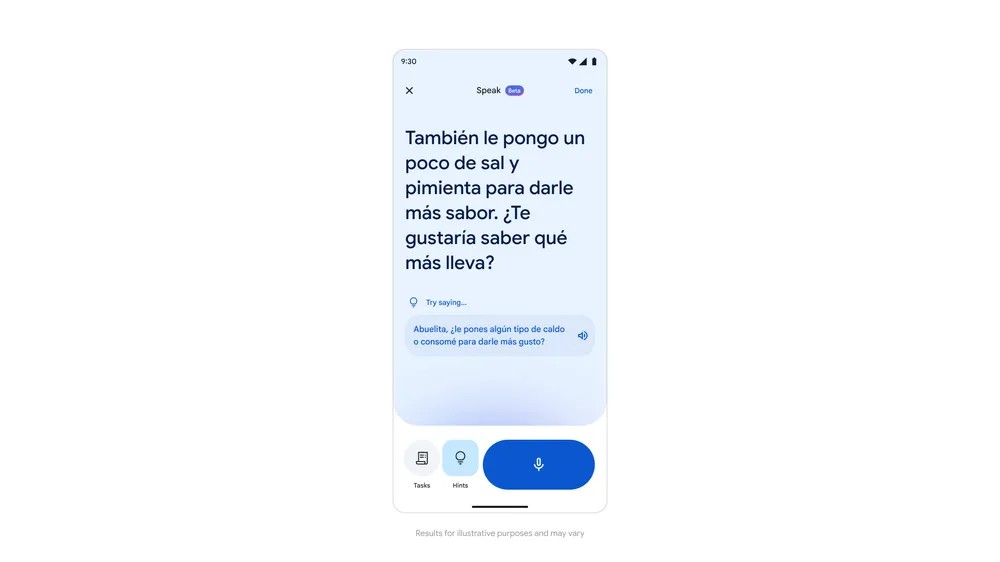
In the new version of Google Translate, the app will have a new “Practice” feature where users can set their proficiency level and goals, and the translation app will then generate customized learning content. Currently, two modes are available: “Listening Practice” and “Speaking Practice.” Google emphasizes that these exercises are all designed by language learning experts.
The Google Translate app also saves your learning progress, giving you a star as a reward after completing daily tasks, similar to other language learning apps.
However, just like AI real-time translation, the new language learning feature is not rolled out to all users at once, but is first made available to users learning Spanish and French from English, as well as users learning English from Spanish, French, and Portuguese.
Source: KOCPC Chinese