


Recently, Google officially released its latest open-source AI model. Gemma 3 270MThis model only has 270 million parametersThis small model not only continues the Gemma series’ strong capabilities in instruction following and text structuring, but also features “high efficiency” and “low power consumption” as its core characteristics. Compared to flagship large models with tens of billions of parameters, Gemma 3 270M achieves high performance with a compact size (approximately 270MB), highlighting Google’s alternative strategic approach in AI development: driving broader deployment of AI across various edge devices and application scenarios through small, quantifiable models.
Google launches Gemma 3 270M: a high-performance, low-power small open-source AI model built for mobile devices
Introducing Gemma 3 270M! 🚀 It sets a new standard for instruction-following in compact models, while being extremely efficient for specialized tasks. https://t.co/kC9OOPwzVi
— Google AI Developers (@googleaidevs) August 14, 2025
Gemma 3 270M, the compact version of the Gemma 3 series, features a well-crafted architecture:
-
Parameter configuration
-
100 million parameters Used for Transformer blocks, responsible for core data processing and computation.
-
170 million parameters Allocated to the embedding layer, specifically designed to handle massive vocabularies.
-
-
Glossary size
To possess 256,000 tokensThis means that the model can cover more rare vocabulary and perform detailed parsing of specialized domain corpora.
This design not only accommodates language diversity, but also enables the model to unlock greater potential in domain-specific fine-tuning. Google even noted that in certain scenarios, small models fine-tuned on Gemma 3 270M may outperform general-purpose large models.
Training focus: instruction following and text structuring
Gemma 3 270M’s training specifically emphasizes two core capabilities:
-
Instruction Following
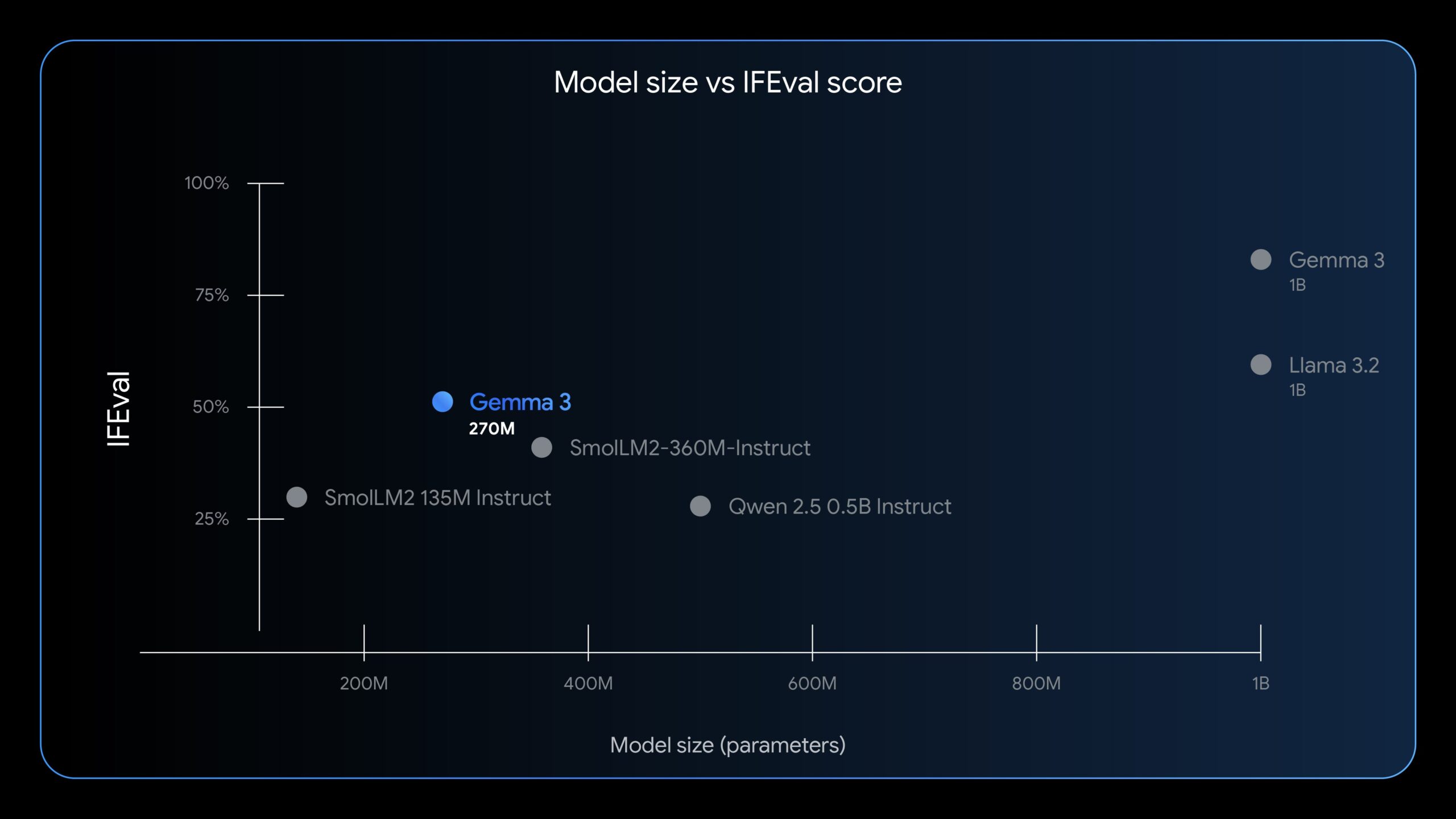
In the latest IFEval benchmark, Gemma 3 270M significantly outperformed other models of similar size, demonstrating strong task understanding and execution capabilities. -
Text structuring
The model can not only generate natural language, but also better handle formatted and structured text, enhancing its application value in areas such as report generation, code-assisted writing, and data summarization.
In other words, Gemma 3 270M is not just a language model, but an intelligent assistant that can be used for “task-oriented” work.
Two versions: a balance of performance and efficiency
Google splits Gemma 3 270M into two main versions:
-
gemma-3-270mStandard edition, offering full performance.
-
gemma-3-270m-itQuantized optimized version, specifically designed for INT4 quantization Designed to run in low-resource environments with limited performance degradation.
Particularly noteworthy is that gemma-3-270m-it demonstrated impressive energy efficiency in Google testing. According to official data:
在 Pixel 9 Pro 的 SoC 上,使用 INT4 量子化版本的 Gemma 3 270M 進行 25 次對話,電池僅消耗 0.75%。
This result not only highlights the model’s low-power advantage but also hints at the possibility of AI becoming an always-on application on mobile devices. From smart assistants to real-time translation, Gemma 3 270M is gradually turning the vision of AI being on standby at all times into reality.
Developer-Oriented: Fine-Tuning and Specialization
Google emphasized that a key feature of Gemma 3 270M is its “fine-tuning friendliness.” Since the model already has a solid foundation in instruction following and text processing, developers can retrain it for specialized domains and quickly obtain efficient, compact domain-specific models.
This strategy has two major implications:
-
Reduce costs.Compared to training or deploying massive billion-parameter models, lightweight fine-tuning is more resource-efficient and requires lower hardware requirements.
-
Performance advantageFor specialized tasks in specific domains, small models often outperform general large models in data precision and response speed.
This also aligns with current AI development trends: more and more companies are beginning to value the benefits of “specialized AI” rather than一味 chasing the largest models. Moreover, this kind of specialized capability isn’t just applicable to enterprise tasks; it can also inspire powerful creative applications. For example, thisGoodnight Story Generator Web ApplicationThat is, it was generated using Gemma 3 270M, and the results are also very good:
Deployment and Ecosystem: Extensive Open Source Support
Gemma 3 270M is currently available through Hugging Face Published and included in the official Google Collection In addition, it has also received Ollama with LM Studio support for common AI runtime environments, etc.
This means that researchers, developers, and even individual enthusiasts can easily deploy Gemma 3 270M on different platforms to conduct experiments and build applications. Google’s open-source strategy will undoubtedly help accelerate the model’s rapid adoption within the community and spark more innovative use cases.
Industry Significance: A Dual-Track Strategy for Small Models and Large Models
In 2025, Google chose to release Gemma 3 270M, reflecting a clear industry trend:
-
Large models remain the cornerstone of flagship-level applications., applicable to scenarios that require vast knowledge and reasoning abilities.
-
Small models, on the other hand, hold advantages in efficiency, specialization, and on-device applications., particularly suitable for smartphones, wearable devices, and edge computing scenarios.
The release of Gemma 3 270M fills the gap for “lightweight and efficient” solutions in the AI ecosystem. This also signals that the future of AI adoption will no longer rely solely on massive cloud-based models, but will instead reach into everyday use cases through compact, specialized AI versions.
Source: KOCPC Chinese