


SpaceX’s Starlink is the world’s leader in low-orbit satellites, but it has been unable to land in Taiwan due to restrictions on Taiwan’s Telecommunications Management Law. The Legislative Yuan passed the amendments to Article 36 and Article 95 of the Telecommunications Management Law (commonly known as the “Starlink Clauses”) on the third reading on July 21, unlocking the first layer of shackles that prevent Starlink from being launched.
What is the content of the amendment to Article 36 of the Telecommunications Management Act passed by the Legislative Yuan on the third reading? Is Starlink expected to be launched? If low-orbit satellite services are launched, will it be the end of the three major telecommunications and mobile broadband networks? Here is a summary and explanation:
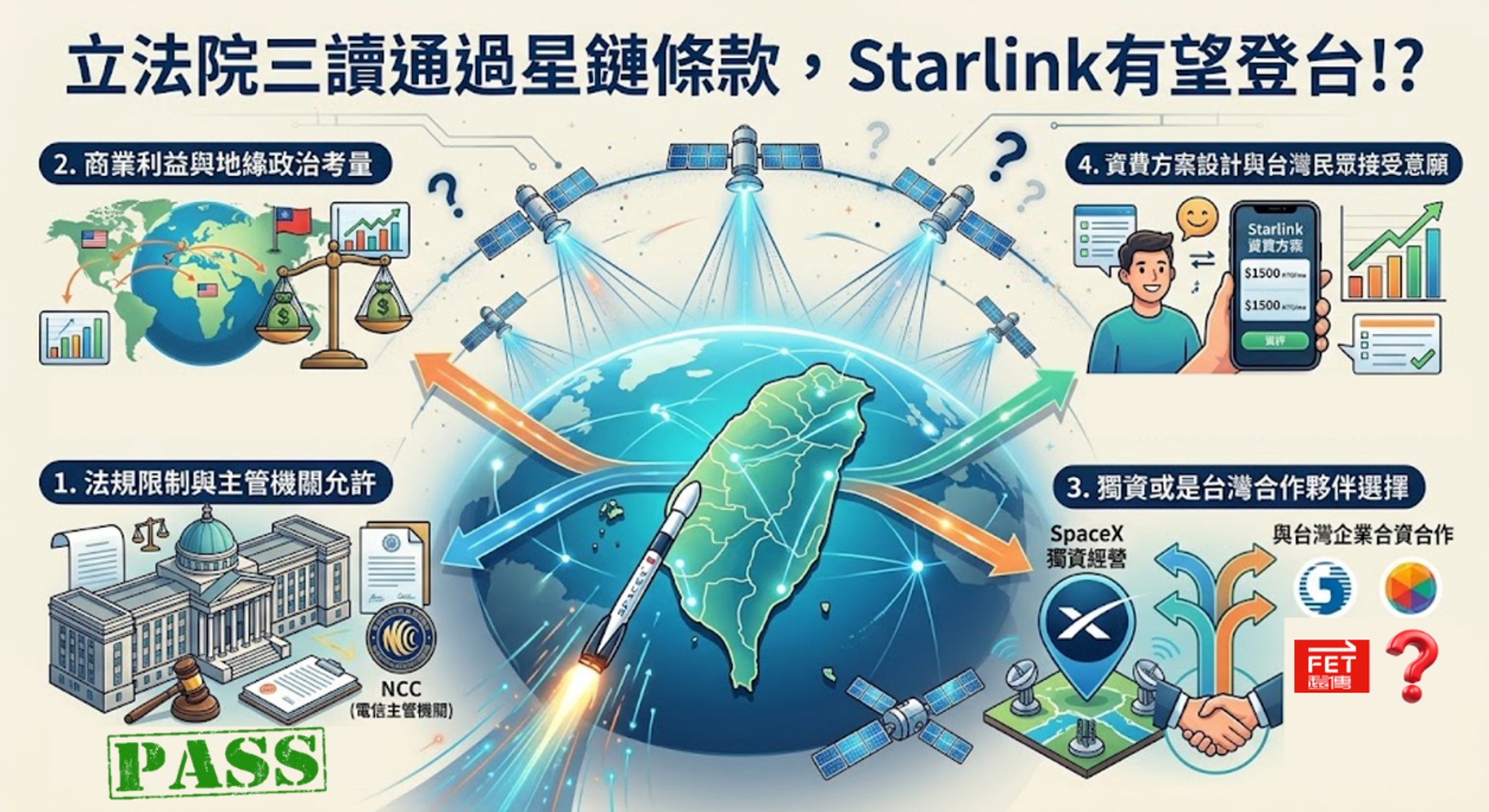
The Legislative Yuan passed the amendment on the third reading a few days agoArticles 36 and 95 of the Telecommunications Management Law have removed the biggest regulatory obstacles to the launch of the much-anticipated Starlink low-orbit satellite Internet and D2D mobile phone direct-connection satellite services. However, Starlink still needs to pass five hurdles and six generals to launch. The following is a summary video and detailed description of issues related to Starlink’s launch:
1. Amendments to Article 36 and Article 95 of the Telecommunications Management Law
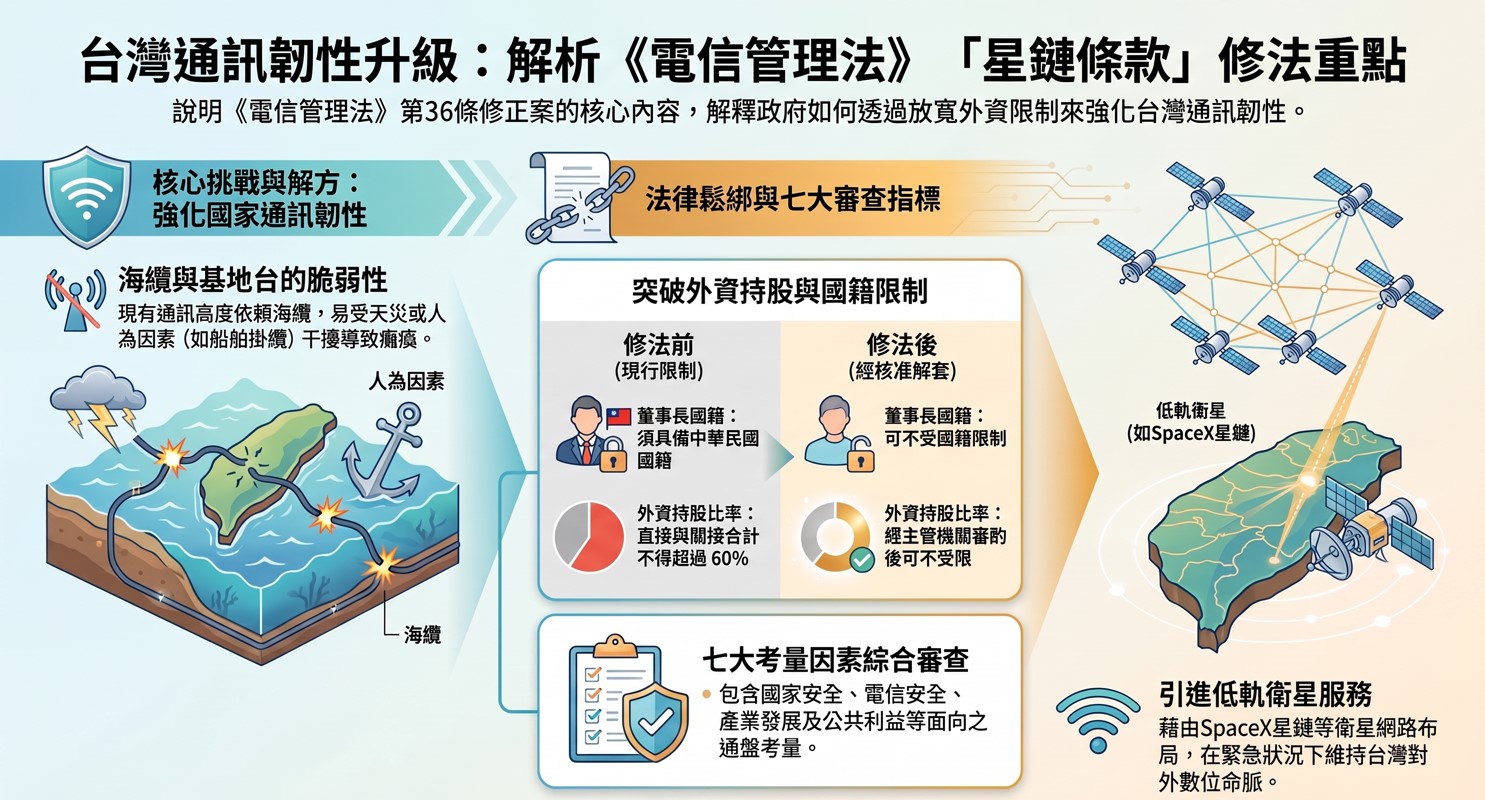
Currently, Starlink satellite broadband service, which has the largest market share of low-orbit satellites in the world, has yet to be launched in Taiwan. The industry used to believe that foreign shareholding regulations were the biggest hurdle. According to the current Telecommunications Management Law, the chairman of a public telecommunications network operator must have the nationality of the Republic of China. Direct shareholding by foreigners shall not exceed 49%, and the total direct and indirect shareholding shall not exceed 60%. However, Starlink’s tendency to operate under a 100% foreign-owned model has become one of the main reasons why Starlink cannot take the stage.
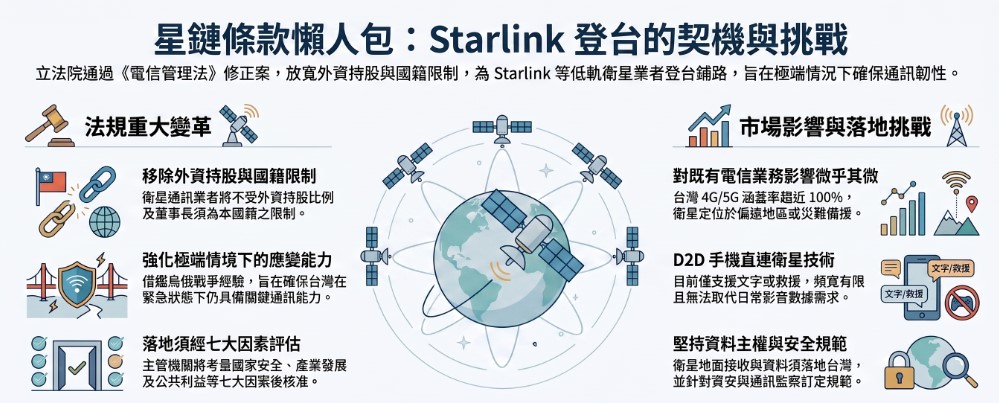
In view of the fact that low-orbit satellites maintained critical communication capabilities during the Ukraine-Russia war, and to ensure Taiwan’s ability to respond to extreme situations, the Legislative Yuan passed amendments to Articles 36 and 95 of the “Telecommunications Management Act” on July 21, 2026, relaxing restrictions on shareholding and nationality of satellite communication technology. After the amendment to the “Telecommunications Management Law” is passed, the competent authority considers seven major factors, including national security, public telecommunications network security, telecommunications resource usage, telecommunications network overall planning and promotion, telecommunications industry development, telecommunications service market development, and other public interest needs, and approves the amendment. Satellite communications operators will not be subject to restrictions on shareholding and nationality, and the Executive Yuan is authorized to set an implementation date.
The NCC warned: From a regulatory perspective, Japan, South Korea and other countries have relaxed foreign investment restrictions, usually based on diplomatic conditions such as free trade agreements (FTA) or requiring the establishment of on-ground ground stations (Gateways) to ensure data sovereignty. At the same time, including domestic industry players to participate will also help improve supervision efficiency; in the absence of local industry players, the supervision agency will rely more on foreign self-discipline, and the risks will be relatively higher. Furthermore, the development of the second generation of Starlink technology will have a greater impact on the industry. In the future, mobile phones will be directly connected to satellites and support image transmission, which will have a substitution effect on existing telecom operators. The impact on the industry must also be evaluated in advance.
Therefore, the bill also proposes two accompanying resolutions, requiring the competent authorities (Ministry of Digital Development and NCC) to formulate supervision systems, information security standards, communication supervision and other regulations and orders for D2D (mobile phone direct connection) services after taking into account suggestions from industry, government and academia; it also requires satellite ground reception and data landing in Taiwan to ensure data sovereignty.
3. Starlink is expected to appear on stage!?
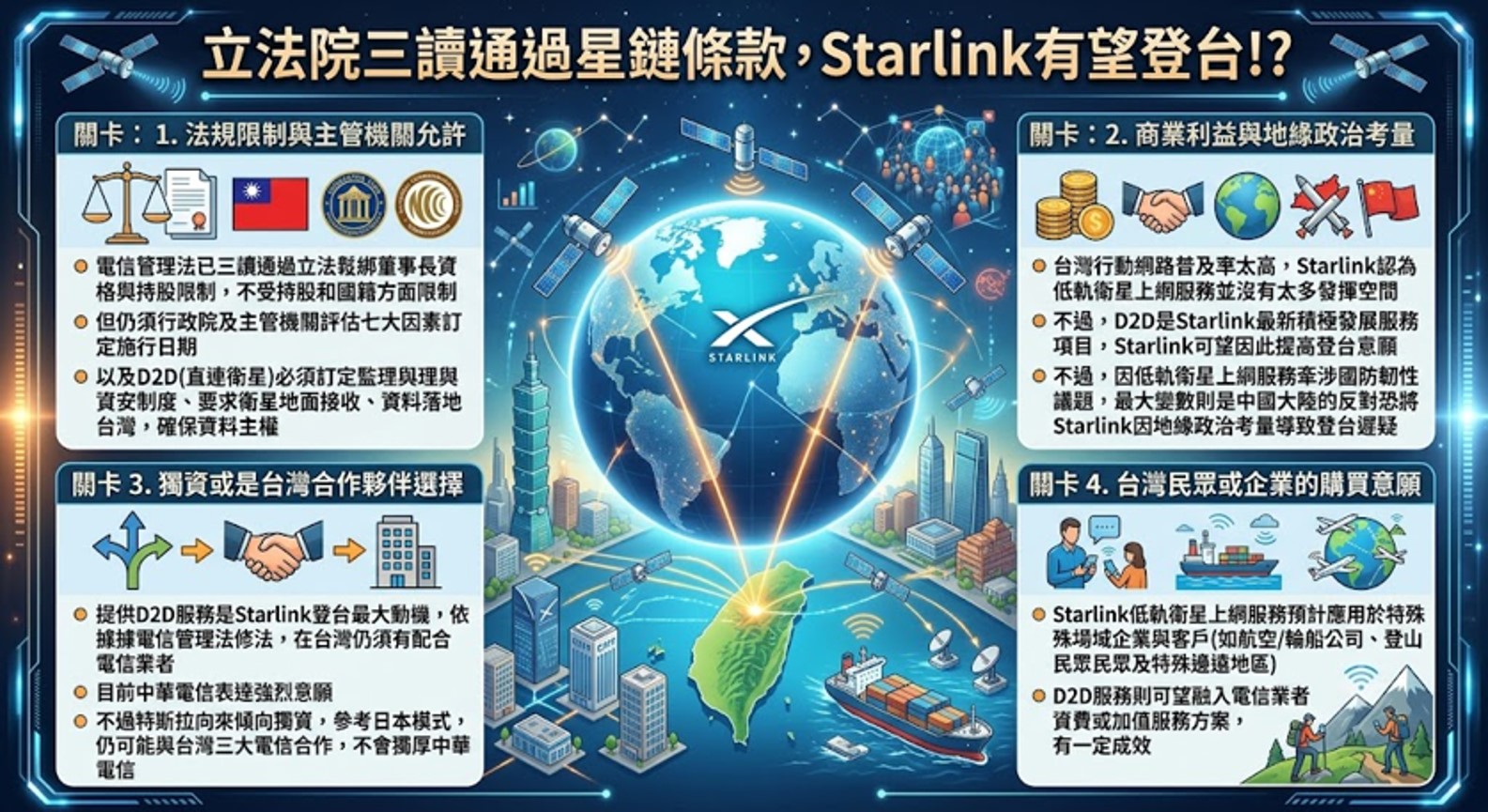
In order for the Starlink low-orbit satellite service to be launched in Taiwan, it must pass the following hurdles, including regulatory restrictions and permission from the competent authorities, commercial interests and geopolitical considerations, the choice of a sole proprietorship or a Taiwanese partner, the Taiwanese people’s willingness to accept, etc.:
A. Regulatory restrictions and permission from competent authorities:
The Telecommunications Management Act has passed the third reading to loosen restrictions on chairman qualifications and shareholdings. It is not subject to restrictions on shareholding and nationality. However, the Executive Yuan and the competent authorities still need to evaluate seven major factors to set an implementation date. D2D (direct connection to mobile phones) must establish a supervision and information security system, require satellite ground reception, and data landing in Taiwan to ensure data sovereignty.
B. Commercial interests and geopolitical considerations:
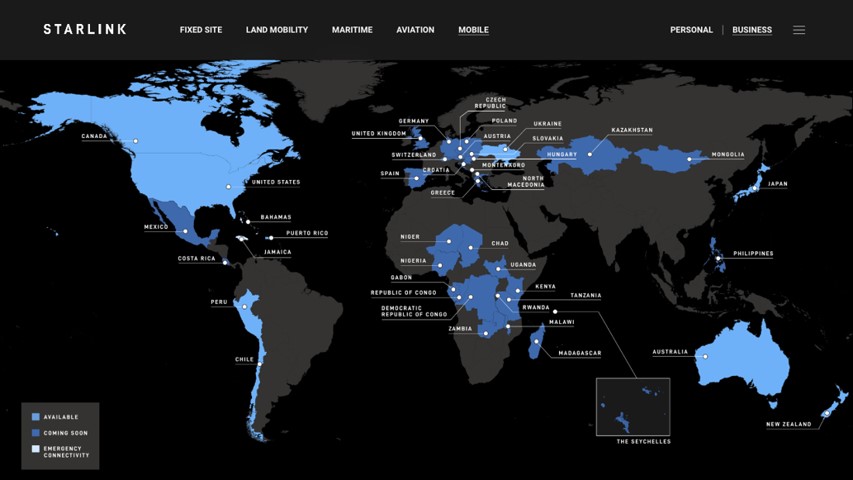
Taiwan’s overall mobile Internet penetration rate is as high as 87.12%. In terms of mobile communication coverage, the 4G/5G population coverage rate in Taiwan has approached 100%. Tesla once told the Digital Development Department that Starlink does not have much room to develop, so it does not regard Taiwan as the top priority market. According to the current blueprint of Starlink providing services in more than 40 countries around the world, the Digital Development Department’s statement is not groundless.
However, D2D is Starlink’s latest active development service project, and Starlink is expected to increase its willingness to launch. However, since low-orbit satellite Internet services involve issues of national defense resilience, the biggest obstacle and variable is the opposition from mainland China, which may cause Starlink to hesitate to launch due to geopolitical considerations.
C.Sole proprietorship or Taiwan partner choice:
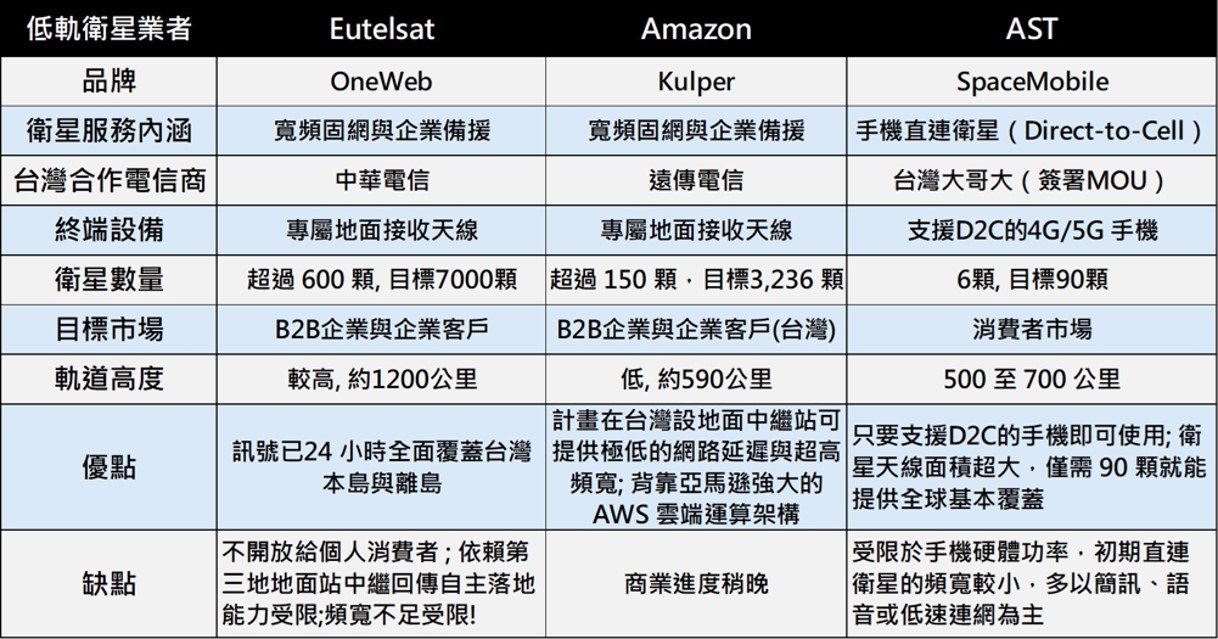
Providing D2D mobile phone services is the biggest motivation for Starlink to launch. According to the revision of the Telecommunications Management Act, cooperating telecom operators are still required in Taiwan. Since OneWeb, which Chunghwa Telecom currently cooperates with, does not provide D2D services, Chunghwa Telecom has expressed a strong willingness to cooperate. However, Tesla has always preferred sole proprietorship. Referring to the cooperation model with Japan’s three major telecom operators, it may still cooperate with Taiwan’s three major telecoms and will not be exclusive to Chunghwa Telecom.
D. The purchasing and selling intentions of Taiwanese people or enterprises:
Starlink low-orbit satellite Internet service charges are very high. It is expected that in the short to medium term, it will only be used by enterprises and customers in special fields in Taiwan (such as aviation/shipping companies, mountaineers, and special remote areas). D2D services are expected to be integrated into telecom operators’ tariffs or value-added service plans, and are expected to have certain results.
If Starlink Mobile can be successfully launched, low-orbit satellite Internet service is expected to be an independent company charging mechanism, and the fees will refer to Starlink’s global pricing strategy. Telecom operators will at best play the role of bill collection; D2D mobile phone direct connection services will be integrated into telecom operators’ tariff plans or independent value-added services, and the charging standards will be designed and determined by telecom operators.
3. If low-orbit satellite services are launched, will it be the end of the three major telecommunications and mobile broadband networks?
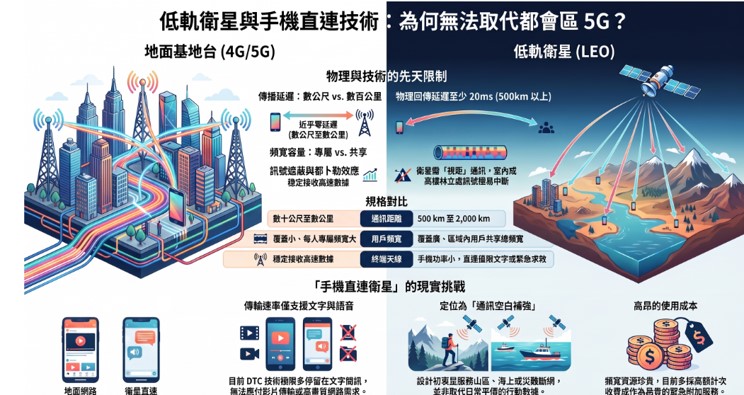
Since satellite signals are easily obscured by buildings or terrain and the Doppler effect caused by the high-speed movement of satellites, low-orbit satellites and direct mobile phone connection technologies currently face physical limits and cannot replace ground base stations in urban areas.
Taiwan’s mobile broadband population coverage has reached 100%, and current mobile phone rates are cheap and generous. Therefore, Starlink’s low-orbit satellite Internet service has minimal impact on Taiwan’s three major telecommunications mobile broadband businesses.
As for the direct connection of D2D mobile phones to satellites, due to the limited shared bandwidth of the satellite and the insufficient transmission power of the current terminal hardware, most of the direct connection services of mobile phones can only support text messages or emergency rescue, rather than the use of pictures and audio-visual mobile data currently used by mainstream mobile broadband, and it is impossible to replace mobile broadband. In addition, satellite technology is positioned as a backup solution to fill communication gaps in remote areas or disaster scenes, rather than replacing daily mobile broadband Internet needs.
In short, whether Starlink can be successfully launched depends on the commercial interests of Tesla (Starlink Mobile). Currently, the Taiwan government is open-minded and some telecommunications companies are actively pursuing it. The biggest variable is that China may block it.
Source: KOCPC Chinese