


In artificial intelligence (AI) As technology continues to advance the parameter scale (Scaling law), trainingLarge Language Model (LLM)The vast amounts of data and high costs required have long been the biggest bottleneck to technology deployment and rapid iteration.Google A breakthrough research result was recently announced, claiming that the newly developed data filtering and annotation process can reduce the high-fidelity data required for training to one ten-thousandth of the original amount while maintaining model accuracy.
From tens of billions of parameters to data bottleneck: the dilemma of LLM training
As AI model scale continues to expand, the latest generation of LLMs has reached parameter counts in the tens of billions or even hundreds of billions. While this scaling has brought improvements in reasoning ability and multi-task adaptability, it has also driven an explosive growth in data requirements. Traditionally, achieving stable performance on complex tasks with cultural background differences required large amounts of precisely human-annotated training data.
Taking ad safety review as an example, how to identify unsafe or policy-violating content from a massive ad library involves not only semantic judgment but also consideration of cultural context and differences in regional norms. Such high-complexity tasks often require “high-fidelity” training data—that is, data reviewed and annotated by professionals. However, the time and monetary costs of professional annotation are extremely high, and as policies are updated or new types of content emerge, models may need to be completely retrained, further driving up costs.
Google’s new strategy: closed-loop optimization of data selection
Facing this challenge, Google made “significantly reducing the amount of training data required without compromising annotation quality” its top priority, and proposed a brand-newData filtering loop process (curation process)。
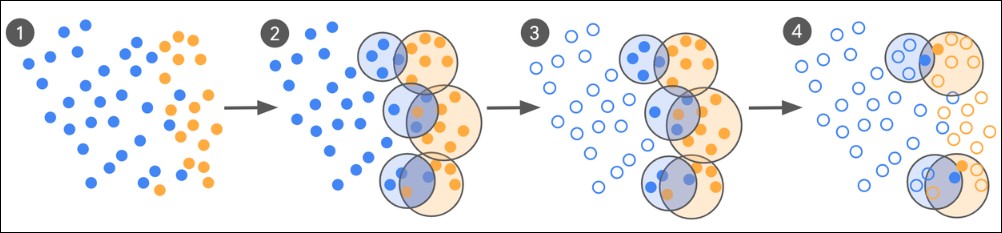
This process places human expertise at the core, combined with the model’s own preliminary classification capabilities, adopting a closed-loop optimization approach of “coarse first, then fine”:
-
Few-shot startup
Using a zero-shot or few-shot approach, first have the model perform preliminary classification based on existing labels (e.g., “safe ads” and “unsafe ads”). -
Identify boundary samples
In most cases, the model can make clear judgments, but there will be a portion of “boundary samples,” i.e., cases where the model’s judgment is ambiguous or may be erroneous. -
Expert-annotated boundary samples
These boundary samples were sent to human experts for precise annotation. Since the annotation scope is limited to high-uncertainty cases, the required amount of manual annotation is far lower than that for the full dataset. -
Model Retraining and Iterative Cycles
Reuse the expert-annotated results for model fine-tuning, and repeat the above process until performance improvement stabilizes.
The key to this method lies inConcentrate expert resources on the most controversial cases that can best influence model judgment., to avoid wasting manpower on a large number of easily classifiable samples.
Experimental Data: The Leap from 100,000 Entries to 500
In the experiment, Google used two LLMs of different scales: parameter count 1.8 billionof Gemini Nano-1 and 3.25 billion‘s Gemini Nano-2,Test advertising safety classification tasks of varying complexity. Each task’s dataset contains approximately 100,000 ads, of which approximately 95% Marked as harmless.
Through the new process, Google will reduce the amount of expert-annotated data needed from 100,000 entries plummet to Within 500 entries., while also achieving the following results:
-
Gemini Nano-1 (small model)
Even with significantly reduced data, performance remains nearly on par with results achieved using the full dataset for training. -
Gemini Nano-2 (large model)
When the training data volume was reduced to 1/1000 to 1/10000 of the original, accuracy actually improved. 55%~65%。
This result shows that, for specific tasks, “a small amount of carefully selected high-quality data” may be more valuable than “massive but uneven-quality data.”
The key to annotation quality: Kappa > 0.8
Google emphasized that the success of this approach does not rely solely on data selection strategies; high-quality annotation itself is an indispensable foundation. In these ad safety review tasks, for the model to surpass the performance of crowdsourced workers’ annotations, it is essential to ensure annotation consistency (measured by Kappa value measure) exceed 0.8This means that the judgments among experts must be highly consistent in order to become effective training data.
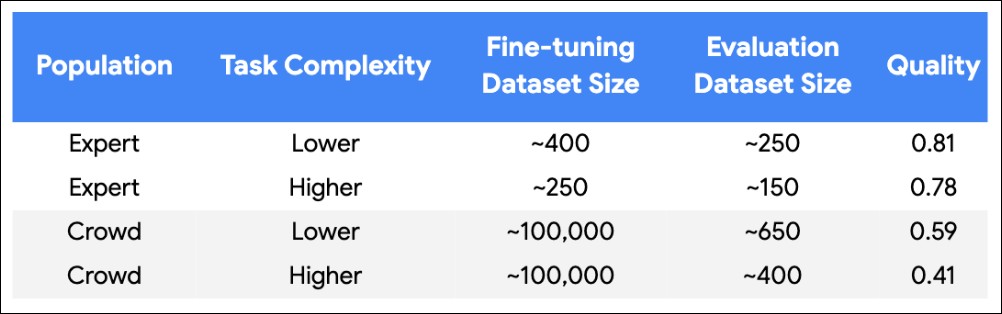
By combining LLM’s initial classification capability for a wide range of content with experts’ precise judgment on difficult cases, Google believes it can more flexibly use high-fidelity annotated data and break through data bottlenecks.
Implications for the Industry: The Arrival of the Data Efficiency Era
Google’s research brings two important insights for AI model training:
-
Efficiency over scale.
In certain contexts, optimizing data selection and annotation processes can yield greater performance improvements than blindly pursuing larger data volumes. -
The Value of Collaboration Between Experts and Models
LLMs can quickly process and filter large-scale data, but in high-uncertainty cases, they still need to rely on human expertise. This human-machine collaboration model may become the standard methodology for future AI training.
In high-risk application areas such as ad safety, medical diagnosis, and content moderation, this approach is particularly attractive because it can significantly reduce data collection and annotation costs and shorten model iteration cycles.
Facing the rapid changes in AI technology and application scenarios, Google’s achievement shows that future competition is not just about model scale and computing power, but also a contest of data management and annotation strategies. As data efficiency becomes the keyword for a new round of technological innovation, whoever can achieve higher performance with less data will have the opportunity to stand out in the AI race.
Source: KOCPC Chinese