


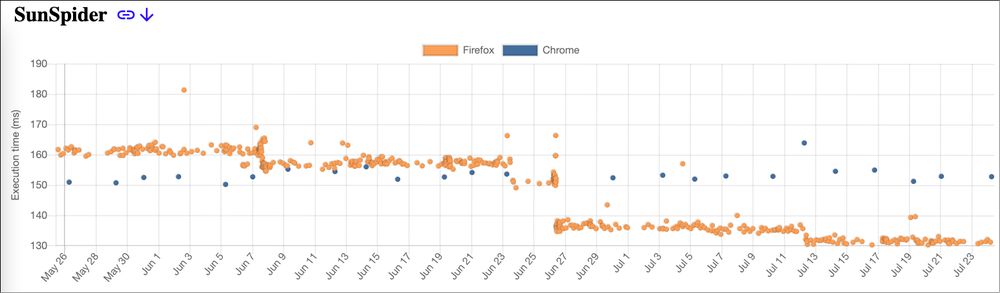
Friends who have only recently started to get involved with Internet browsers may not have much memory of the browser wars of the past decade or so. In the past, Internet Explorer once dominated, then Mozilla Firefox and Google Chrome emerged, and then the modern Chromium core unified the world. For Mozilla, Firefox was once a driving force in overthrowing IE’s exclusive situation, but now it has become less and less important, and its leadership has been crushed by Google Chrome browser. Maybe for the sake of face, or maybe I want to have a little more presence. interestingly, Firefox actually went against the trend in a recent test, beyond Google Chrome. The project is Sunspider, a performance test related to JavaScript functionality.Data shows Firefox is doing extremely well lately, and even recently finally surpassed the Chrome browser. The results were surprising.

The Sunspider test is a benchmark test created by the webkit development team. The test was relatively active mainly from 2007 to 2010, but the test was later replaced by Kraken with a similar purpose, or the V8 and Octane tests launched by Google. In the case of Kraken, this test is relatively focused on actual workloads and forward-looking applications, and was developed by the Mozilla organization for Firefox speed testing. With test projects such as Kraken, Sunspider is not as reference-heavy.
Firefox rarely wins, but it doesn’t seem to win
Sunspider was last updated in 2013 and has not been updated since. In other words, the test has not been revised or maintained for 10 years now. For recent browsers, if you want to test JavaScript, you naturally have to find a more credible software to test. Taking Apple’s JetStreme 2 test (which is also a comprehensive test project for JavaScript performance), although Mozilla Firefox continues to improve, the magnitude is not large, and the gap with Google Chrome is difficult to bridge.
Modern people naturally have more choices for browsers, but in fact most of them use the same engine, and their common name is Chromium. Even established browsers that were proud of developing typesetting engines in the past, such as Microsoft and Opera, later chose to switch to Chromium. Although the engines are the same, functional differences can be made based on user preferences. And integrate other services of its own to strengthen its momentum. For example, Microsoft, which has a rich set of software services, has added many special features to the Edge browser, such as synchronizing accounts directly with a Microsoft account, which is the same as on Windows systems.
However, these highly integrated services are more disadvantageous to Mozilla Firefox. The excellent performance of rival engines creates competitive pressure on the Firefox browser. This may be the purpose of Mozilla even if it is just a test project that has not been updated in ten years, it has a chance of winning. Perhaps technically Mozilla is no worse than anyone else, but Google’s financial resources and influence are simply too powerful. These are the result of Google Chrome completely crushing Mozilla Firefox in all aspects.
Perhaps Mozilla Firefox has its own place outside of Windows systems. For example, many Linux distributions still insist on using Mozilla Firefox as the preferred browser. This is because the browser is relatively in line with this spirit for Linux systems that pursue freedom and openness. Google Chrome, which is as commercial as a banknote, mostly requires external sources to install, or choose the Chromium browser, which has more limited functions, but the core is the same as Google Chrome.
In addition to the continuous improvement of JavaScript performance, Firefox has also made many improvements recently, such as improvements in HTTP/2 upload speed, automatic input of credit card information in some areas, etc. Most of these features are in the testing stage, and it will still take some time before they are available in the official version.
Source: KOCPC Chinese