


If you’ve been paying attention to streaming tools for years, you might be excited to see the rumored AV1 codec support, which would be a huge step forward for codecs like H.264 and VP9, but there’s more to the story than that. AV1, also known as AOMedia Video 1, was first announced in 2018 but has been very slow to roll out across the industry. This time I will compile all the information about AV1 at once, what improvements it has compared to H.264 and VP9, and its importance.
What is the AV1 codec? How does it make the file smaller?
- What is AV1?
- AV1 History
- Differences between AV1 and HEVC / H. 265
- The future of AV1
- Why is AV1 important for streaming devices like Google Chromecast HD?
What is AV1?
AV1 is a codec developed by the Alliance of Open Media (AOMedia), a consortium of many different companies in the technology field. Its main advantage is that it is license-free (so enterprises can implement it in their software for free), which results in significant cost savings compared to products such as VP9 and H.264. Facebook Engineering conducted tests in 2018 and concluded that the AV1 reference encoder achieved 34%, 46.2%, and 50.3% higher data compression rates than libvpx-vp9, x264 High profile, and x264 Main profile respectively. This means that for those with slower internet speeds, you may be able to enjoy higher quality audio and video than you are used to; for those with faster internet speeds, you will be able to get higher bit rates for the same connection speed.
The first smartphone chipset to support AV1 decoding is the MediaTek Dimensity 1000, which supports up to 4K @60FPS. The Nvidia Geforce 3000 series supports decoding, the new Nvidia Geforce 4000 series supports encoding and decoding, and Samsung’s Exynos 2100/2200 also supports AV1 decoding. Subsequently, Qualcomm Snapdragon 8 Gen 2 brought support for AV1 decoding, and it is rumored that the upcoming Tensor G3 will also support AV1 encoding. Industry support is slowly growing, and the chipset in Chromecast HD also supports AV1 decoding.
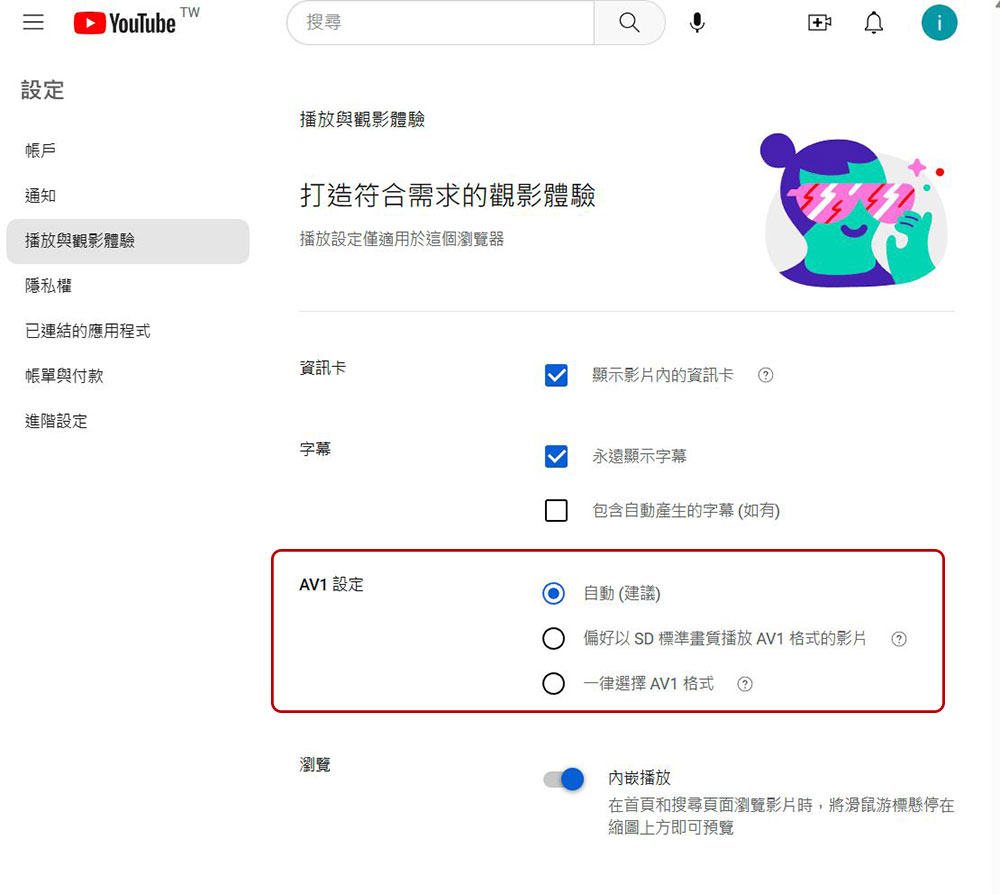
Not only that, the desktop version of YouTube is available as long as you use a compatible browser andEnable in account settings, can also support AV1 content. In fact, the company has designed its own chip for AV1 video encoding, code-named “Argos”, and will be used in YouTube data centers. Argos is a second-generation video (reverse) encoding unit (VCU) that converts videos uploaded to the platform into various compression formats and optimizes them for different screen sizes. Google claims Argos VCU processes video 20 to 33 times more efficiently than traditional servers.
AV1 History
The backstory about AV1 and why it was developed is also important. VP9, developed by Google, is a license-free codec that anyone can use, and because it’s free, it can be used on any platform or service that wants it. YouTube uses the codec on any device that supports it (Google can save a lot of money due to the reduced bandwidth), and it’s even used by streaming video on-demand services like Netflix, Twitch, and Vimeo.
However, because Google would benefit from using better compression algorithms to reduce bandwidth usage in its data centers, they began working on the next generation of VP10 and announced that it is expected to be launched in 2016, with updates every 18 months thereafter. Although the compression rate of each video increases very slightly, it can save a lot of costs and significantly improve the user experience when processing hundreds of millions of minutes of video. Google even began publishing the code for VP10, but the company later announced that it would cancel VP10 and establish AOMedia instead.

AOMedia members include everything from processor design (AMD, Arm, Broadcom, Chips&Media, Intel, Nvidia), to browser development (Google, Microsoft, and Mozilla), to streaming media and video conferencing services (Adobe, Amazon, BBC R&D, Cisco, Netflix, YouTube), and Apple, Huawei, etc. are also involved. Whether it’s through a hardware codec imported into the chipset, implementing the codec in the browser, or using the codec on a streaming service, all of these companies provide some form of support for AV1.
Differences between AV1 and HEVC / H. 265
The biggest difference between AV1 and HEVC (High Efficiency Video Coding) (also known as H.265) is licensing. In order to release a product that supports HEVC, developers need to obtain licenses from at least four patent pools (MPEG LA, HEVC Advance, Technicolor, and Velos Media) as well as numerous other companies, many of which do not offer standard licensing contracts and instead require negotiation.
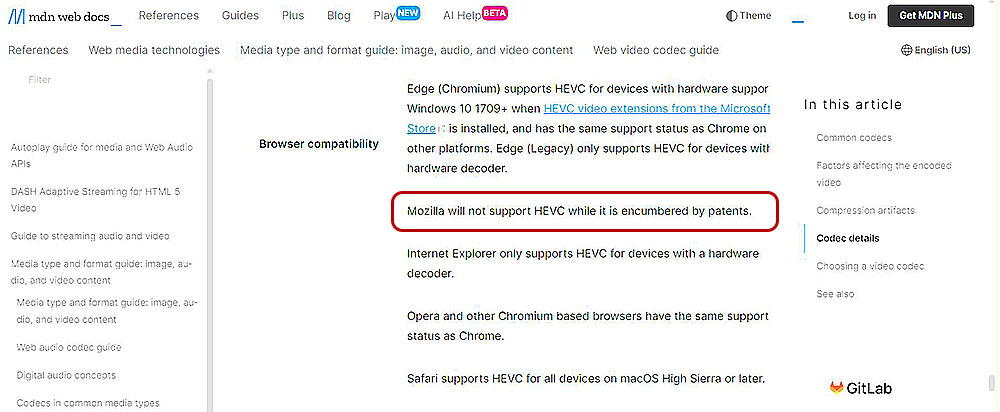
These high licensing fees are already a problem for products like Google Chrome, Opera, Netflix, Amazon Video, Cisco WebEx Connect, Skype, and others, and projects like Mozilla Firefox rule out HEVC as an option entirely. That’s because it goes against several of Firefox’s core values. Firefox requires license-free release in many FOSS projects, and the use of HEVC blocks this. Mozilla believes in a free and open Internet, and it doesn’t work if you promote standards that are protected by patents. Even ignoring these two issues, Mozilla cannot afford to waste hundreds of millions of dollars on licensing fees and negotiating the necessary licensing agreements.

An interesting fact is that these same issues prevented Firefox (and Chromium) from offering native H.264 playback on many platforms until a few years ago, and it still requires a plug-in on Linux. It’s unlikely that Firefox will even support HEVC until its patent expires in the 2030s (or possibly later). Even today, Firefox only supports H.264 natively, thanks to Cisco paying all of Mozilla’s licensing fees through OpenH264 in order to standardize H.264 before the next generation codec was ready for streaming in the market. exist Mozilla Video Codecs Guide, the company stated that “Mozilla will not support HEVC due to patent obstacles.” To date, only Microsoft Edge and Internet Explorer support native HEVC playback, and only on specific hardware that supports decoding.
In terms of efficiency, both codecs are on par. Their efficiency is generally comparable (although testing shows the AV1 is slightly ahead), but there’s a catch. AV1 generally takes longer to encode due to the lack of hardware encoding capabilities. The University of Waterloo found in 2020 that although AV1 saves 9.5% on the bit rate compared to HEVC when encoding 4K videos, AV1 videos also take 590 times longer to encode than AVC. In comparison, HEVC took only 4.2 times longer. These tests were apparently conducted in the early days of AV1, before hardware support was really available.
https://www.youtube.com/watch?v=YXweGeExm5s
The future of AV1
As more and more devices support hardware decoding, AV1 is likely to pave the way for high-definition compressed video playback. Given that HEVC is only supported by one browser on the desktop (Internet Explorer is now dead, anyway), AV1 is clearly the codec of choice in the future as a successor to VP9. As support continues to grow, more and more devices will eventually adopt it. There are already some experimental flags involving AV2 on the AOMedia repository, and the timing of the start of AV2 research dedicated to the repository last year suggests we’ll see a follow-up to AV1 in the future as well.
For those eyeing a smartphone preloaded with Android 14 when that version launches, you’ll be happy to know that it will likely have AV1 support out of the box. Qualcomm’s Snapdragon 8 Gen 2 and MediaTek Dimensity 9000 series both support AV1, so in that sense there aren’t really any hardware limitations anymore.
Why is AV1 important for streaming devices like Google Chromecast HD?
If you’re looking to buy a Google Chromecast HD, one big reason you might care about the AV1 is your network capabilities. If you buy the HD version instead of 4K, there may be a few reasons why you do so, one of which may be that the network doesn’t have the bandwidth for 4K streaming. The addition of AV1 means you can get higher bitrate video from Chromecast, which will give you better overall video quality at the same network data rate.

Not only that, but the bigger reason is that it is the first truly mainstream TV accessory to actively support AV1. Roku is somewhat mainstream, but only in certain regions, and the Fire TV Stick 4K Max is the only option right now, but again with very significant regional restrictions. Google’s ecosystem of TV accessories is the most geographically diverse yet, so including AV1 is a big deal. It makes AV1 mainstream an option and may push other companies to keep up with supporting AV1 in other ways.
Source: KOCPC Chinese