


Tianfeng International analyst Ming-Chi Kuo released the latest industry analysis today and pointed out that among several customized ASIC manufacturers on the table, MediaTek is likely to become a strategic partner of Elon Musk’s giant wafer fab Terafab. MediaTek will fully support the introduction and production of Intel’s 14A advanced process and advanced packaging, and is expected to begin small-scale production of chips required by Musk’s IC design team in 2028.
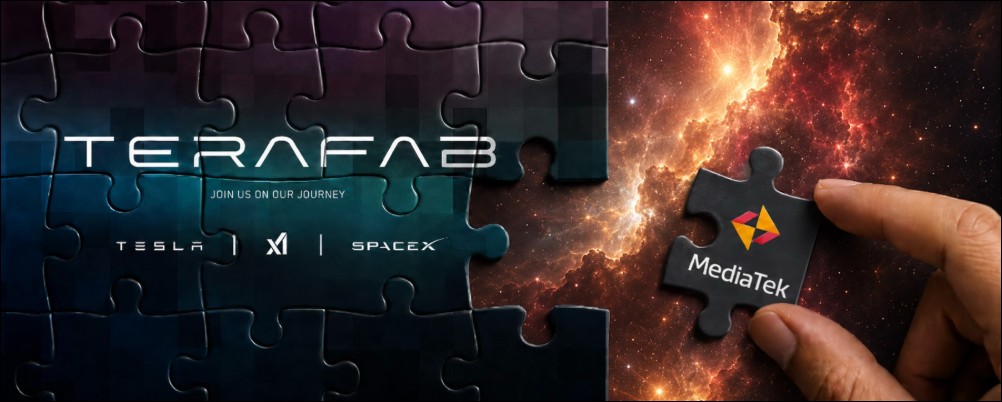
Ming-Chi Kuo: MediaTek will become a key puzzle piece for Musk’s Terafab
Terafab is a semiconductor manufacturing plant jointly planned by Tesla, xAI, SpaceX and Intel. In April this year, Musk announced at Tesla Q1 Earnings Conference CallOfficially confirmed to use the Intel 14A process. The goal of this super fab is to provide Musk’s empire with a full range of chips from AI inference to humanoid robots, from ground edge computing to space environments. The scale is unprecedented in the industry. Ming-Chi Kuo pointed out that MediaTek is currently the most suitable partner to assist Terafab with its actual cooperation experience with Intel, the successful case of Google TPU, and its existing business relationship with SpaceX.
Terafab’s triple pressure: scope, time, manpower
Ming-Chi Kuo analyzes Terafab’s execution challenges from three aspects. The first is “category pressure“: Musk’s IC design team simultaneously cooperates with three wafer foundries: TSMC, Samsung, and Intel, which is unprecedented in the IC design industry. It covers more than 6 projects such as AI series, Dojo series, and SpaceX exclusive chips, spanning two major computing power product lines: terrestrial reasoning and chips optimized for the space environment; it also integrates the four key processes of mask design, logic chips, memory chips, and advanced packaging in a single factory.
followed by”time pressure”. Intel 14A’s PDK 0.9 is expected to be released to external customers in October 2026. This is the first time that external customers can participate in the key node of the actual design of 14A. If Terafab does not master the PDK (Process Design Kit) as soon as possible, it may miss the goal of small batch production in 2028, and even face the risk of falling behind by one process generation. Ming-Chi Kuo revealed that Terafab has proposed to equipment manufacturers to purchase key equipment at prices significantly higher than the market price, further verifying the urgency of time pressure.
The third is “Human pressure”. Comparing Apple’s Silicon Engineering Group, its manpower size is roughly estimated to be several to dozens of times that of SpaceX and Tesla’s IC design teams combined, but Musk’s team has to execute a wider range of operations under a tighter timeframe. Ming-Chi Kuo bluntly said that Terafab’s real challenge lies in execution under multiple pressures.
MediaTek’s three major advantages: Intel experience, Google performance, and SpaceX trust
Ming-Chi Kuo analyzed that MediaTek meets three key conditions, making it the best partner for Terafab. First, MediaTek has experience in both Intel 16 front-end process production and participation in EMIB-T advanced packaging. It is more familiar with the cooperation model with Intel and can help Terafab grasp the golden window of several months after the release of 14A PDK 0.9.
Second, due to the cooperation between MediaTek and Google, the performance of TPU exceeded expectations. TPU 8t is expected to be mass-produced in the fourth quarter of 2026, and Humufish is expected to be mass-produced in the second half of 2027. The development progress is ahead of schedule. This means that MediaTek has the Semi-COT model to cooperate with customers, EMIB-T production synergy capabilities and Tier-1 mass production experience, and these are the capabilities Terafab currently needs. According to research estimates, the combined shipments of TPU v8t and v8e may be close to 5 million units by 2028, and MediaTek’s role in this continues to expand.
Third, MediaTek and SpaceX already have existing trust and business relationships. MediaTek MT7629 and MT7762/61 series are Starlink client Wi-Fi/Router SoC suppliers. Under Terafab’s high schedule pressure, cooperation with existing proven suppliers can greatly accelerate progress.
The hidden dividends of Taiwan Semiconductor’s accelerated R&D model
Ming-Chi Kuo specifically mentioned that MediaTek’s value, in addition to the company’s own capabilities, also includes the ability to introduce Taiwan’s entire semiconductor accelerated R&D ecosystem into Terafab. TSMC’s 24/7 shift R&D model “Project Nighthawk” is one of the keys to improving its execution efficiency. Even South Korean politicians and the semiconductor industry have called on the government to amend the law to follow suit.
Ming-Chi Kuo gave an example. In order to meet Apple’s new product development pace, a leading U.S. upstream materials supplier has set up a laboratory in Taiwan and followed the Nighthawk model, and the results satisfied Apple. If Terafab cooperates with MediaTek and takes advantage of Taiwan’s accelerated R&D advantages, it will further enhance execution efficiency by conducting R&D across time zones in the United States and Taiwan.
Strategic significance to MediaTek
If Ming-Chi Kuo’s wish comes true, this will be another heavyweight customer that MediaTek has won in the AI ASIC field after Google TPU. MediaTek used to be famous for its mobile phone chips, but in recent years, its layout in the customized ASIC market has gradually blossomed. From Google TPU to potential Terafab orders, MediaTek is transforming from a “mobile phone chip factory” to a “full-scale ASIC service provider.”
For Musk, choosing MediaTek also means giving up cooperation with traditional ASIC manufacturers such as Broadcom or Marvell to a certain extent, and turning to a partner who is more familiar with the Intel ecosystem and can mobilize Taiwan’s R&D resources. At a time when Terafab is facing triple pressures of scope, time, and manpower, the logic of this choice is quite clear.
Conclusion
This industry analysis by Ming-Chi Kuo adds another major benefit to MediaTek’s long-term layout in the AI ASIC market. From Google TPU to Musk’s Terafab, MediaTek is gradually establishing its key position in the field of customized chips. There are still variables in the mass production schedule in 2028, but with the support of Intel’s ecosystem experience, Tier-1 mass production performance, and Taiwan’s accelerated R&D model, MediaTek has occupied a favorable position in this new semiconductor battle.
Source: KOCPC Chinese