


Everyone has probably heard of many legacy programs where repeated iterations and multiple handoffs left the code so complex that no one could understand it. In most cases, engineers choose to “just leave it alone as long as it still runs,” but this also causes certain issues to become perennial bugs that later engineers want to fix but have no clue where to start. Recently, a veteran programmer with 30 years of C++ development experience in Reddit shared how they used Anthropic’s latest Claude Opus 4 model to fix a “white whale bug” that had stumped them for four years, all in just a few hours—a testament to Claude Opus 4’s coding prowess.

A New Era of AI Debugging! Overseas Engineer Uses Claude Opus 4 to Fix a Years-Old Unsolvable Bug
This person’s Reddit account is ShelZuuz A senior C++ developer with 30 years of experience, having worked at major companies such as FAANG (Meta, Amazon, Apple, Netflix, and Google), and now serves as an indispensable technical support role within the company team.

Four years ago, during a large-scale refactoring project involving 60,000 lines of code, he unexpectedly discovered an extremely elusive bug. This issue only triggered rendering errors under a specific shader with a particular extreme boundary condition. Bugs of this kind are almost impossible to reproduce under normal circumstances, yet when they do occur, they cause system anomalies. As a result, he jokingly dubbed it the “white whale bug” (inspired by Captain Ahab’s pursuit of the elusive giant whale in the novel *Moby-Dick*).
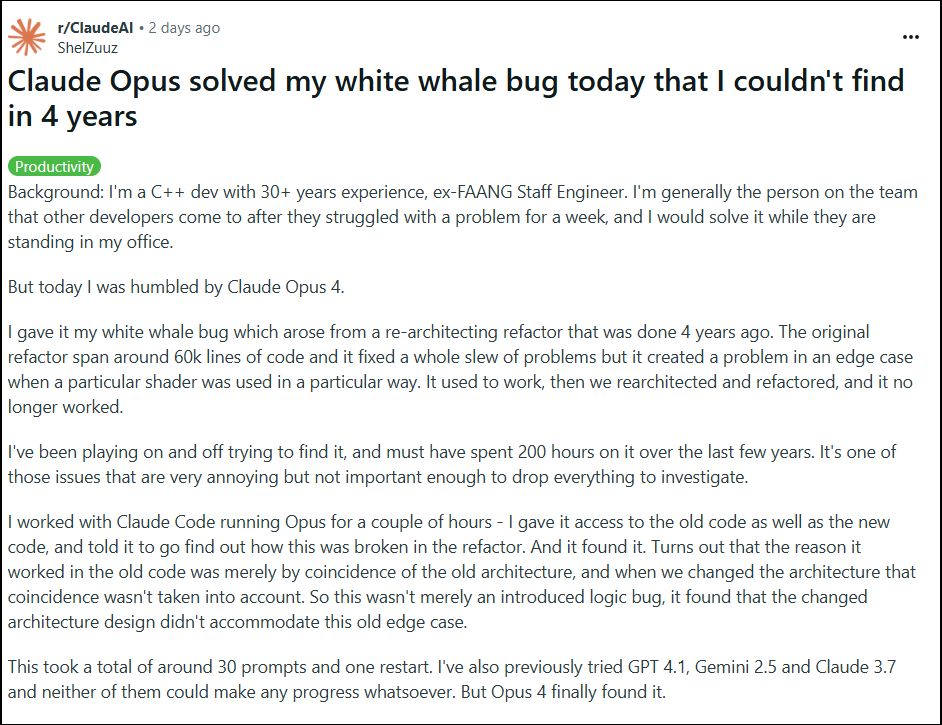
ShelZuuz had previously spent more than 200 hours debugging, trying various AI models for analysis, including GPT-4.1, Gemini 2.5, and Claude 3.7, all to no avail. It wasn’t until the recent release of Claude Opus 4 and its enhanced Claude Code features that ShelZuuz decided to try again. This time, using 33 carefully designed prompts and one restart, along with the complete pre- and post-refactoring code, Claude Opus 4 successfully identified and explained the root cause of the bug.
The core issue identified by AI diagnosis is not a traditional logical error, but a compatibility loss at the architectural level:
-
Legacy architecture: Without conscious design, it coincidentally supported the special usage of this shader.
-
New architectureBecause this usage pattern, which falls outside the intended design, was not considered, scenarios that previously worked have become ineffective under the new architecture.
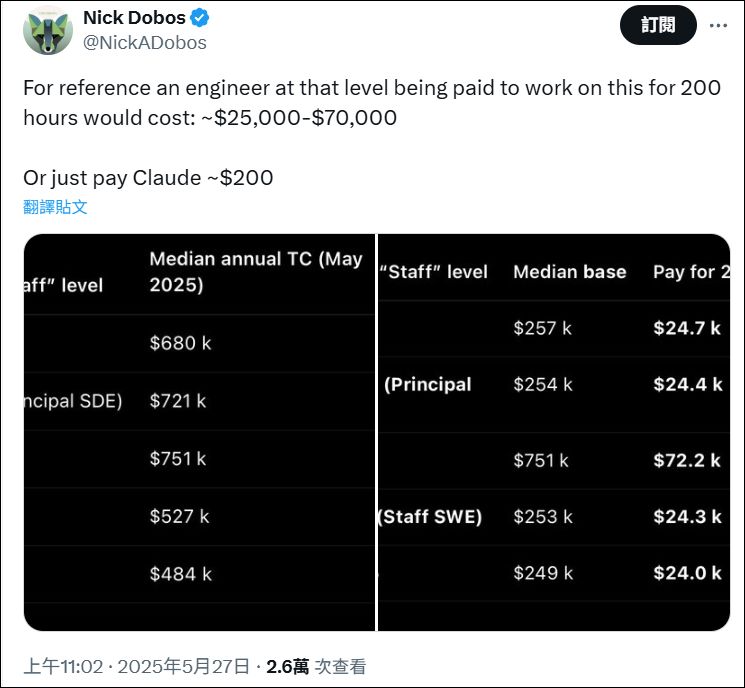
This type of code is too old and complex to be practically traced and reproduced through manual effort alone, but AI can quickly provide reasonable explanations and modification suggestions through cross-file deep relationship analysis and architectural logic reasoning, completing a debugging process that could be considered textbook-level.Developer’s rough calculationFor a senior engineer like ShelZuuz, 200 hours of labor costs at least $25,000; meanwhile, a Claude Opus 4 subscription costs only $200/month. This is not just a striking cost disparity—it also highlights AI’s potential in solving certain types of technical challenges.
Of course, some engineers also pointed out that Claude Opus 4’s success is highly correlated with the quality of prompt design. In other words, AI still relies on experienced developers to design reasonable questions and provide the right context. But regardless, the capabilities Claude Opus 4 demonstrated in this incident have undoubtedly raised people’s perception of what AI coding assistance can achieve.
Claude Code, available in Claude Opus 4, is the real hero behind this event. This feature enables AI to go beyond answering questions—it can genuinely understand, navigate through, modify, and even refactor large codebases.
Its applications include, but are not limited to:
-
Bug fix
-
New feature implementation (feature development)
-
Writing Unit Tests (unit testing)
-
Code modification and refactoring across files (cross-file refactoring)
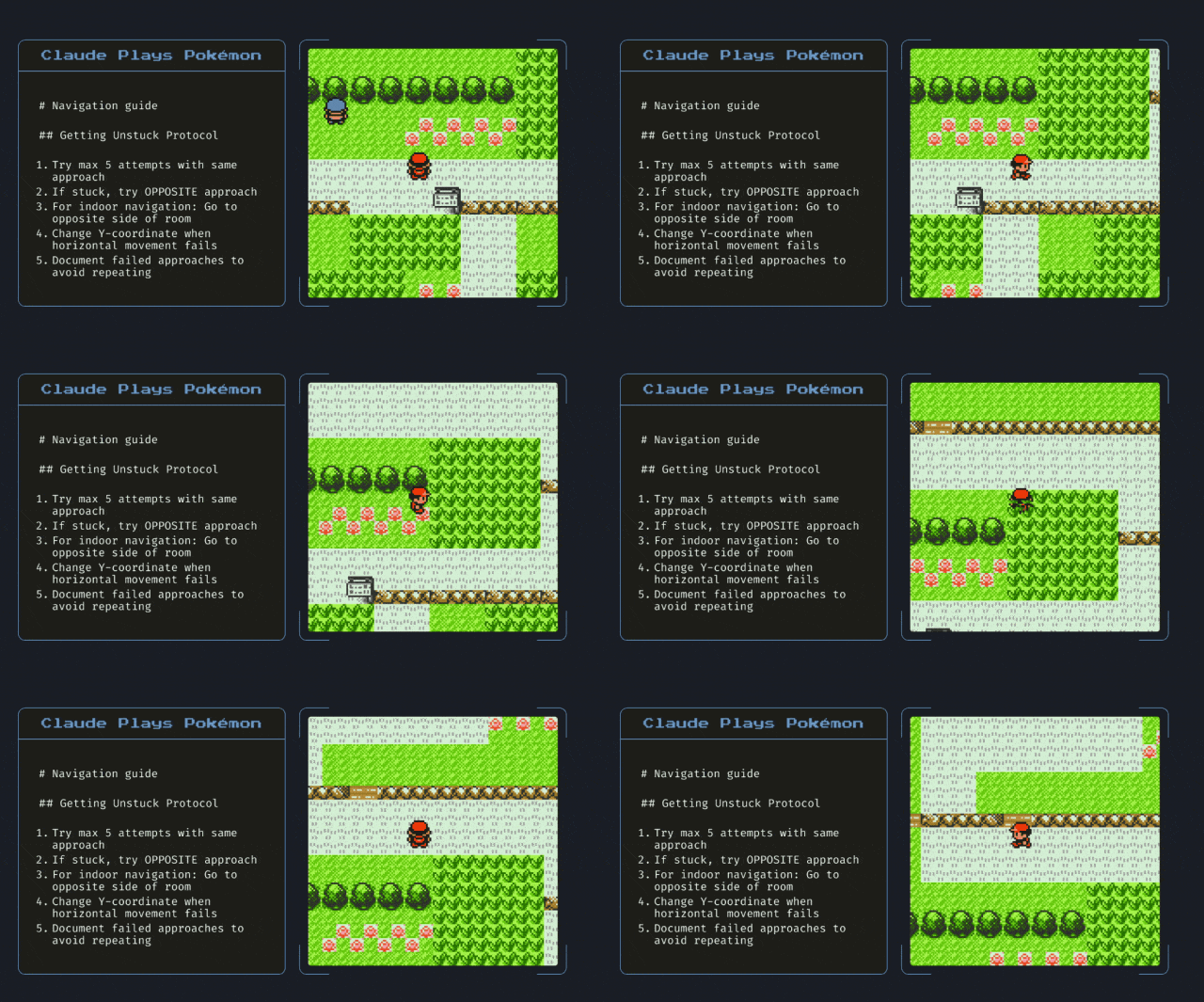
According to Anthropic’s official demo, Claude Code can handle high-difficulty tasks such as seven hours of continuous independent programming, or 24 hours of non-stop AI playing Pokémon, demonstrating its breakthrough progress in understanding and generation.
After the “White Whale bug” incident, many developers around the world have started trying to use Claude to solve bugs they encounter, and all have received very positive feedback. At present, it seems that Claude Opus 4 is indeed quite adept at programming and debugging. I believe that from now on, more engineers will use it to resolve program bugs that have accumulated due to historical factors and are difficult to fix (Editor’s note: However, the person involved still needs to understand the code; otherwise, if they rely entirely on AI to solve it without understanding the cause, it’s hard to say there won’t be bigger trouble later…).
C++ dev and ex-FAANG staff engineer with 30+yrs of experience was stuck on a bug for ~200hrs over 4 years.
Claude Opus 4 solved it, and was the only model that could. pic.twitter.com/QSJnesC90S
— Deedy (@deedydas) May 27, 2025
Source: KOCPC Chinese