


Google’s on May 20, 2025, a few days ago Google I/O developer conference unveiled Google’s brand-new AI video generation model.:Veo 3In addition to more realistic visuals and the addition of Flow editing features, this new model also brings real-time audio dubbing capabilities—not only taking AI-generated videos out of the “silent film era,” but also elevating the realism of AI-generated content to unprecedented heights, to the point where it’s already becoming difficult to tell real from fake.
Veo 3: A Revolutionary Breakthrough in AI Video Generation
Google Veo 3 is the latest-generation AI video generation model developed by the Google DeepMind team. Compared with its predecessor Veo 2, the biggest breakthrough of Veo 3 is that it achieves synchronized generation of visuals and audio for the first time. Now users simply need to provide prompts describing the characters and environment, along with suggested dialogue content and desired sound effects, and Veo 3 can generate videos with complete audio, including sound effects, background noise, and dialogue.
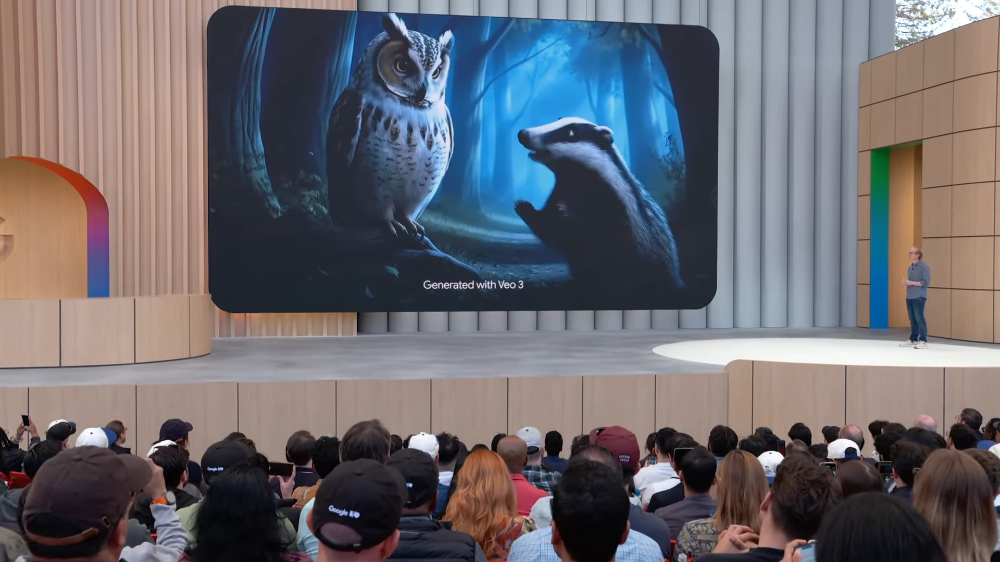
As for whether the videos produced by Veo3 are truly as impressive as Google claims, that’s likely a key point many are curious about, especially since OpenAI’s Sora failure is a recent cautionary tale. Right now, there are many striking examples on the social platform X (formerly Twitter). Here we’ve compiled some cases made by creators who have already used Veo3.
Hyper-realistic fake internet beauties
In the future, seeing a beautiful woman on the internet chatting with you in a sweet, coquettish voice may no longer be trustworthy. This video was generated using Veo3, and you can see the virtual character even pulls off coughing and a lazy vibe. If not for the slightly odd eyes and fingers, ordinary people might not be able to tell real from fake at all. From now on, when it comes to online dating, unless you meet in person first, don’t ever be a fool throwing money around.
不得不说Veo3这个TTS的语气比大部分现在的平台都靠谱。。。 pic.twitter.com/Qu6gAscLMV
— 汗青 HQ (@hq4ai) May 22, 2025
Will Smith eating spaghetti in a way that conforms to the laws of physics
The AI-generated “Will Smith eating pasta” video that went viral online a while back had several segments where his face glitched and warped, and the physics just didn’t add up, which spawned all kinds of memes at the time. Even the man himself made a video poking fun at it, and we’ve also covered it in articles before.
However, when netizens used Veo 3 to recreate the classic AI video generation challenge of “Will Smith eating spaghetti,” the result this time was already extremely realistic—unless you looked closely, it was almost impossible to tell.
Just got access to Veo 3 and the first thing I did was try the Will Smith spaghetti test. SOUND ON pic.twitter.com/y0CiZwNxgM
— Javi Lopez ⛩️ (@javilopen) May 22, 2025
Here’s also the version of “Will Smith eating spaghetti” that Ada just made with Sora:
AI-generated characters’ self-awareness
An interesting conceptual case exploring what would happen if AI-generated characters refused to believe they were AI-generated, with the scenes and dialogue of course being human-inputted.
Prompt Theory (Made with Veo 3)
What if AI-generated characters refused to believe they were AI-generated? pic.twitter.com/GJSRCXp3JP
— Hashem Al-Ghaili (@HashemGhaili) May 22, 2025
Shoot ads at a lower cost.
This user said he previously spent $500,000 to shoot a pharmaceutical ad, but now he only spent $500 in credits to use Veo3 to produce the ad below (although it’s much cheaper, it’s still a significant expense for the average user).
I used to shoot $500k pharmaceutical commercials.
I made this for $500 in Veo 3 credits in less than a day.
What’s the argument for spending $500K now?
(Steal my prompt below 👇🏼) pic.twitter.com/4UH43EXDux
— PJ Ace (@PJaccetturo) May 22, 2025
Real-time rendered game graphics
This shows that if Veo3 continues to evolve, it might become possible for future game graphics to be rendered in real-time by AI, significantly saving development time.
Veo 3 does video games really well. It’s like you can explore new worlds already.
Prompts are all variations of:
> a third-person open world video game walking around…
> an fps video game in/on a… pic.twitter.com/bpDGaKNU55— fofr (@fofrAI) May 22, 2025
Additionally, some people use Veo3 to generate real-world game scenes in real time.
Veo 3 tackling some real world locations but “in-game”
1. Paris – Eiffel Tower pic.twitter.com/ownfb9JrZy
— Linus Ekenstam (@LinusEkenstam) May 23, 2025
Will fake news be everywhere?
The video shows a seemingly ordinary street interview, with a man being interviewed by two women. Without being told beforehand, it would be nearly impossible to tell that this is AI-generated content. The facial expressions and movements of the people in the video are natural and fluid, the lighting and shadow changes in the environment feel real, and even the sync between the dialogue and lip movements is convincing enough to pass as genuine.
Veo 3 has been out for <24 hours.
I’ve generated so many videos that I already ran out of credits on the $250/month plan.
Here’s a collection of my best clips (with prompts!) 👇 pic.twitter.com/E6HImXaYhp
— Justine Moore (@venturetwins) May 21, 2025
Even news channels with anchors can now be easily generated — the scenes, movements, and tone all look real. Fake news problems are likely to get even worse in the future.
It’s been 48h since Google launched Veo 3
It’s time for the thing that everyone feared.
Fake news: pic.twitter.com/JaWjsrKt9V
— Alex Patrascu (@maxescu) May 23, 2025
Drama filming
Everyone can see the scene and the smoke effects — it’s really terrifying.
#Veo3 further blurs the lines between reality and imagination with audio, stronger text adherence, and richer visual details. pic.twitter.com/Tv5H9Uwzh3
— MBZ (@babaeizadeh) May 20, 2025
From OpenAI Sora to Veo 3: The Rapid Evolution of AI Video Generation
The emergence of Veo 3 marks the rapid evolution of AI video generation technology, as recently as February 2024,When OpenAI released Sorathe industry was already stunned by its video generation capabilities. Just three months later, Google’s Veo 3 has surpassed Sora in multiple aspects (but honestly, Sora is indeed the worst performing among the many AI video generation services.), especially in audio generation and image realism.
The rapid iteration of this technology has also sparked concerns about “Internet death.”dead internetTheoretical concern: future internet content may be flooded with AI-generated videos and comments. If current AI-generated videos that aren’t very realistic can already rack up massive views on YouTube, how much attention would the more realistic Veo 3-generated content attract?
The Impact and Challenges for Creators and Audiences
Veo 3’s broader future application areas
-
Hollywood productionAccording to reports, Hollywood directors have begun integrating DeepMind products into their productions. Renowned directors… Darren Aronofsky is one of the latest examples.
-
Education and TrainingVeo 3 can be used to create highly realistic educational and training materials, from medical education to vocational training.
-
Virtual Try-On and E-CommerceCombined with Google’s other AI features, Veo 3 will be used to create virtual try-on experiences that upgrade from photos to videos, enhancing e-commerce interactivity.
-
Personalized contentCreate highly personalized video content for users, from birthday greetings to custom tutorials.

Source: KOCPC Chinese