


SSD solid state drives use flash memory to store data, while HDDs have disks and many machine parts. Therefore, normally, most people would think that SSDs are more reliable and HDDs are more likely to have problems after long-term use. But in fact, this does not seem to be the case. Backblaze’s latest report shows that the reliability of SSDs is not much higher than that of HDDs.
Backblaze’s latest report points out that SSD reliability is actually only slightly higher than HDD
Backblaze is a company that provides enterprise cloud storage and data backup. It is headquartered in California. It provides some statistics every year so that everyone can better understand the reliability of each hard drive brand. This company started using SSDs in the fourth quarter of 2018, from 5 different brands, with a total of 13 models. They released their 2022 annual report a few days ago, confirming what they said in mid-2022, that SSDs are more reliable than HDDs, but the difference is not huge.
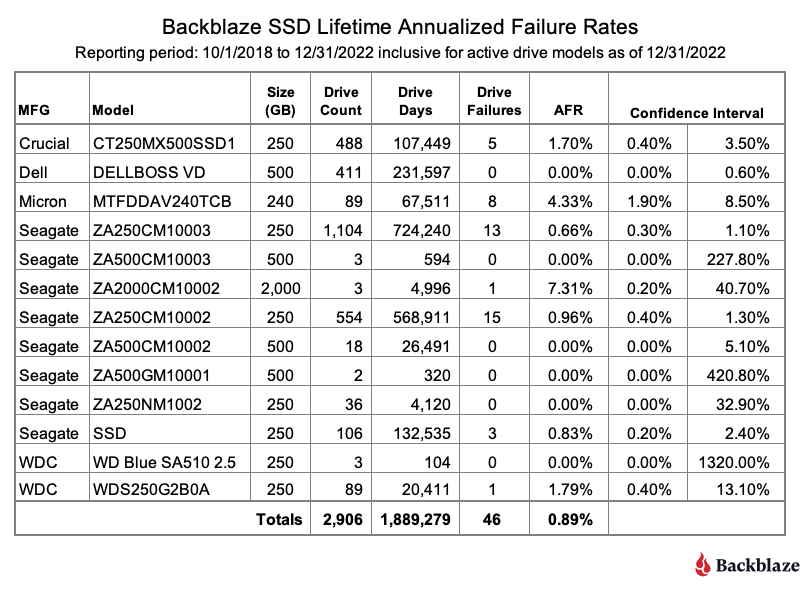
The report states that as of December 31, 2022, there were a total of 2,906 Backblaze servers, most of which are consumer-grade SSDs, which representatives said are worth reference for general users.
The five brands are Crucial, Dell, Micron, Seagate and WDC, of which Seagate has the most, with more than 1,000, followed by Crucial:
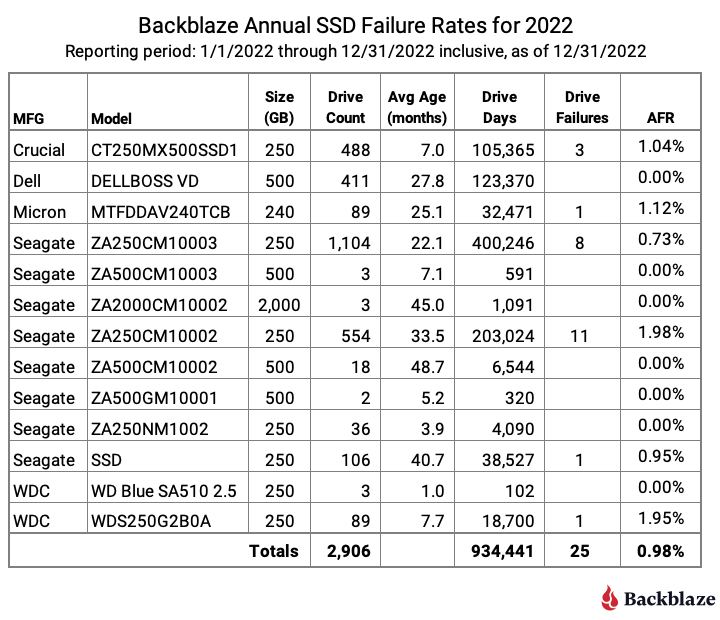
Overall, Backblaze’s SSD failure rate in 2022 is 0.98%, that is, only 25 of 2906 SSDs have errors. This seems good at first glance, but it should be noted that the HDD failure rate is 1.37%, a difference of only 0.39%. Strictly speaking, SSDs are not particularly eye-catching.
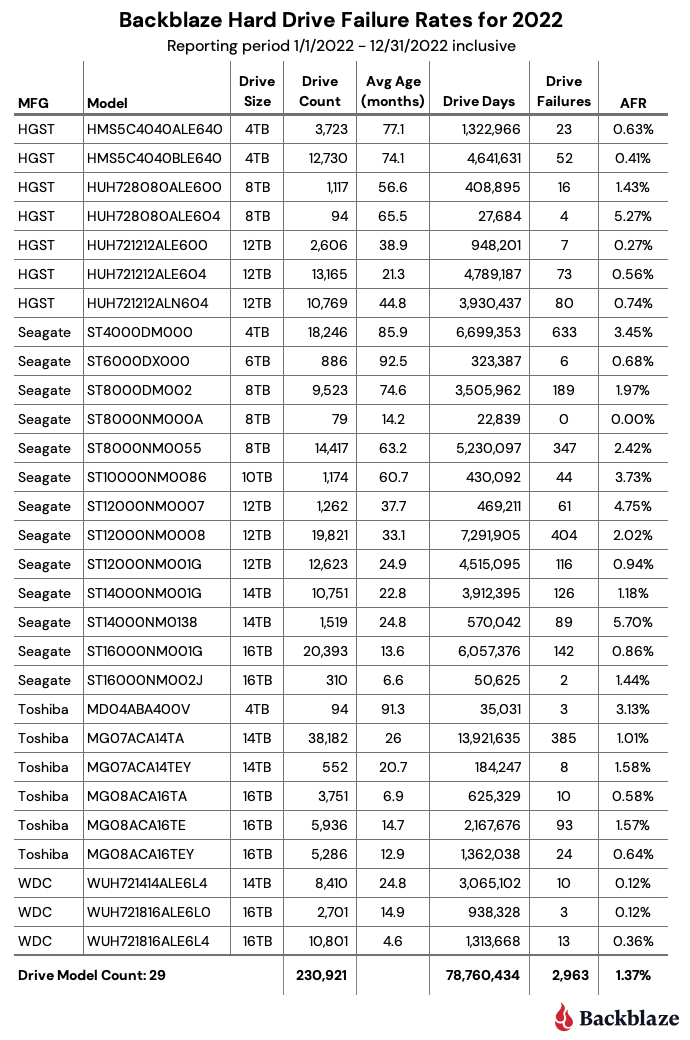
As mentioned before, SSD does not have a mechanical structure and uses flash memory to store data. The structure of HDD is more complex. Logically speaking, the failure rate of HDD should be much higher. It’s unclear which side of the SSD is faulty and only the SSD manufacturer has the equipment to diagnose it.
Compared with previous years, the Crucial CT250MX500SS1 has a very high failure rate in 2021, but it will become normal in 2022. Backblaze believes that this should continue in the future:
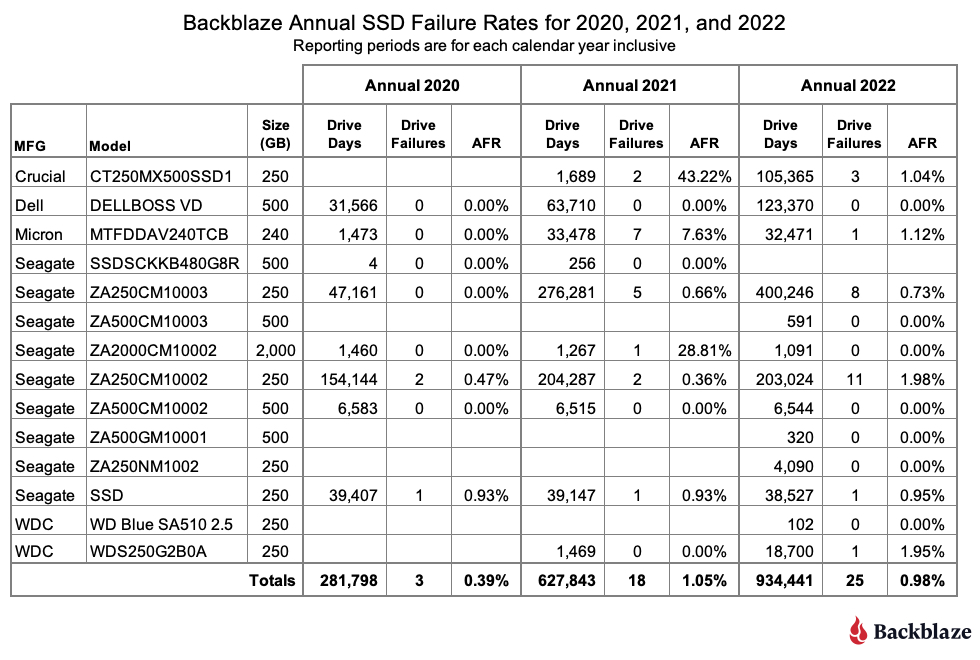
Seven of the 13 SSD models in 2022 have not failed, but six of them have less than 10,000 Drive Days, so the data is not large enough to make this section worth reference:
The report also contains insights about the SMART report. When it comes to SSDs, Backblaze believes that the SMART report is completely useless. It mainly analyzes HDD:
In particular, Backblaze does not use Samsung SSDs. Today, Samsung has many choices for consumer SSDs. One possible explanation is that Samsung SSDs are not cheap. Backblaze basically looks for SSDs that can be purchased in bulk at cheap prices.
Source: KOCPC Chinese