


In the world of beauty products, food, and household goods, “fragrance” is often an indispensable part of the consumer experience. From the complex layers of perfumes to the scents of laundry detergents, cookies, and even skincare products, the addition of fragrance makes them more valuable. However, developing a completely new fragrance has long been a time-intensive task requiring expert perfumers. Recently, a research team at Tokyo Institute of Science developed an AI model capable of automatically generating fragrance formulas: “OGDiffusion (Odor Generative Diffusion),” which promises to make fragrance creation simpler, faster, and even accessible to non-professionals.
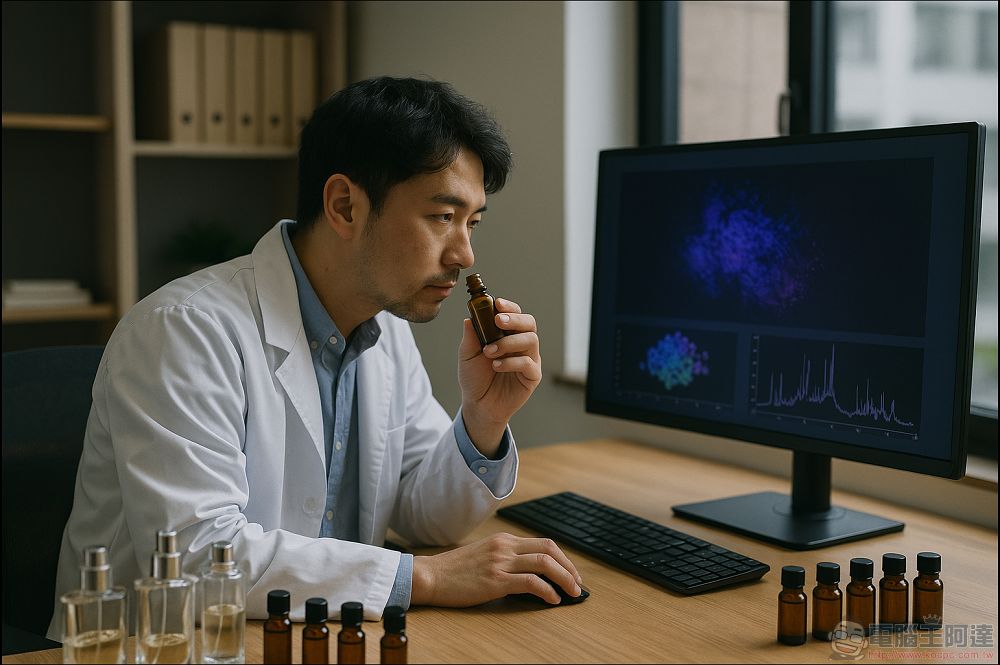
Tokyo University of Science develops AI model “OGDiffusion” that can automatically create specified fragrances.
At the core of OGDiffusion is an AI system based on a diffusion model, led by Professor Takamichi Nakamoto and his research team at Tokyo University of Science. What makes this model unique is that users only need to input a description of the scent they want—such as “woody,” “sweet,” or “floral”—and the system automatically calculates the corresponding essential oil formula to actually reproduce that fragrance.
To train OGDiffusion, the research team prepared 166 different essential oil samples and annotated each fragrance with nine categories of odor descriptors, including herbal, floral, woody, sweet, spicy, fruity, citrus, fresh, and musky. These descriptors provided the foundation for OGDiffusion to learn, enabling it to establish connections between scent perception and chemical composition.
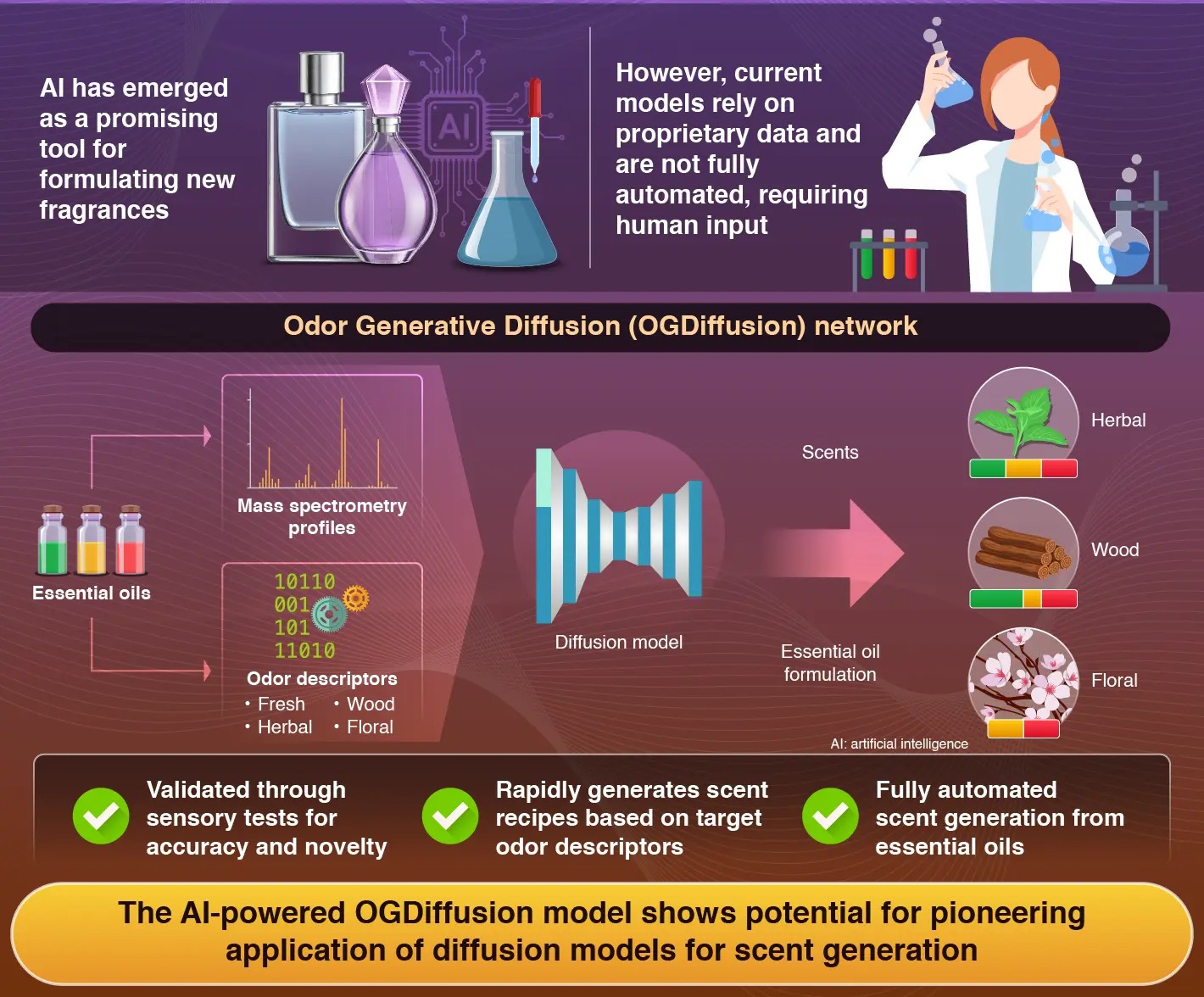
But subjective descriptions alone are not enough—OGDiffusion further incorporates mass spectrometry data, a chemical analysis technique that precisely measures the molecular weights and structures of compounds in a mixture. The research team trained AI to learn how to infer combinations that can reproduce a fragrance from both scent description words and mass spectrometry data.
To validate the performance of OGDiffusion, the researchers first conducted reverse generation experiments. They randomly added noise to the original mass spectrometry data, then fed this noisy data together with fragrance description words into OGDiffusion, asking it to “restore” the original mass spectral data. The results showed that OGDiffusion successfully recovered the original mass spectral structure with high accuracy, demonstrating that its understanding of fragrances is both reversible and stable.
Next, the research team tested whether OGDiffusion could generate physical scents based on compound fragrance descriptions. They had the AI generate fragrance formulas from multiple sets of descriptors and actually blended the corresponding essential oils. These scent samples were then given to 14 testers for a blind olfactory assessment, where they were asked to match each scent to its descriptor based on their olfactory experience. The results showed that most testers’ responses matched OGDiffusion’s original descriptors, with a correct identification rate significantly higher than random selection, further confirming the AI model’s high capability for descriptor reproduction.
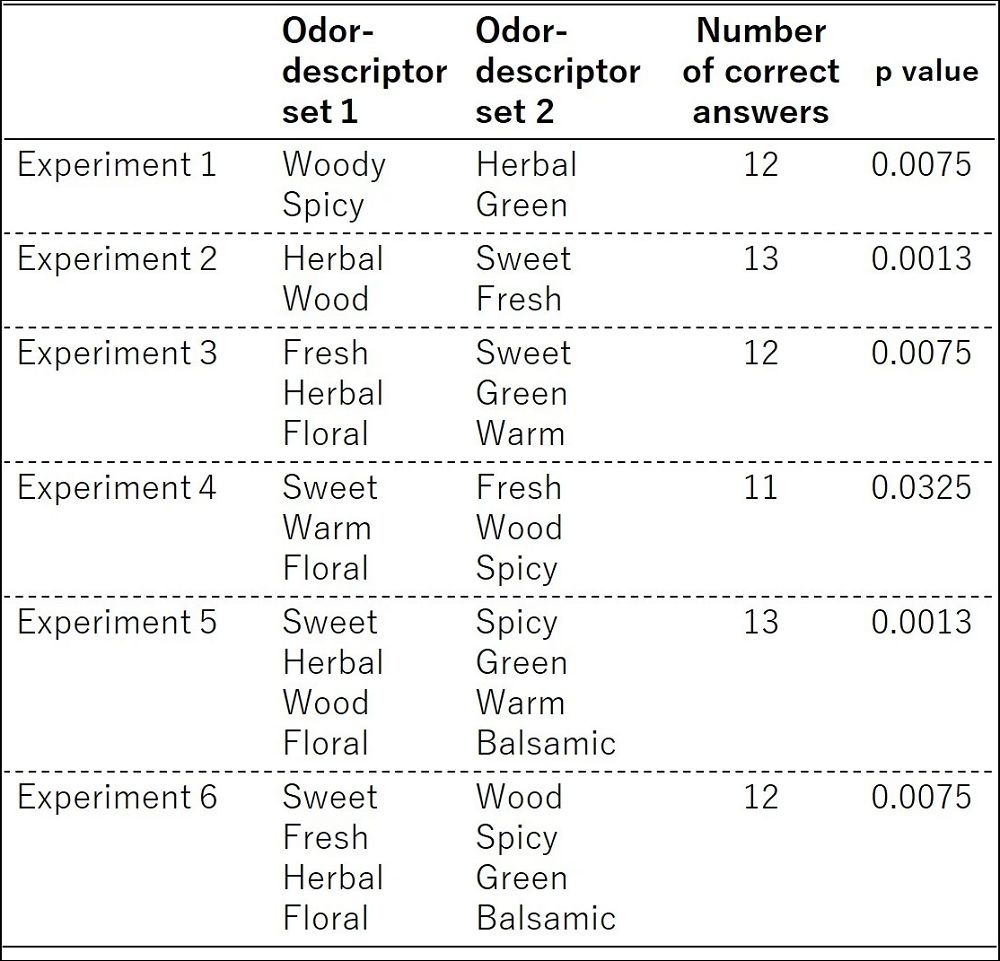
Additionally, the team designed a two-choice experiment: subjects were asked to smell two sets of fragrance samples—one containing a specific descriptive term and the other not—and choose which set better matched that term. In the experiment, subjects consistently made correct judgments, showing that the fragrances generated by OGDiffusion possess clear sensory distinctiveness.
AI fragrance creation is not a brand-new concept — there are already several machine learning–based scent generation tools on the market. However, most of these existing models rely on closed proprietary databases and interfaces designed for professional users, which keeps fragrance design within the realm of experts. The breakthrough of OGDiffusion lies in its openness and ease of use. It not only generates formulas automatically based on descriptive text but also outputs physical formulas composed of multiple essential oils, allowing users to actually mix the scents themselves — significantly lowering the barrier to creation. This means that even general product designers, entrepreneurs, and fragrance enthusiasts can develop their own custom scents without relying on a team of perfumers.
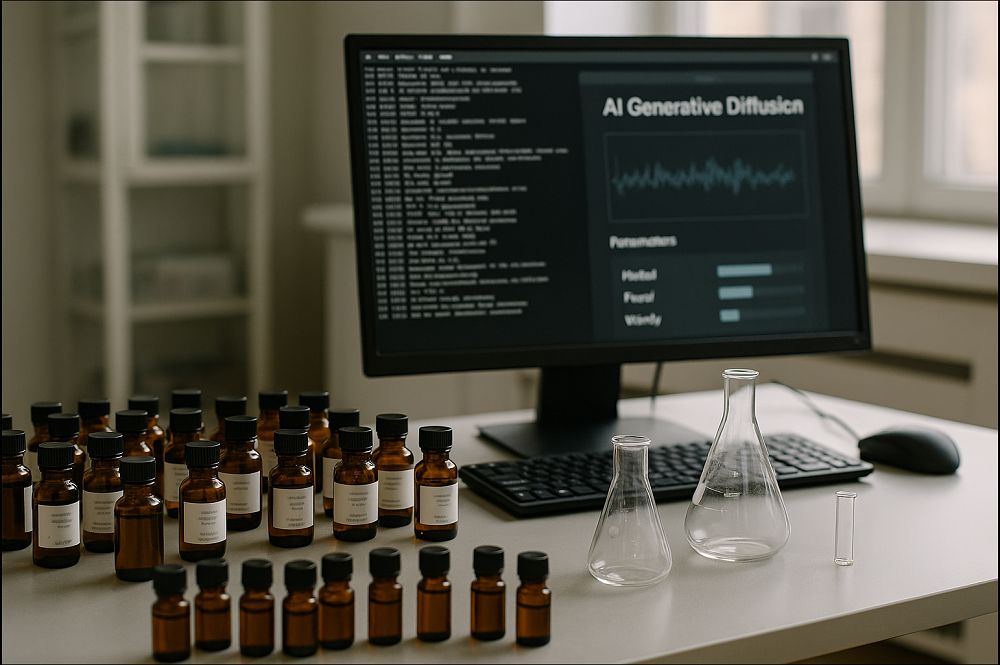
As Professor Nakamoto stated: “OGDiffusion achieves a highly efficient fragrance creation method through automated technology. Even users without professional backgrounds can design fragrances that match their intentions. This AI model is the first to handle fragrance generation in this way, opening up entirely new possibilities for AI applications in the field of fragrance design.”
The Future Potential of the AI Olfactory Revolution: From Scent Customization to Olfactory Interaction
The development of OGDiffusion is not only a technological innovation in AI applications, but also heralds the potential role of scent in future human-computer interaction. Imagine a future smart home system that automatically adjusts ambient fragrances based on the user’s mood or context, or personalized products that generate unique scent designs according to consumer preferences. Going further,AI combined with virtual reality (VR)Augmented reality (AR) or immersive entertainment may also enhance the level of experience by simulating scents.
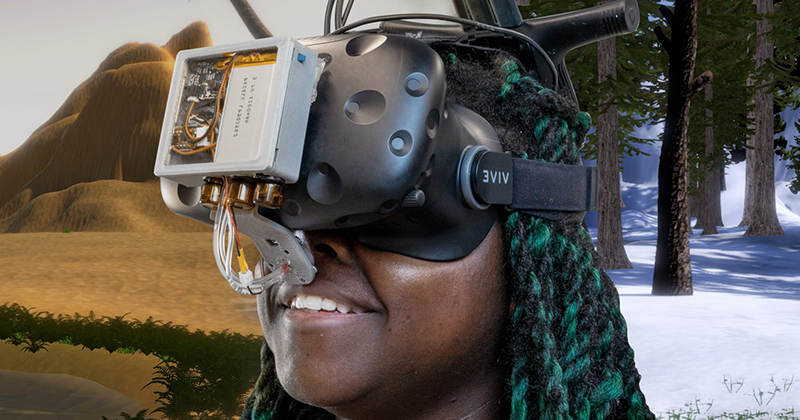
Models like OGDiffusion will become the foundational technology for building these digital fragrance worlds. Of course, this technology is still in its early stages, and actual commercialization still requires overcoming many challenges, such as the portability of fragrance generation devices, fragrance safety, and cost control—but OGDiffusion has undoubtedly demonstrated a new direction for AI applications in sensory design.
Source: KOCPC Chinese