


For the sake of eyesight, parents always remind their children not to get too close to the TV, but have you ever thought about the ideal distance? The distance between you and the TV is crucial for an immersive viewing experience. If you sit too close, you may notice small pixel-level flaws too easily, or your eyes may tire easily. If you sit too far away, you may miss some small details in the picture. This time, let’s learn to estimate the optimal viewing distance for TV.
What’s the ideal distance for watching TV?
What are the effects of watching TV too close?
Since TV images are constantly changing, if you are too close to the screen, your eyeballs must keep moving to see the complete picture. Over a long period of time, your eyeballs will easily become tired and create a sense of oppression. For elementary and middle school children, myopia is likely to worsen, while for the elderly, due to physical degradation, their ability to adjust the focus of their eyes is poor, their tear secretion is less, and they are more likely to feel tired. In addition, if you are too close to the TV, you will see book particles instead of the full range of images on the big screen, which greatly affects the viewing experience.
So how far away should I be from the TV?
If you want to know a fixed ideal TV viewing distance, there is no single recommended standard. Instead, various industry groups and manufacturers have given many suggestions and provided formulas for how much field of view the screen should cover, so that you can estimate the ideal distance yourself based on the size of the TV screen. At the same time, this distance can also provide a basis for using space when purchasing a TV.
For example, the two most frequently cited recommendations come from the Society of Motion Picture and Television Engineers (SMPTE) and THX, known for its high-fidelity audiovisual standards. SMPTE recommends that monitors should be kept at a distance that occupies a 30-degree viewing angle, which translates to approximately 1.62 times the size of the TV screen. The recommendation made by THX is to cover the minimum distance of 40-degree viewing angle and the maximum distance of 28-degree viewing angle. The converted distance is about 1.2 times to 1.8 times the size of the TV screen.
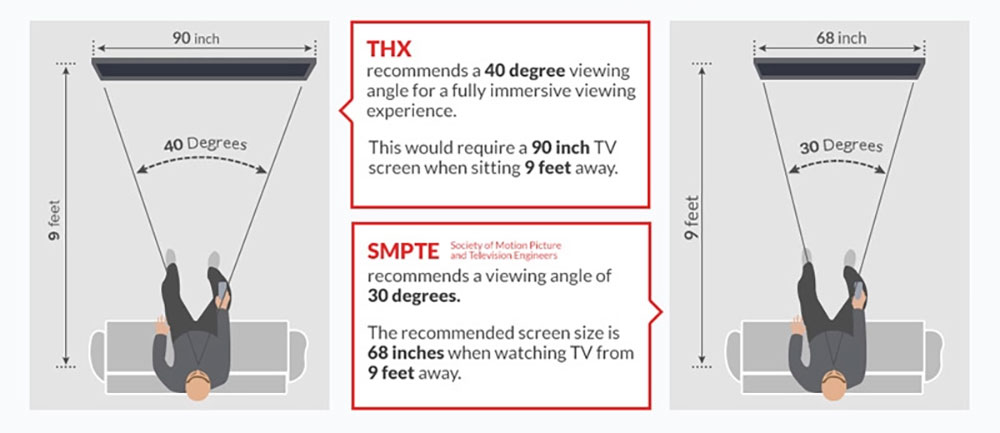
Using SMPTE standards, if you have a 55-inch TV, you should be sitting about 89.1 inches (7.42 feet, about 2.26 meters) away from the TV.
| TV size | SMPTE recommended distance | |
| foot | meter | |
| 30 inches | 4.1 | 1.2 |
| 35 inches | 4.8 | 1.46 |
| 40 inches | 5.5 | 1.68 |
| 45 inches | 6.1 | 1.86 |
| 50 inches | 6.8 | 2.07 |
| 55 inches | 7.5 | 2.26 |
| 60 inches | 8.2 | 2.5 |
| 65 inches | 8.9 | 2.71 |
| 70 inches | 9.5 | 2.9 |
| 75 inches | 10.2 | 3.11 |
| 80 inches | 10.9 | 3.32 |
| 85 inches | 11.6 | 3.54 |
If converted according to the THX standard, the author has also compiled the minimum and maximum distances of the current mainstream screen sizes for your reference:
| TV size | THX recommended distance (meters) | |
| minimum distance | maximum distance | |
| 30 inches | 0.91 | 1.37 |
| 35 inches | 1.07 | 1.6 |
| 40 inches | 1.21 | 1.83 |
| 45 inches | 1.37 | 2.06 |
| 50 inches | 1.52 | 2.29 |
| 55 inches | 1.68 | 2.51 |
| 60 inches | 1.83 | 2.74 |
| 65 inches | 1.98 | 2.97 |
| 70 inches | 2.13 | 3.2 |
| 75 inches | 2.29 | 3.43 |
| 80 inches | 2.44 | 3.66 |
| 85 inches | 2.59 | 3.89 |
Although the recommended distances of SMPTE and THX are both good, they are both formulated for movie theaters and therefore do not take into account the high-resolution characteristics of modern new TVs. If you want to have the highest enjoyment when watching UHD TV, you must sit relatively close to the screen, otherwise no matter how high the resolution is, it will be useless.
So for high-definition TV…
Sony is one of the few TV manufacturers to make viewing distance recommendations based on screen size and resolution. According to the company, the ideal distance for viewing a 4K TV is 1.5 times the vertical size of the screen, so if you have a 55-inch 4K TV, you’ll ideally need to sit about 1 meter away. Likewise, according to Sony, the recommended distance is three times the vertical screen size for HD and FHD TVs and six times for SD TVs. Since Sony doesn’t provide viewing distances for 8K TVs, the recommended values for 4K TVs are a good guide. Other brands such as Panasonic and Sony have the same distance recommendations, as shown in the table below:
| TV size | vertical size | Recommended distance between Sony and Panasonic (meters) | ||
| 4K | HD | SD | ||
| 32 inches | 15.7 inches | 0.61 | 1.22 | 2.44 |
| 40 inches | 19.6 inches | 0.73 | 1.49 | 2.99 |
| 43 inches |
21.1 inches |
0.79 | 1.58 | 3.17 |
| 50 inches | 24.5 inches | 0.94 | 1.89 | 3.78 |
| 55 inches | 27 inches | 1.04 | 2.07 | 4.15 |
| 60 inches | 29.4 inches | 1.13 | 2.26 | 4.51 |
| 65 inches | 31.9 inches | 1.22 | 2.44 | 4.88 |
| 70 inches | 34.3 inches | 1.31 | 2.62 | 5.24 |
| 75 inches | 36.8 inches | 1.4 | 2.8 | 5.61 |
| 80 inches | 39.2 inches | 1.49 | 2.98 | 5.97 |
| 85 inches | 41.7 inches | 1.58 | 3.17 | 6.34 |
TCL’s recommendations for HD TVs are similar to Sony’s, but not identical, as the company recommends using a range rather than a fixed distance. Additionally, for smaller sizes, they require viewers to sit closer to the TV. TCL doesn’t share viewing distances for 4K TVs, but note that you can choose to have a better viewing experience closer than the HD TVs listed in the table below:
| TV size | TCL recommended viewing distance for HD TVs (meters) |
| 40 inches | 0.91 – 1.6 |
| 43 inches | 1.1 – 1.65 |
| 50 inches | 1.28 – 1.92 |
| 55 inches | 1.49 – 2.1 |
| 60 inches | 1.52 – 2.29 |
| 65 inches | 1.65 – 2.47 |
| 70 inches | 1.77 – 2.67 |
| 75 inches | 1.92 – 2.87 |
| 80 inches | 2.04 – 3.05 |
| 85 inches | 2.16 – 3.23 |
The downside to the recommendations given by Sony, Panasonic, and TCL is that if you watch lower-resolution content on a high-resolution TV, it’s easy to notice pixel-level flaws on the screen. This is especially true when watching cable, DVD, YouTube, and older movies. It’s especially obvious on 4K TVs. This is definitely not a problem with the TV itself, so everyone should pay attention to it.
Source: KOCPC Chinese