


WWDC 2026 officially ended yesterday (June 8). Apple released new operating systems such as iOS 27 and macOS 27. Just today, MKBHD (Marques Brownlee), the world’s most influential technology YouTuber, released a 7-second high-quality concept video on

What’s hidden in the video? Frame by frame teardown
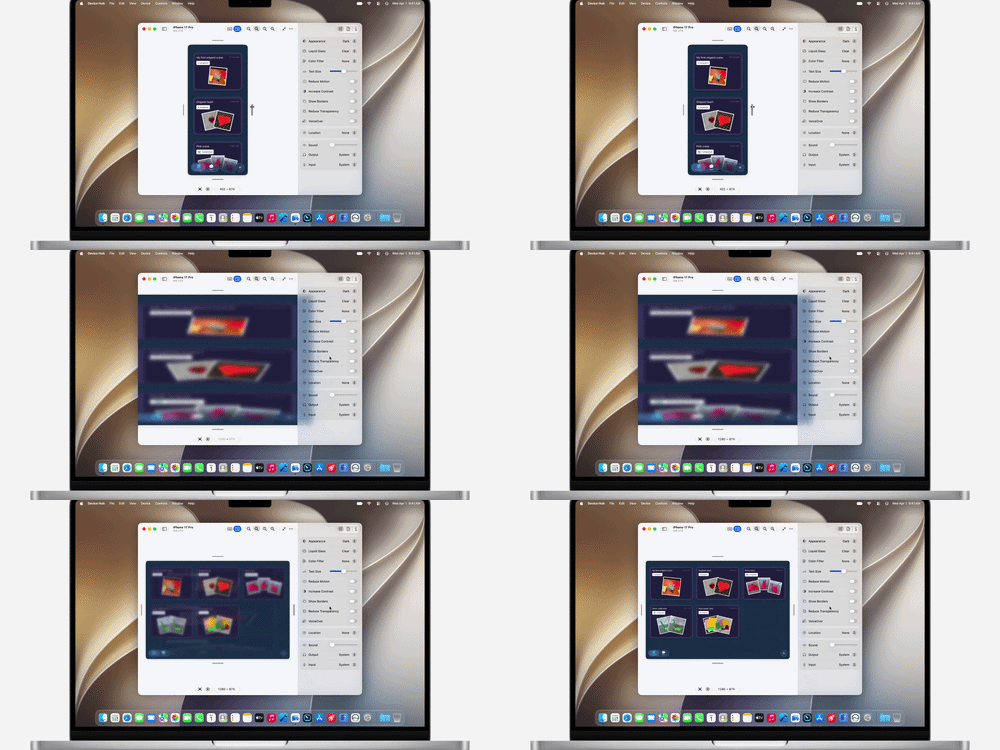
The 7-second video shows a macOS desktop with an application window running a simulated device labeled “iPhone 17 Pro” and the system version showing “iOS 27.0.” The screen ratio of the simulated phone is extremely narrow and long (402 x 874), which is the typical size of the external screen when the folding phone is closed.
Tell me you have a foldable coming without telling me you have a foldable coming pic.twitter.com/5gs3XKP6s5
— Marques Brownlee (@MKBHD) June 9, 2026
What’s even more clever is that the App displayed on the simulated screen is an “Origami” application, and items such as “My first origami crane” and “Origami heart” appear in the list. Origami folds in pairs, this may be a hint.
Several key details also appeared in the video. When the mouse stretches the screen, an animation similar to the flashing of the inner screen appears, and the screen ratio changes from a straight version to a wide version of a tablet:
iOS 27 confirmed to include foldable iPhone support
MKBHD’s hints are not unfounded. According to WWDC 2026Developer documentation, iOS 27 has indeed added system features tailored for foldable iPhones. first isNew adaptive layout API. SwiftUI and UIKit have received a new adaptive layout API, allowing developers to design interfaces for different screen sizes. This means that the same app can run in compact mode with a 5.5-inch screen when the iPhone is closed, and automatically switch to full-screen mode with a larger 7.8-inch screen when unfolded. This kind of dynamic switching has never been seen on previous iPhones.
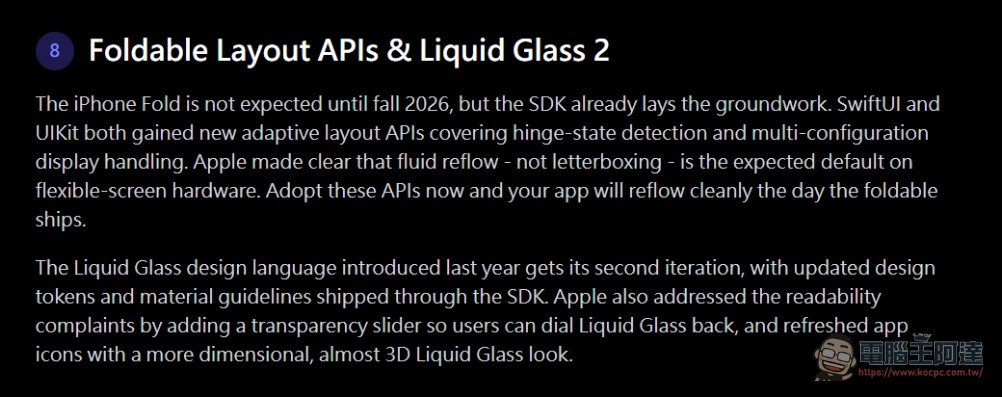
followed bySplit-screen multitasking function. iOS 27 adds the Split-Screen App feature, which allows two apps to be run simultaneously on the large screen of a folded iPhone. This is the first time this has appeared on the iPhone. In the past, it was only supported by the iPad.
A latecomer to the folding market may be the biggest disruptor
Apple entered the foldable phone market much later than its competitors. Samsung has launched multiple generations of Galaxy Z Fold and Z Flip, and OPPO, vivo, Xiaomi, and Huawei also have mature folding product lines. However, Apple’s consistent strategy is to “strike later” and wait for the technology to mature before entering with higher-quality products.
According to rumors, Apple’s foldable iPhone has several key differentiators: an OLED screen with no visible creases (a problem that all current Android foldables cannot fully solve), structural strength brought by titanium frames, and iOS 27’s software ecosystem tailored for the foldable form. Although Samsung’s foldable phones have mature hardware, the adaptation of Android apps to large screens has always been a pain point.
Apple has been developing folding iPhone technology since 2018. It chose to enter the market after rivals such as Samsung and OPPO launched multiple generations of folding machines to ensure that issues such as screen creases and hinge durability seem to have been completely resolved. Now the SDK of iOS 27 seems to have laid the software foundation for folding devices, and the debut of the folding iPhone seems to have entered the final countdown. If the rumored September release schedule remains unchanged, there will be less than three months left before Apple officially announces the first foldable iPhone. Is MKBHD overthinking it? Or is it hinted by Apple itself? Let’s all wait and see.
Source: KOCPC Chinese