


Recently, there is news in the industry that Intel is about to increase the price of CPUs., for friends who want to build a new gaming computer, they may wonder whether they should build it soon or wait for the release of Intel’s 13th generation processor. After all, there are only about two or three months left before the possible release. Recently, China EP Extreme Gamer Hall tested the performance of i9-13900K QS on multiple games. It should be able to give you a good reference. I will summarize it below.
Actual measurements show that the gaming performance of the unreleased i9-13900K is on average 5% faster than that of the i9-12900KF
Although the i9-13900K QS is not yet an official version, its performance is very close. It is equipped with 8 P cores and 16 E cores, with a total of 24 cores and 32 threads. Featuring 36MB L3 cache and 32MB L2 cache for a total of 68MB, plus a base TDP of 125W (PL1) and an MTP of 250W.
The test platform used by China EP Extreme Player Hall:
- ASUS ROG Maximus Z690 Extreme
- T-Force Delta 32 GB (16 GB x 2) DDR5-6400 memory
- 360mm AIO radiator
- Coolermaster Silence II 1500W power supply,
- MSI GeForce RTX 3090 Ti 24GB graphics card
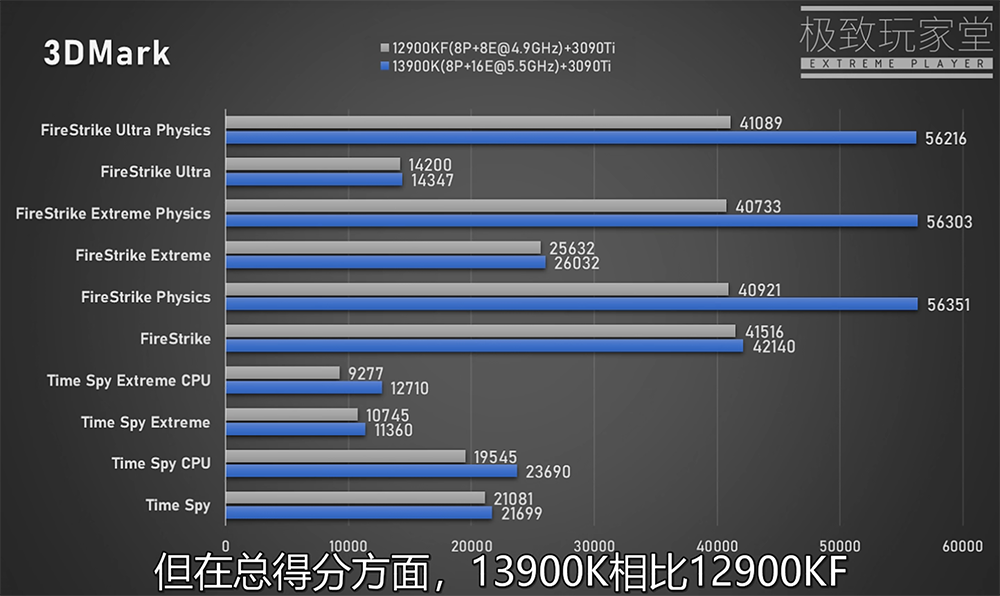
Let’s first look at the 3DMark running scores. Because the i9-13900K has 8 more small cores, its pure CPU and physical scores are much higher than the i9-12900KF. The overall score is not that big of a difference. The i9-13900K is only about 1~5% faster:
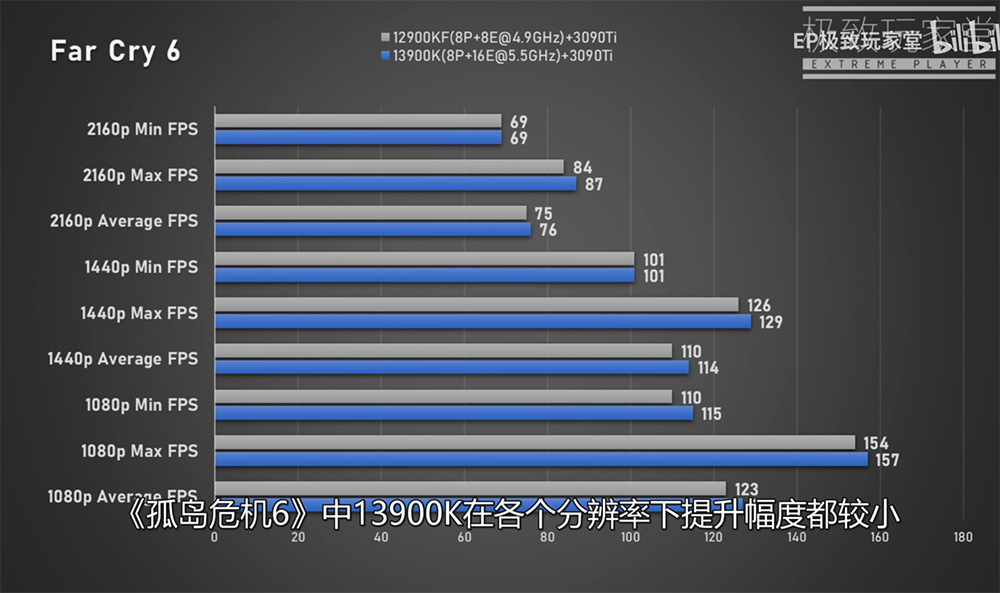
No matter which resolution is used in “Far Cry 6”, the improvement is relatively small. This is mainly due to the fact that the DUNIA engine used by the game is very old, so the CPU encounters a bottleneck after reaching a certain level:
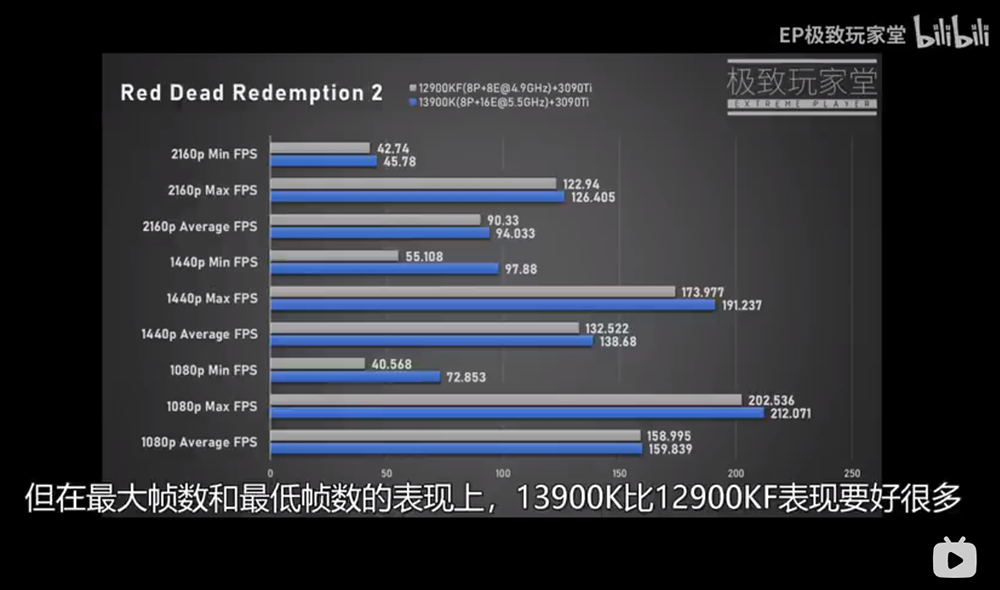
Although the average FPS performance of each resolution in “Red Dead Redemption 2” is similar, in the maximum and minimum FPS parts, the i9-13900K is much better:
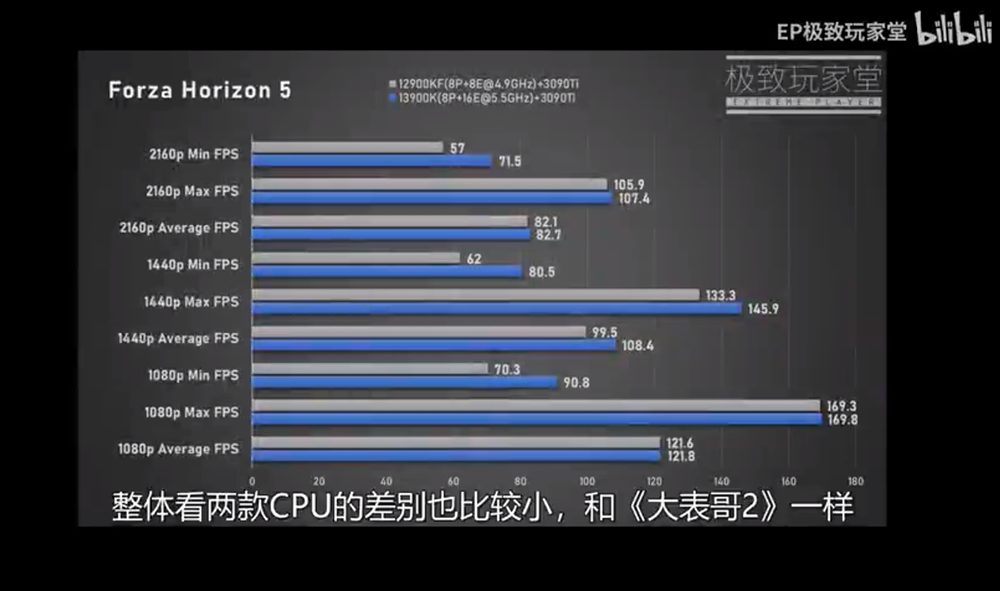
In the game “Forza Horizon 5”, the difference between the two processors is basically not big, except that the 1440p resolution i9-13900K performs better:
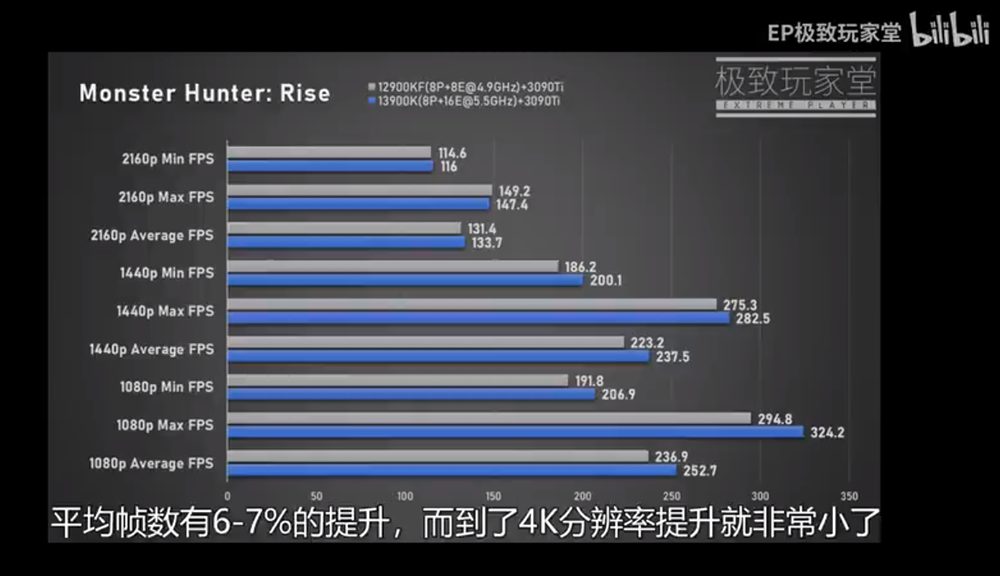
In “Monster Hunter: Rise” in 1080p and 2K resolution, the average FPS of i9-13900K is 6%~7% higher than that of i9-12900KF, but the 4K resolution is not much different:
The picture below is a test summary table of all games.Please click me to watch the full video:
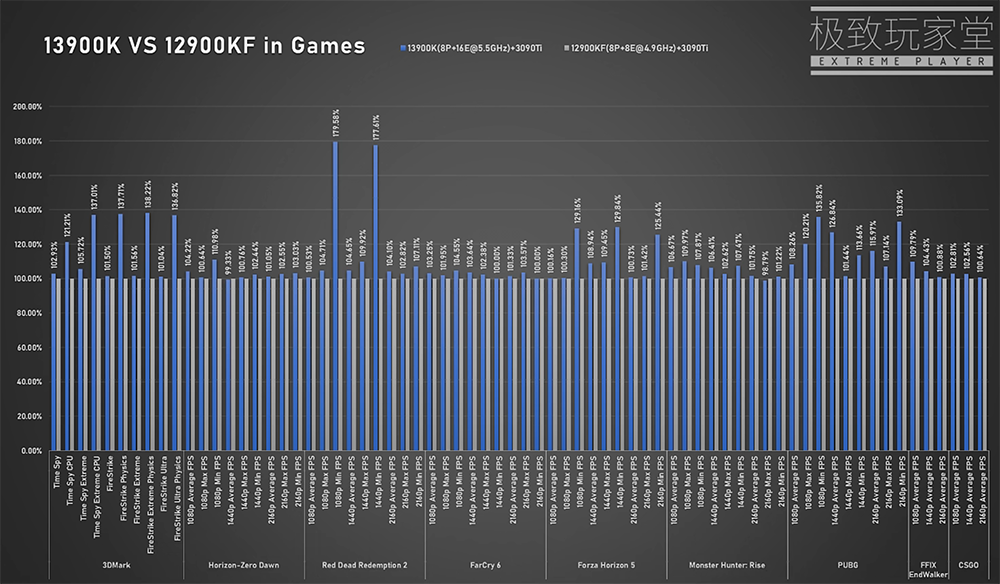
Overall, average FPS section:
- In 1080p resolution, Intel Core i9-13900K has an average performance improvement of 4.22% compared to i9-12900K
- In 1440p resolution, Intel Core i9-13900K has an average performance improvement of 6.97% compared to i9-12900K
- In 2160p resolution, Intel Core i9-13900K has an average performance improvement of 3.30% compared to i9-12900K
- Average i9-13900K is 4.83% faster across all resolutions
Minimum FPS section:
- In 1080p resolution, the minimum FPS of Intel Core i9-13900K is 27.93% faster than that of i9-12900K
- In 1440p resolution, the minimum FPS of Intel Core i9-13900K is 21.83% faster than that of i9-12900K
- In 2160p resolution, the minimum FPS of Intel Core i9-13900K is 12.82% faster than that of i9-12900K
- Average i9-13900K lowest FPS across all resolutions is 20.86% faster
Highest FPS section:
- In 1080p resolution, the maximum FPS of Intel Core i9-13900K is 6.29% faster than that of i9-12900K
- In 1440p resolution, the maximum FPS of Intel Core i9-13900K is 4.42% faster than that of i9-12900K
- In 2160p resolution, the maximum FPS of Intel Core i9-13900K is 2.58% faster than that of i9-12900K
- Average i9-13900K top FPS 4.43% faster across all resolutions
In addition, the power consumption performance of each resolution is shared:
- In 1080p resolution, Intel Core i9-13900K consumes 19.1% more power
- In 1440p resolution, Intel Core i9-13900K consumes 19.8% more power
- In 2160p resolution, Intel Core i9-13900K consumes 26.2% more power
China EP Extreme Player Hall has also conducted software performance benchmarks before.Interested readers can click me to read。
Source: KOCPC Chinese