


In this era of popular online video streaming platforms, the way many people watch movies at home has changed significantly. Audiences who used to be willing to pay for DVDs and Blu-ray discs have gradually switched to using mobile phones or other devices to watch audio and video programs on streaming platforms as wireless networks become faster and more affordable. As the most important manufacturer in the PC industry, Intel seems to have discovered this situation. But they surprisingly took a rather radical approach, which is to directly let the latest generation of Alder Lake processors give up the ability to support genuine Blu-ray discs. The key lies in a security technology in the CPU, which was disabled by Intel. This led to the so-called reality that “the latest processors cannot play 4K Blu-ray discs”:
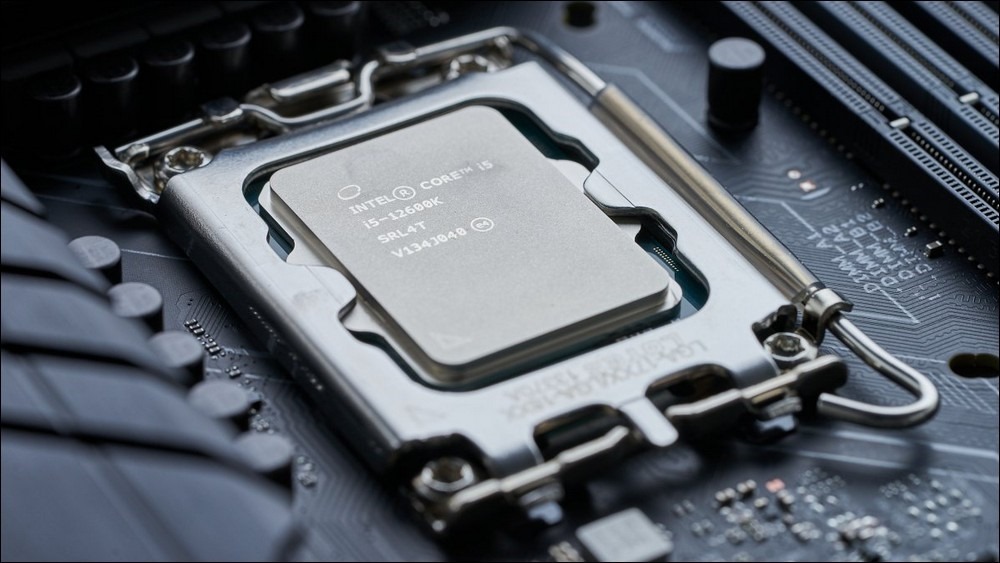
▲Although there are not many users who still watch Blu-ray movies on their computers, they are not completely absent. Intel’s cut directly stops the playback function completely (Image source)
Blu-ray discs have been accompanying many multimedia audio and video enthusiasts for a long time. Its advent has directly led to the evolution of video disc content. After upgrading from limited-capacity DVD discs to larger-capacity Blu-ray discs, film companies have also followed suit and provided higher-resolution and more refined audio-visual content for larger-capacity DVD discs.
However, playing Blu-ray discs on personal computers is subject to many limitations. The improvement of movie resolution requires that the PC platform’s ability to encode and decode movies must also be improved. In addition, Blu-ray disc introduces digital copyright management DRM technology, AACS technology, etc. to protect the legal rights of copyright owners. In order to legally play DVDs with genuine content, the Blu-ray Association recommends that the processor needs to support SGX technology, and the GPU needs to support the newer HDCP 2.2 in order to watch Blu-ray movies on your computer:

▲You can directly watch 4K or higher quality movie carriers without using the Internet. Currently, there are only Blu-ray discs (Image source)
These strict play restrictions have caused many players to turn to other players for assistance. For example, Sony’s Play Station 3 and later consoles can support the playback of Blu-ray discs. Compared to playing Blu-ray discs on a computer, buying a PS5 to watch Blu-ray discs is more economical and saves trouble:

▲Sony is great, watching Blu-ray with PS5 is super good (Image source)
Is the PC so unfriendly to Blu-ray? Not really. When Intel launched the Skylake series of processors in 2016, it added a technology called SGX (Intel Software Guard Extensions) to the processor. This technology was not yet linked to Blu-ray discs, but it was later supported by the Kaby Lake series of processors together with HDCP 2.2, which truly became the first processor to support Blu-ray playback:
▲Intel has added SGX technology since its 7th generation processors, and the processor has the opportunity to support Blu-ray playback (Image source)
Starting from Intel’s 7th generation processors until the 10th generation Comet Lake processors, Intel processors launched during this period all maintained support for Blu-ray discs.
Today, Intel SGX technology is determined to disappear on Alder Lake processors, which is equivalent to Intel’s decision to officially cut off the Blu-ray playback function. No matter how good a graphics card a user plans to buy or how good an HDMI transmission cable they use, Blu-ray movies cannot be played back as smoothly as before: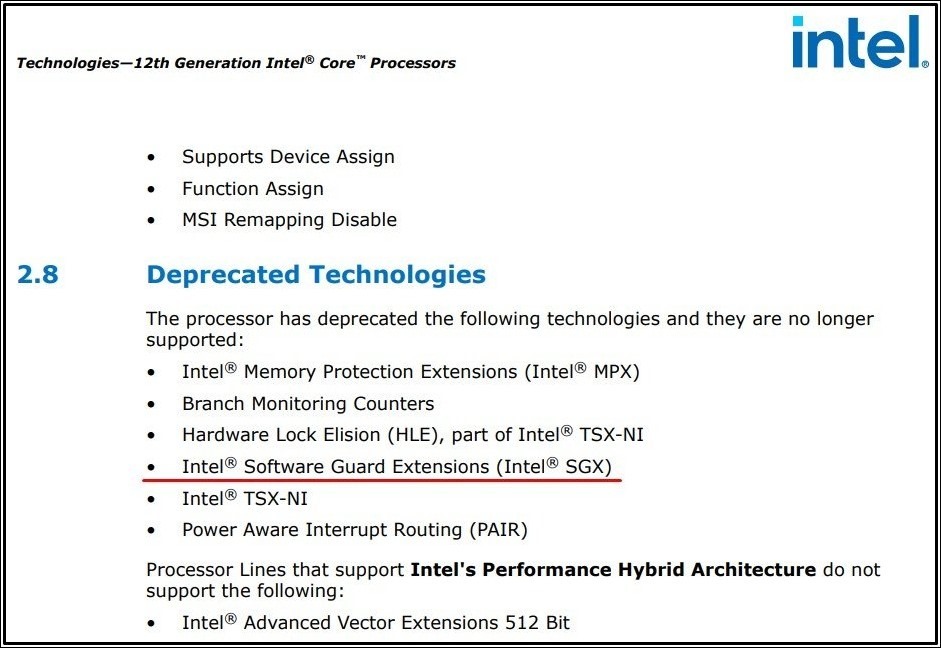
▲Intel SGX technology may have discovered too many problems and has reached the point where it has to be abandoned (Image source)
Intel has not yet provided any explanation for this decision. But it may be speculated that the removal of SGX technology was due to product security concerns.
According to officially announced product security issues and attacks, it is not difficult to see that many incidents are closely related to vulnerabilities in SGX technology. For example, the Prime+Probe attack in 2017 used this vulnerability to directly obtain L3 Cache data; the Specter-like vulnerability attack discovered in 2018; the Enclave attack discovered in 2019, etc., these events have shown that Intel’s processor security has been greatly tested.
Therefore, for security reasons, although it is not allowed to remove SGX technology, it can prevent various security attacks caused by SGX, which is still beneficial in comparison.
Because Intel directly removed the SGX technology, the new processor does not support Blu-ray playback function. PowerDVD development company CyberLink is also at its wits’ end;Consumers can only be advised to switch to older processors, such as 7000, 8000, 9000, 10000 series. More importantly, do not update to Windows 11 to avoid other compatibility issues that may occur due to driver updates:
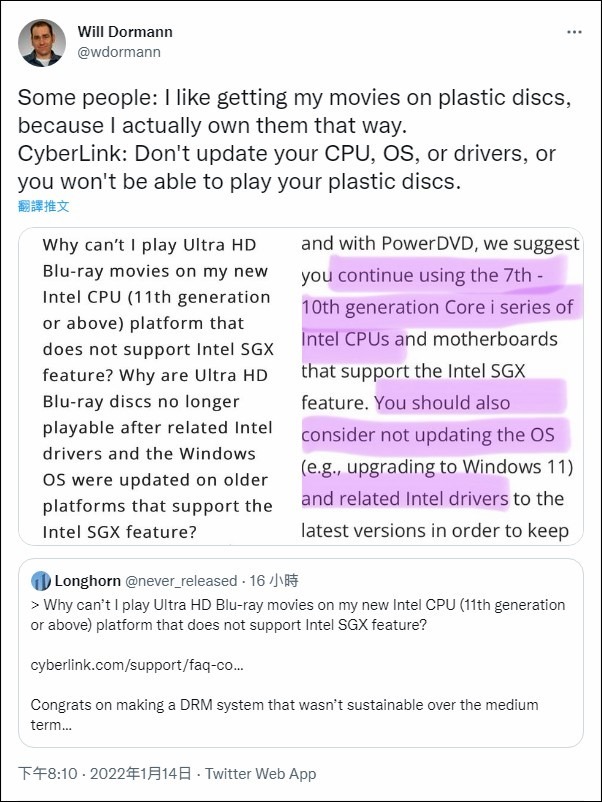
▲The solution provided by CyberLink on the official website is also very negative. Considering that this is a CPU support issue, in addition to switching to an old processor, it must also maintain the Windows 10 system (Image source)
All in all, if users who still own physical Blu-ray movie discs and happen to have bought an Alder Lake platform computer, buying the latest PlayStation 5 game console and connecting it to a TV will be the most comfortable solution. If you have to insist on watching it on a computer, the best solution may be piracy.
Source: KOCPC Chinese