


Currently, services like “API proxy stations” are heavily advertised across major social media platforms. From low-cost tokens sold on Taobao and Xianyu, to Justin Sun’s high-profile promotion of B.AI on X (nicknamed “Sun-ge”), and various platforms advertising “30% cheaper than official” and “one key for all models,” API proxy stations have become the hottest and most controversial sector in the AI economy. An investor told media that a leading proxy project can generate up to NT$22.5 million (5 million RMB) in monthly revenue, with gross margins approaching 50%, claimingMore profitable than drug dealingHow exactly is this money made? Below, we break down the profit-making methods of transfer stations from five technical perspectives.
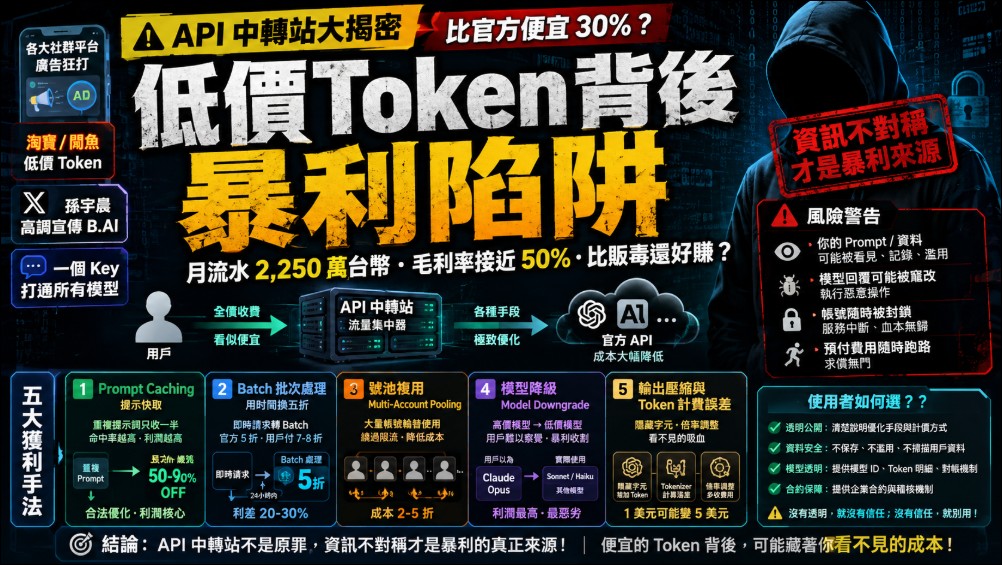
Prompt Caching: The Most Essential Legitimate Optimization
This is the most important and most underestimated arbitrage method. Official APIs from OpenAI, Anthropic and others all support Prompt Caching: when system prompts or fixed context content repeat in requests, the official providers charge only half or even less (approximately 50–90% off). This mechanism was originally intended to help developers reduce the cost of repetitive computations, but intermediaries turn it into a source of profit.
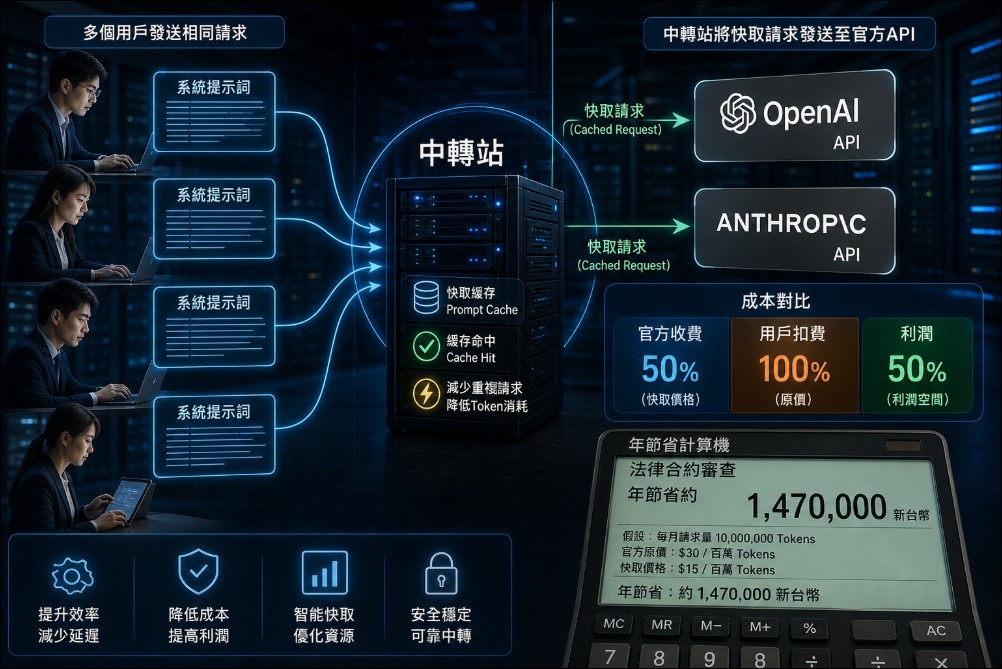
The relay station functions like a traffic aggregator. When numerous users send similar requests—especially in Agent scenarios where System Prompts are nearly identical—the relay station can enjoy extremely high cache hit rates on the backend, while the frontend still charges at full price. The difference in between is pure profit.
A quick calculation: for a legal contract review product that processes approximately 15 million input tokens and 6 million output tokens per day at a law firm, standard API calls would cost approximately $81,000 USD (about NT$2.43 million) per year. With Prompt Caching combined with Batch processing, this can be reduced to $22,000–$32,000 USD (about NT$660,000–960,000) per year.
In other words, through legitimate technical optimization alone, there’s more than 60% potential for cost reduction, and this margin is the core source of profit for transfer stations.
Batch Processing: Trading Time for 50% Space Savings
The official API offers a Batch mode that allows asynchronous batch submission of large numbers of requests at 50% of the instant API rate, but results are returned within 24 hours. This mechanism was originally designed for off-peak tasks that don’t require immediate responses.
The relay station works by batching and scheduling users’ real-time requests, sending them to the official API in batch mode to get 50% off pricing, then passing the savings back to users at 70-80% of the real-time API rate (depending on the platform). The difference is profit. Users get a cheaper price than the official rate, the relay station earns a 20-30% margin, but users don’t realize they’re trading batch latency for the discount.
This is particularly common in non-Agent scenarios (such as batch content generation, data analysis), where users have lower sensitivity to response speed.
Multi-Account Pooling: The Most Common Gray-Area Tactic
This is currently the most mainstream and controversial technique in the market. The relay station establishes a large number of official API accounts: sources include enterprise free tiers, multiple credit card registrations, and accounts from lower-priced regions (such as Turkey, India, etc.), forming an “account pool.” When one account’s quota is exhausted or triggers a Rate Limit, the system automatically switches to another account.
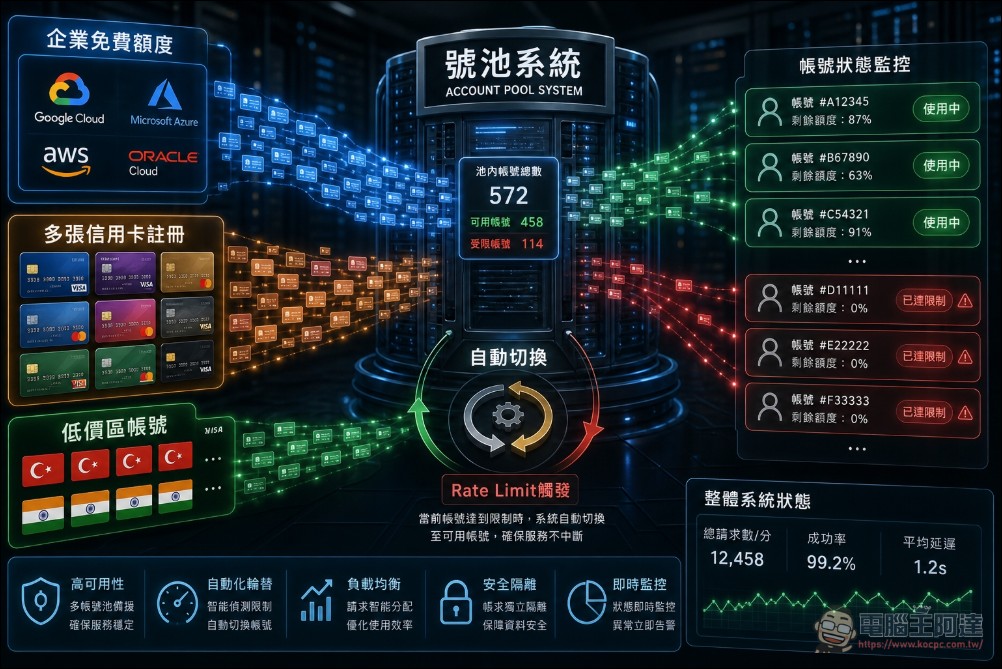
This method can effectively bypass official rate limits, but it also carries the risk of account bans. DoNews’s analysis categorizes this as the second-tier mainstream form of intermediary services: utilizing overseas enterprise free programs and multi-account reuse distribution, reselling at 20% to 50% of official prices. A Claude Code Max enterprise account with a $200 monthly rental can be split into a dozen or more sub-keys distributed to different users, charging each user several hundred dollars, with total revenue reaching $2,000 to $5,000.
However, this model typically violates the model provider’s terms of service. Anthropic’s commercial terms explicitly restrict unauthorized resale of services and prohibit reverse engineering or copying services, among other practices. Accounts may be suspended at any time, and the risk of service disruption is extremely high.
Model Downgrade: The Worst Fraud
This is the third tier, and the most shameless method. Users think they’re calling Claude Opus (Anthropic’s most expensive model), but the proxy actually routes requests to cheaper Sonnet or Haiku, or even uses other vendors’ models to impersonate it. Since LLM responses inherently have randomness—quality of answers to the same question can vary at different times—users can barely detect the difference, while the proxy rakes in massive profits.
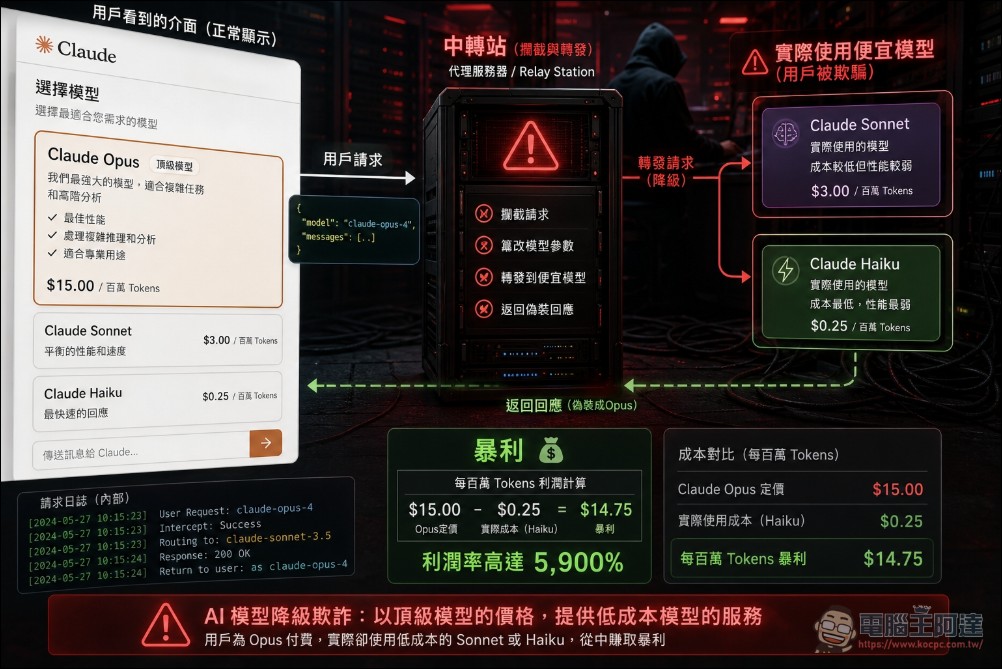
This is also the final tactic many transfer stations use before disappearing with the money. They start by using genuine models to build reputation, then after accumulating a large number of prepaid users, gradually redirect traffic to cheaper models to cut operating costs. By the time users start complaining “the model has gotten dumber,” the platform has already harvested all the profits and vanished.
Without service providers offering transparent upstream request logs, model ID verification, token usage details, and billing reconciliation, regular users can hardly confirm that they are actually getting advanced models.
Output Compression and Token Calculation Errors: The Invisible Drain
This is the most covert profit-making method. The relay station exploits the gray area of token-based billing, covertly profiting by adjusting the billing multiplier. The stated rate is 1 dollar per 1 million tokens, but the actual charge can be as high as 5 dollars.
There are several specific manipulation methods: First, inserting hidden characters into API responses to inflate token counts. Second, exploiting the fact that Chinese characters are counted differently from English in certain tokenizers to overcharge. Third, directly modifying the billing rate multiplier settings—when the backend runs on open-source gateway systems like One API or New API, the admin panel already has multiplier configuration capabilities. Users see “how many tokens were used” but have no visibility into “how much each token was actually charged.”
Information asymmetry is the real source of excessive profits.
What all five techniques above have in common is that the intermediary sits between the user and the official, controlling information invisible to the user.
A relay station doesn’t just “forward packets” for you—it can see the complete plaintext request and response content. Your prompts sent to the model, project source code, database schemas, customer data, and business plans all theoretically pass through the relay server. In April 2026, an article titled “Your Agent Is MineIn their research, they analyzed LLM API Routers as a supply chain attack surface, finding that some Routers inject malicious code, and even cases where Ethereum private keys placed by researchers were withdrawn.
This risk is further amplified in the AI Agent era. When tools like Cursor, Claude Code, and OpenCode gain the ability to execute local commands, modify files, and control browsers, intermediaries can not only see the requests but also modify the model’s responses—the risk escalates from “data being seen” to “response content being tampered with.”
How should users choose?
Running an API gateway isn’t inherently wrong. When enterprises use it internally to manage multi-vendor APIs, track costs, and handle model routing, that’s reasonable architecture. Prompt caching and batch processing can significantly reduce costs, but the real question is whether those optimization benefits are fairly passed on to end users. If a service provider clearly tells you which optimization methods it uses, how it prices things, whether it stores data, whether it does model routing, and offers enterprise contracts with audit mechanisms, that’s closer to a legitimate AI gateway. But if a platform only advertises low prices with unclear origins, no terms of service, and no security documentation, that cheap token rate might hide costs you can’t see. My recommendation if you’re going to choose one is to go with a reputable, well-known gateway like OpenRouter, which tends to be more reliable and even offers some free models.
Source: KOCPC Chinese