


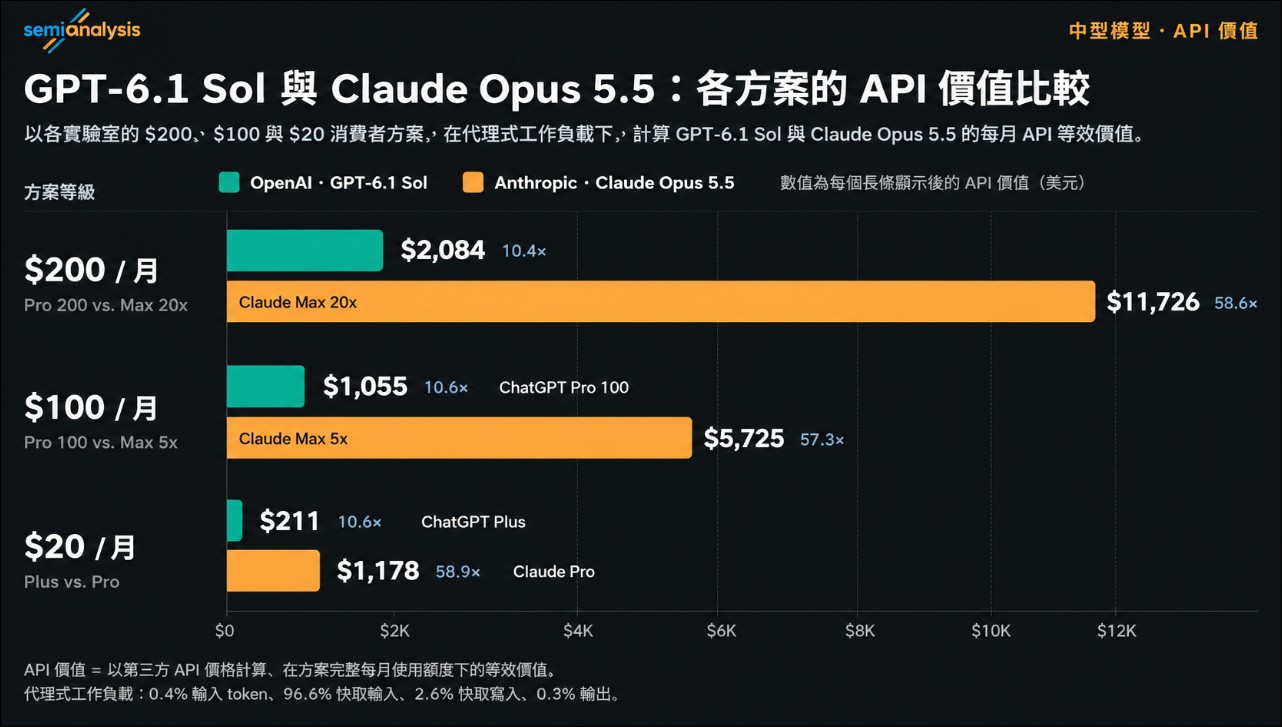
OpenAI and Anthropic, the two AI giants, will stop at nothing to capture more user subscriptions. Beyond releasing newer and more powerful models, whether a subscription plan offers enough “perks” is also one of the things consumers care about most. Research firm SemiAnalysis ran practical usage tests on the subscription plans of Anthropic, OpenAI, Meta, Cursor, Cognition, and others, reaching a startling conclusion: at the same monthly fee, the Anthropic Claude subscription provides more than 5 times the API-equivalent value of the OpenAI ChatGPT subscription for agentic workloads.
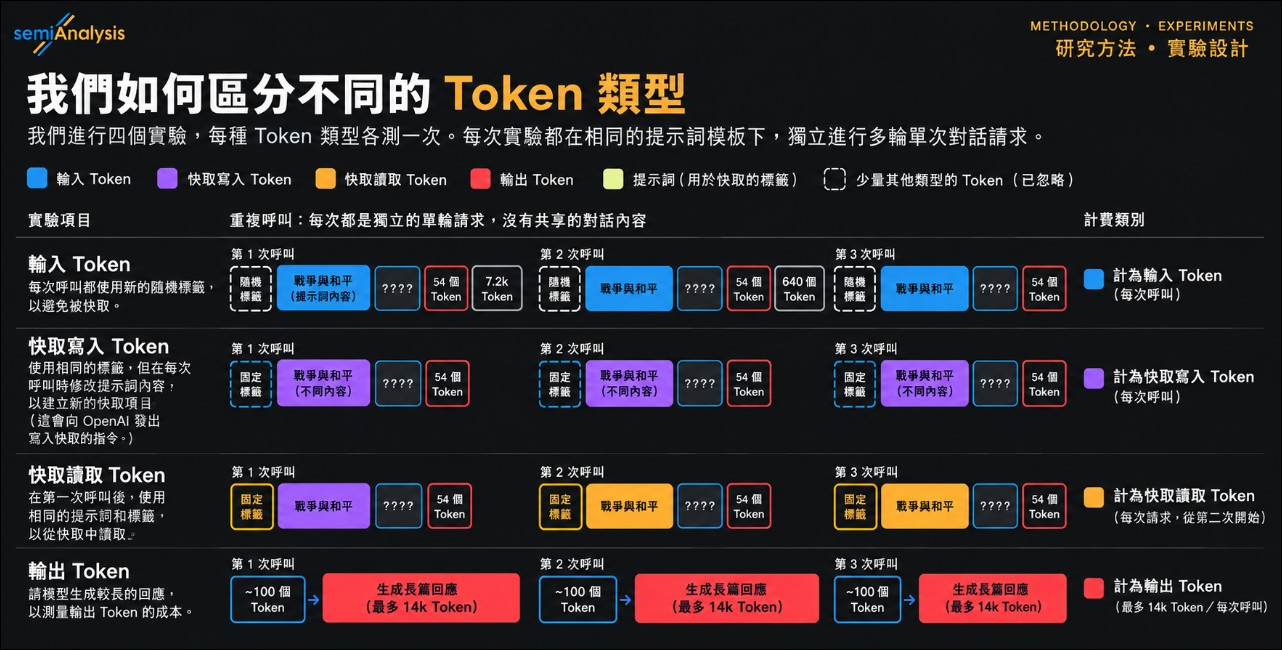
Testing method: isolate each type of token and see how the meter jumps.
Subscription plans do not disclose the usage cost for each model and each token type. They show only a 0 to 100% usage meter and two time windows, 5-hour and 7-day. SemiAnalysis’s approach was to design isolation experiments: each request maximizes only one token type (input, cache write, cache read, or output) while minimizing the rest, then records how much the provider’s meter moves, infers how much quota is consumed per million tokens, and converts that into “API-equivalent value” using current API unit prices. To avoid the model refusing to process meaningless text blocks, the input experiments use passages from War and Peace; the output experiments use technical prose to force the model to generate long outputs. Each interval between meter movements counts as one “step,” and the accumulation is repeated until the error converges to within ±5% before the numbers are reported.
This method also unexpectedly caught evidence of a provider statically adjusting limits. When SemiAnalysis tested three identical subscriptions from the same provider, it found that one account’s limit was about 20% lower, and that account was particularly old, which at one point made the team suspect that the provider’s limits varied with account age. After contacting the provider, they confirmed that the account had happened to be caught in a “very small” usage limit A/B test. The provider emphasized that it had not lowered limits across the board, and that the test’s purpose was “how to better balance when users hit the limit.” This episode also proves two things: providers can silently change subscription limits at any time, and SemiAnalysis’s measurement sensitivity is sufficient to detect such changes.
Opus 5.5 vs. GPT-6.1 Sol: Where Does the 5x Gap Come From?
In comparisons between the two companies, the main focus is on the mid-tier models that most people use as their daily drivers, where the gap is most extreme. In SemiAnalysis’s testing of Opus 5.5 versus GPT-6.1 Sol, the API-equivalent value of Anthropic’s subscription tiers is about 5 times that of OpenAI’s. Some people will protest on OpenAI’s behalf: GPT-6.1 Sol’s API price per token is inherently cheaper than Opus 5.5’s, so comparing API-equivalent value is unfavorable to OpenAI.
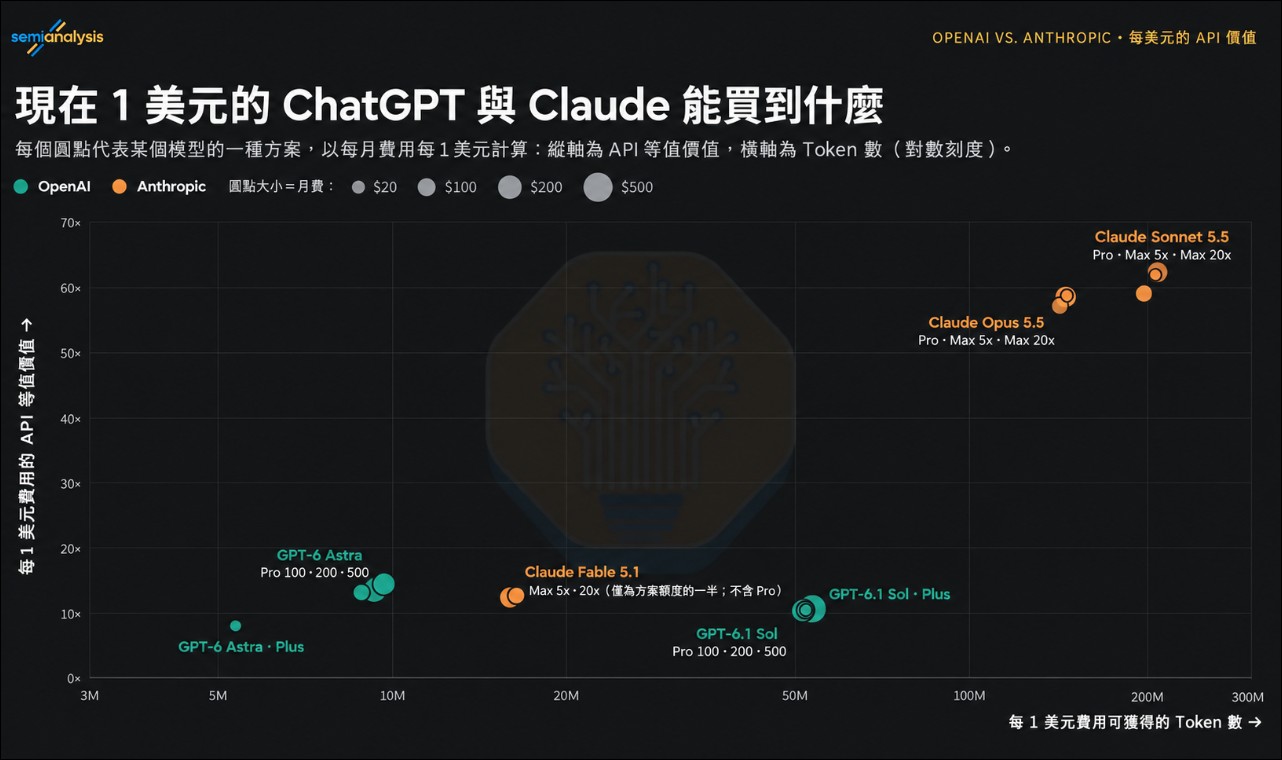
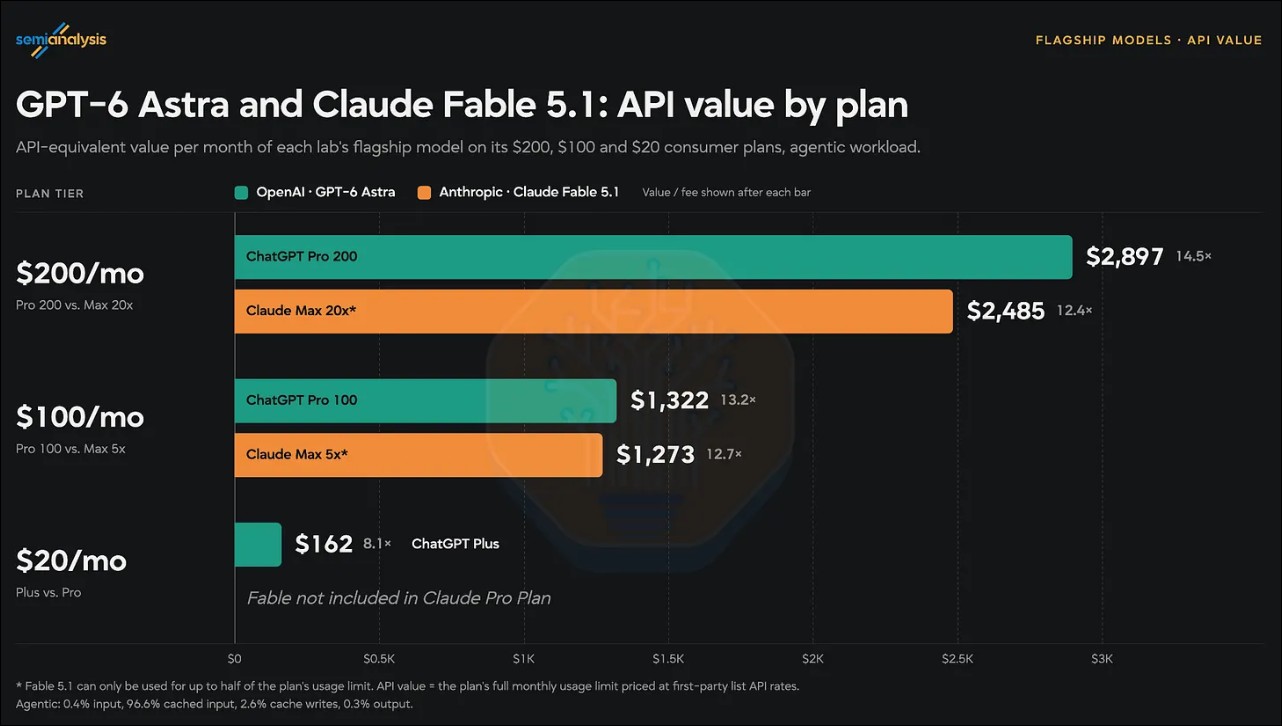
The comparison among high-end models gets more detailed. The usage caps for GPT-6 Astra and Claude Fable 5.1 are fairly close, but Fable can only use 50% of the subscription quota. By the math, after the $200 (about NT$6,200) Claude plan burns through $2,485 worth of Fable 5.1, half the quota remains; OpenAI’s equivalent plan hits bottom after burning through $2,897 worth of Astra. SemiAnalysis concluded in its report: OpenAI used to be favored by independent developers for its generous subscription caps, but today the situation has reversed—any Opus 5.5 on a Claude subscription is worth far more than any OpenAI plan.
OpenAI halves its $200 plan and launches a new $500 premium tier alongside it.
What widened the gap further was a series of adjustments OpenAI announced at last week’s DevDay. The $200 Pro plan’s usage allowance for ChatGPT Work and Codex was cut from 20 times that of Plus to 10 times, and the GPT-6 Pro quota in Chat dropped from 200 messages per week to 100. Tibo Sottiaux, head of product and platform, gave advance notice on X, admitting the new algorithm amounted to halving the API spending allowance of the old $200 plan, but argued that developers “can still get more work done with the same plan than they did a month ago.” Developers’ reaction was blunt: “Everyone, go back to Claude. Rest in peace, OpenAI.”
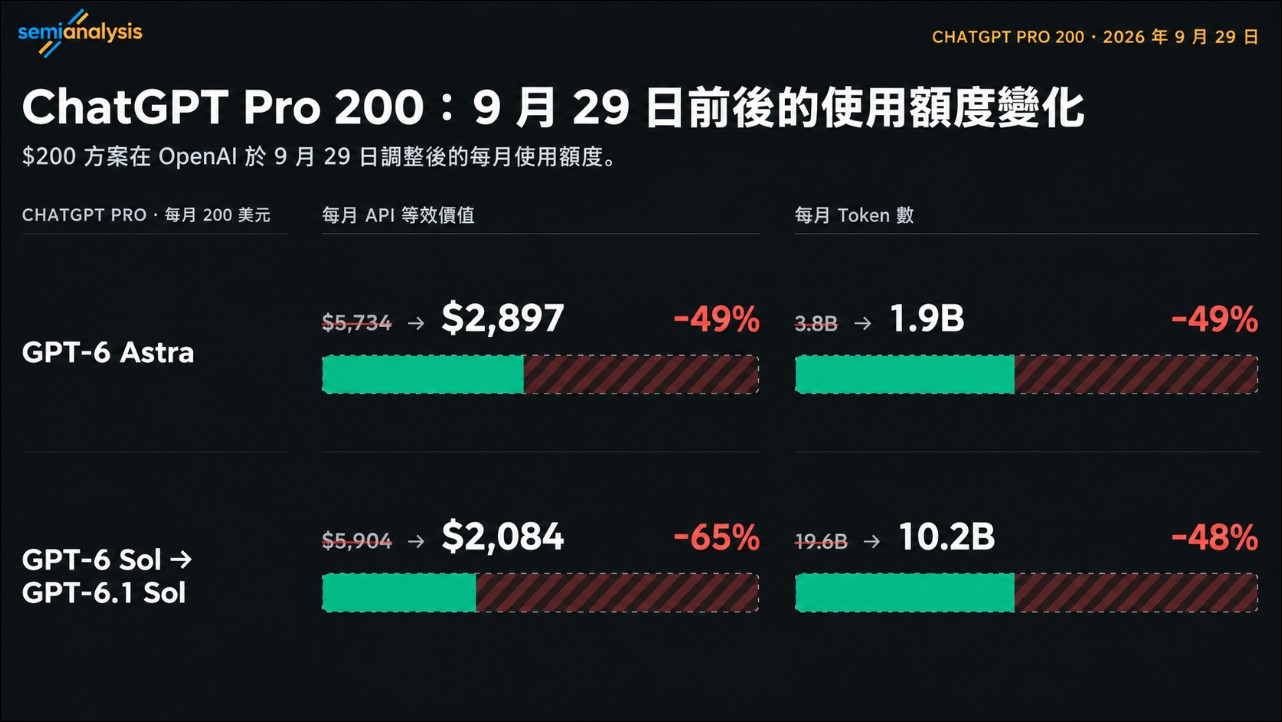
The $500 (about NT$15,500) Pro plan introduced at the same event offers 25 times the usage of Plus and centers on the Ultrafast tier for GPT-6 Astra in Codex, with generation speeds up to 8 times standard. SemiAnalysis points out that Ultrafast at 300 tokens per second is the core selling point of the $500 plan. After the adjustment, OpenAI’s $100, $200, and $500 tiers now deliver the same number of tokens per dollar; previously, the $200 plan’s value per dollar was about twice that of the $100 plan, and the era of the heaviest subsidies is now over, while Anthropic’s value per dollar across subscription tiers has remained consistent. After tracking, SemiAnalysis found that the $500 plan’s Astra capacity is only 21% greater than that of the old $200 plan, and because the cache read unit price for GPT-6.1 Sol had already dropped by 50%, the API-equivalent value of Sol-class models is actually lower on the new plan.
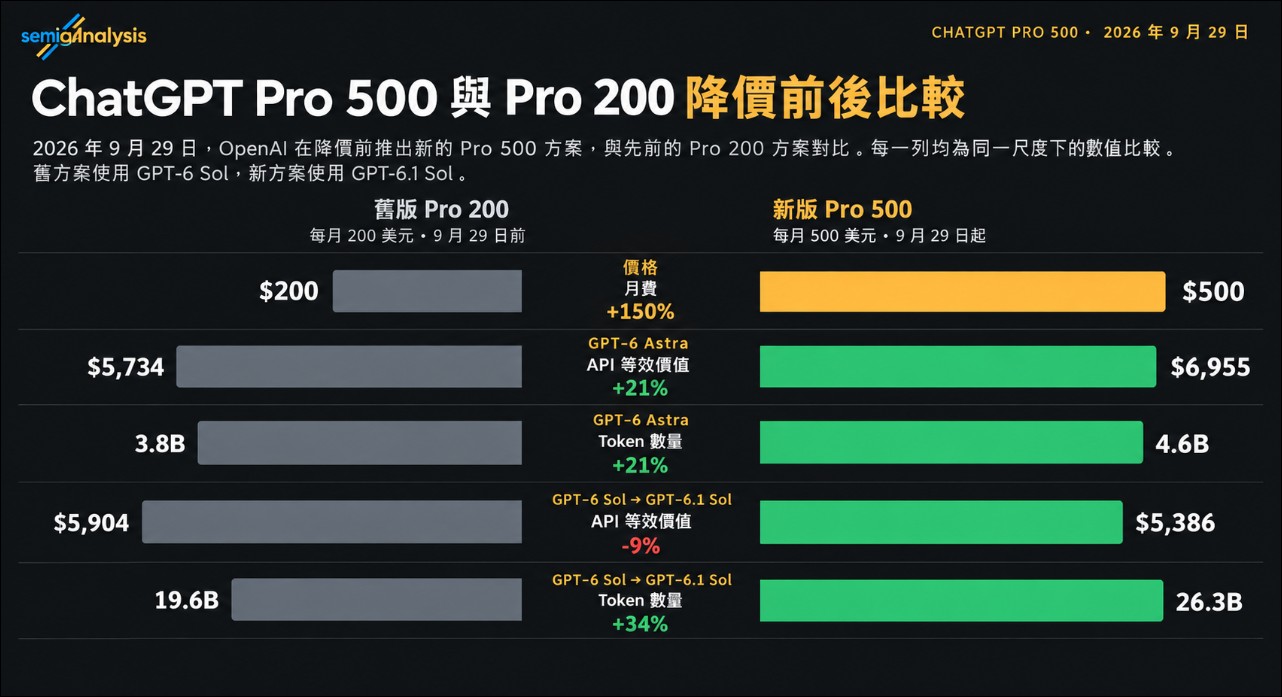
cache read is old content repeatedly sent to the model in multi-turn conversations, and it accounts for an extremely high share of usage for coding agents. When the unit price drops, the same number of tokens converts to fewer US dollars, which explains why the converted value of Sol-class models fell by more than 50%. Existing $200 subscribers can keep the old limits until October 29, after which they’ll get a 62,500-point usage allowance (OpenAI says it’s worth $2,500, about NT$77,500), expiring on December 31, 2026. After cutting the allowance, Tibo, who is responsible for Codex, promised that for the next 28 days, every day he would either ship an improvement or reset the allowance for all users. The goodwill OpenAI accumulated from generously resetting limits many times in the past is one of the reasons for Codex’s recent surge in users, and even forced Anthropic to repeatedly roll back its planned subscription limit tightening.
Over the next 28 days, each day we’ll either ship one thing that is a clear improvement and relevant for most codex/work users or ship a full reset. Let the improvements begin.
— Tibo (@thsottiaux) October 4, 2026
Subscriptions are a money-loser: maxing out usage can burn $200 into $14,000.
The reason subscriptions can be so generous is that they are subsidized. SemiAnalysis previously calculated that if the old $200 ChatGPT Pro (20x usage) were actually used to its full quota, the cost at standard API pricing would be as high as $14,000 (about NT$430,000); Anthropic’s same-priced Claude Max 20x has a ceiling of about $8,000 (about NT$250,000). Usage rates are therefore a make-or-break threshold for providers: Anthropic’s Claude Pro and Max 5x break even at around 20% usage, while OpenAI’s Plus and Pro 5x start losing money once usage exceeds 11.4%; at the top tier, Anthropic reaches zero gross margin at around 10% usage, while OpenAI reaches it at just 5.7%.
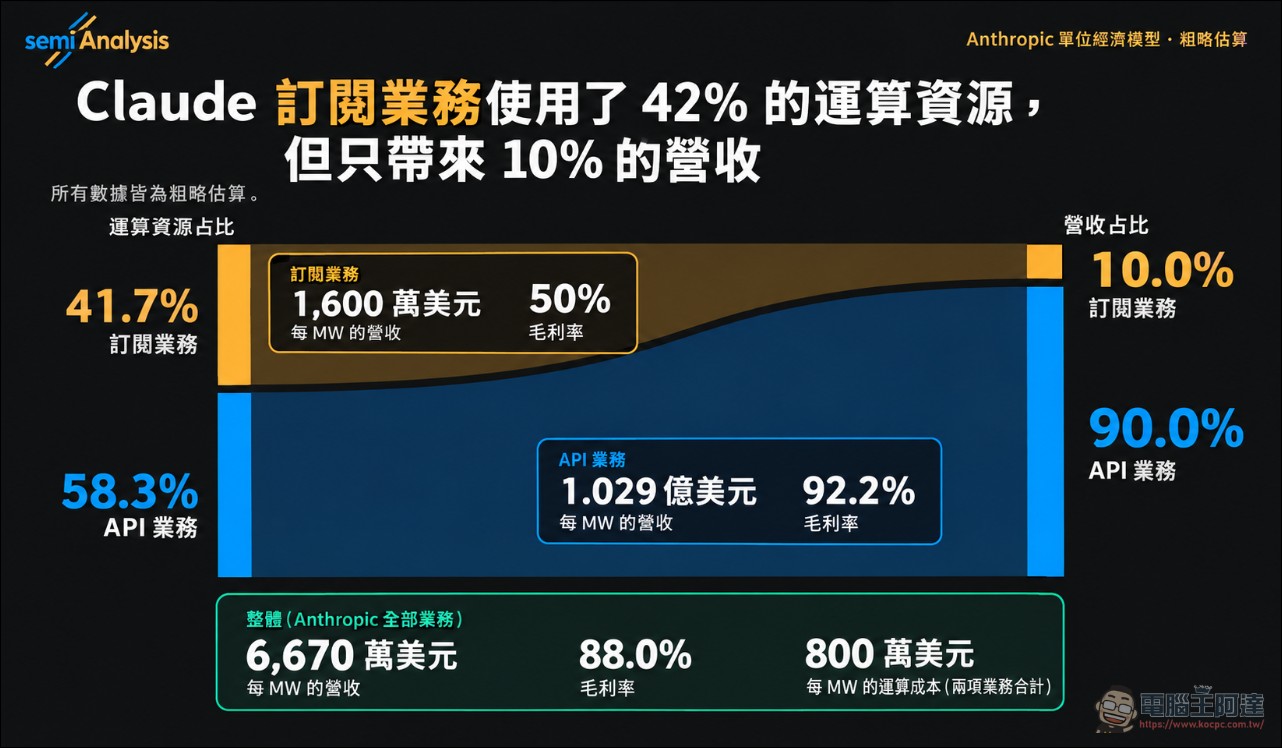
Subscriptions account for only about 10% of Anthropic’s total revenue, but may consume over 40% of its inference compute, dragging down blended revenue per MW by about $36M. Both companies are aware of this and have chosen two different convergence paths. Anthropic’s approach is to make more expensive models have lower equivalent value in subscriptions: the decline from Sonnet 5.5 to Opus 5.5 is small, but by Fable 5.1 it becomes a significant reduction, effectively using new model tiers to quietly reduce subsidies. SemiAnalysis estimates that, assuming an average of only 20% of quota used, the gross margin for Opus 5.5 subscriptions is about 6%, while Fable 5.1 can reach about 80%, close to software company levels.
When Opus 5.5 launched on September 22, API input and output unit prices dropped by 20% and cache read by 60%. Anthropic also raised subscription quotas—about 20% more for the Max plan and about 50% more for the Pro plan—but this still was not enough to fully offset the price cuts; converted into dollars, the value of an Opus subscription was slightly lower than before the price cuts. OpenAI instead chose the “nuclear option,” slashing quotas across all model tiers to Fable-level at once.
SemiAnalysis believes Anthropic’s gradual approach is more subtle, while OpenAI managed to contain the backlash this time by relying on positive DevDay coverage drowning out the previous day’s bad news, plus existing subscribers getting an extra month of buffer at the old limits; I personally estimate the mass cancellation wave will likely hit in early November.
Location of Chinese laboratories and third-party tools
The report also looked at other players. Although Chinese labs are tighter on compute, they still maintain subsidized subscriptions, and the level of subsidy varies widely by model; on average, the API-equivalent value per dollar is slightly lower than OpenAI’s roughly 12x. Third-party tools that offer first-party models are less cost-effective: the same OpenAI and Anthropic models, when accessed through credits in third-party plans such as Cursor or Cognition (Devin), deliver worse value than subscribing directly to the model companies. For heavy agent users, this report makes the choice simple: spend money where it counts most, and among first-party subscriptions, Claude currently offers the best value for money.
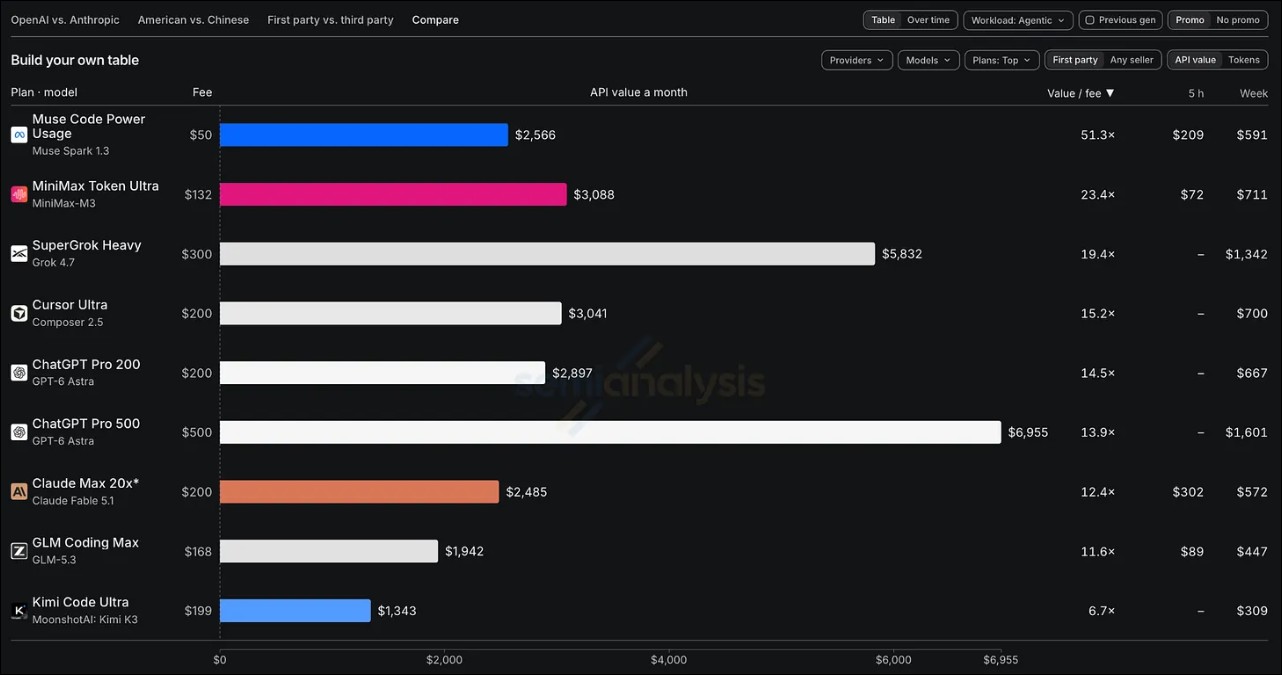
For ordinary users, the significance of this subscription value war is that for the same monthly fee, the amount of work you can run can differ by several times. For people who use AI to write code every day and are choosing between $200 plans, Claude currently offers more, but quotas can change at any time. SemiAnalysis also cautions that looking only at “how much a plan is worth” is meaningless; value depends on the combination of (plan, model, workload), and providers can adjust caps at any time, so current price-performance analyses will soon be outdated. As agentic workloads consume hundreds of times more tokens than ordinary conversations, how subscription quotas are allocated and how much is provided has become the most critical tug-of-war between AI companies’ financial models and users’ wallets.
Source:SemiAnalysis(Images localized into Chinese using AI)
Source: KOCPC Chinese