


A technical document from x86 architecture expert Christian Ludloff recently appeared on the Linux Kernel Mailing List (LKML), revealing that a mysterious manufacturer—neither Intel nor AMD—has successfully developed an x86 processor supporting three major specifications: APX, FRED, and x86S, and has already been deployed at scale for over a year. The chip’s most radical design decision is the complete abandonment of the decades-old 32-bit backward compatibility burden of the x86 architecture. News of this immediately drew significant attention in the x86 ecosystem, because the product’s specifications happen to fill exactly the gap in Intel’s own abandoned roadmap.

Only keep 64-bit; 32-bit compatibility depends on software.
According to documents published by Ludloff on LKML, this processor’s core architecture only supports 64-bit protected mode (PM64) and five-level page tables (PML5). Traditional Legacy Mode and 32-bit compatibility mode have been completely removed, and all related backward compatibility is handled through software emulation.

This design is quite radical. Since the x86 architecture debuted in 1978, it has accumulated a massive burden of backward compatibility over the decades—from 16-bit Real Mode to 32-bit protected mode, with every generation of processors having to carry this legacy hardware logic. While this ensures compatibility for hundreds of thousands of older software titles, it also keeps the die area, power consumption, and design complexity of modern x86 chips persistently high. In contrast, the Apple ecosystem made a clean break when it dropped 32-bit apps starting with iOS 11 in 2017, and on the desktop side eliminated them with macOS 10.15 Catalina in 2019. Honestly, Intel should have done this long ago.
Shifting compatibility from hardware to software is not a brand-new concept. In the past, some vendors attempted similar approaches, but most failed due to excessive performance loss. This time, the challenge is: 32-bit applications have largely declined on the consumer side today, but many legacy systems remain online in enterprise, industrial, and embedded environments. Whether software emulation can hold up to the performance demands of these scenarios is the first test this chip will face.
Ludloff stated bluntly in the email: “After more than two decades of the x86-64 era, Legacy Mode and Compatibility Mode have fulfilled their mission—it’s time to cast off these heavy burdens.” He summed it up in one sentence: “Move the complexity into x86 software emulation, reject the x86 myths, and put away those duct-tape patches.”
A mysterious manufacturer takes over the x86S abandoned by Intel.
Intel proposed the x86S specification in 2023, aiming to clean up the historical baggage of the x86 architecture and create a pure 64-bit-only design. However, by mid-2024, Intel officially abandoned the project, citing insufficient market demand and prohibitive ecosystem transition costs.
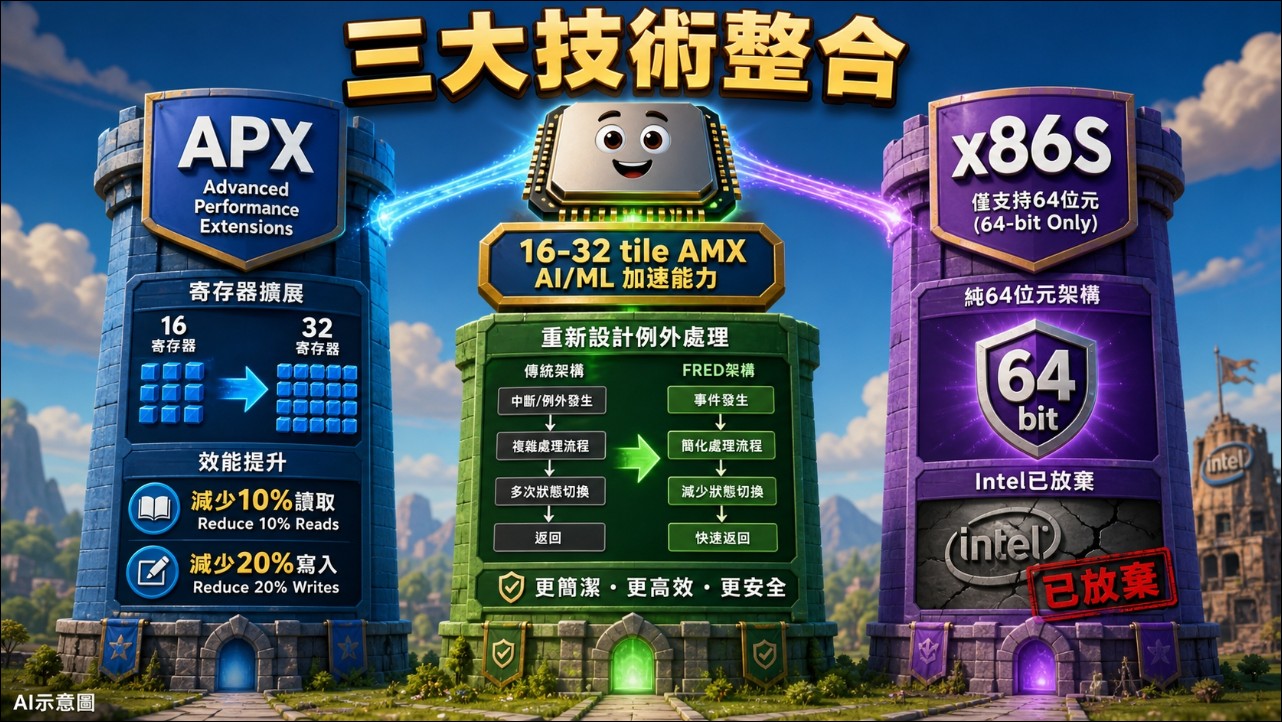
Now, this mysterious manufacturer has picked up the banner Intel dropped, and even gone a step further by integrating both APX and FRED technologies on top of x86S. In Ludloff’s words: “Intel’s abandonment proved premature. Someone carried on.”
APX and FRED: A Dual Upgrade in Performance and Architecture
The two key technologies integrated into this processor each have their own origins. The FRED (Flexible Return and Event Delivery) specification was first released by Intel five years ago, with the goal of redesigning x86’s exception handling and interrupt delivery mechanisms to simplify the processing flow of OS kernels. According to Ludloff’s document, the FRED specification was finalized between late 2023 and early 2024. Intel first supported FRED in products released at the end of 2024, and AMD is expected to follow suit in the near future.
APX (Advanced Performance Extensions) expands general-purpose registers from the traditional 16 to 32, significantly reducing the problem of processors having to frequently read from and write to memory due to insufficient registers. Test data shows that APX can reduce read operations by about 10% and write operations by 20%, delivering a notable performance improvement. The APX specification is expected to be finalized between late 2024 and early 2025, with both Intel and AMD planning to release products supporting APX in the near future.
This mysterious chip supports both FRED and APX, and also implements x86S, which Intel has already abandoned. This manufacturer went all the way, taking the future architecture blueprint that Intel had planned for five years but gave up on halfway, and fully realizing it as a real, working processor that has been deployed for over a year.

Additionally, in previous leaks, this chip was also found to feature AMX (Advanced Matrix Extensions) matrix extension configurations in 16-tile and 32-tile specifications, surpassing the current mainstream Intel Xeon processors’ 8-tile configuration, suggesting it may deliver considerable performance in AI and machine learning workloads.
Identity Mystery: RosaicLabs, Zhaoxin, or Hygon?
Who exactly developed this processor remains shrouded in mystery. The industry speculates there are mainly three possibilities:

The first possibility is Chinese x86 processor makers Zhaoxin or Hygon. Both hold x86 licenses and have long been active in China’s domestic processor market, so pulling off such a radical architectural transformation is not impossible.
The second possibility, and also the most closely watched option, is an American startup company. RosaicLabsAt the end of July this year,Media reports Intel has agreed to license the register transfer level (RTL) code for its Atom processors to RosaicLabs, a new company registered in Delaware just a few months ago. This rare collaboration gives RosaicLabs the technical foundation to design its own x86 cores, which, along with the aforementioned advanced specifications such as the 32-tile AMX, aligns closely with the descriptions in Ludloff’s documents.
RosaicLabs’ CEO Amarjit Gill He is a seasoned veteran in the chip industry, with a long-standing co-investment relationship with Intel’s current CEO, Lip-Bu Tan. TechSpot’s analysis notes that the specific use of this license remains unclear, but speculates that it may point to high-end application areas such as robotics and AI.
The third possibility is that this chip actually comes from a new player completely unknown to the outside world. After all, the licensing ecosystem for the x86 architecture has undergone many changes over the past few years, and there may be even more surprises in the future.
Conclusion
Whoever the developer of this mysterious x86 processor may be, it has already shown the industry an alternative path for the x86 architecture beyond the established roadmaps of Intel and AMD—shedding historical baggage, adopting a purer 64-bit architecture with modern instruction set extensions, and solving compatibility issues at the software layer. Whether this approach can succeed ultimately depends on market acceptance and the level of support from the software ecosystem. But at the very least, it has made the future of x86 look more interesting than it has in the past few years.
Source: KOCPC Chinese