


When a phone has accumulated a large amount of unorganized video footage, many people lose the motivation to keep editing after seeing long, scattered clips, and may even give up posting content entirely. To address the most common challenge creators face in the early stages of video production, Instagram recently launched a new feature called “First Draft,” a smart tool that quickly and automatically turns raw footage into Reels short videos. In just a few seconds, users can transform scattered clips into a short video with a complete structure, significantly lowering the barrier to video editing. First Draft is currently available first on iOS, while the official timeline for the Android version has not yet been announced.

Instagram’s New Editing Tool “First Draft” Streamlines the Tedious Process of Editing Reels Videos
The workflow for First Draft is quite intuitive, and largely the same as the usual way of making Reels. Creators simply select the video clips they want from their phone’s photo library first, and then can activate the feature via the new “First Draft” button, no longer needing to manually trim each segment or spend time arranging the order of clips. Additionally, if users shoot content with Instagram’s built-in camera, they can use the feature directly while recording, making the process of organizing footage and creating videos smoother.
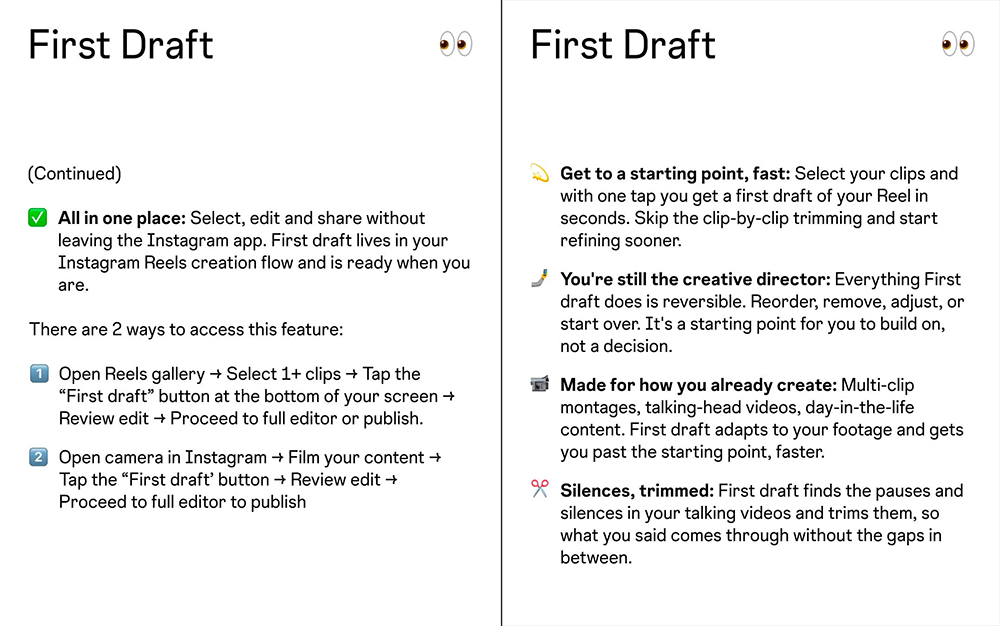
Once activated, the system automatically begins analyzing the video content, running a series of computational processes to identify the most engaging clips and highlight moments, then rearranging these key segments into a short video. The entire workflow covers steps such as footage analysis, highlight selection, and automated editing, requiring almost no manual intervention. Official demo cases show that a nearly five-minute video, after being processed by First Draft, is condensed into a fast-paced, highly watchable 17-second Reels, demonstrating the potential of automated editing technology to improve content efficiency.
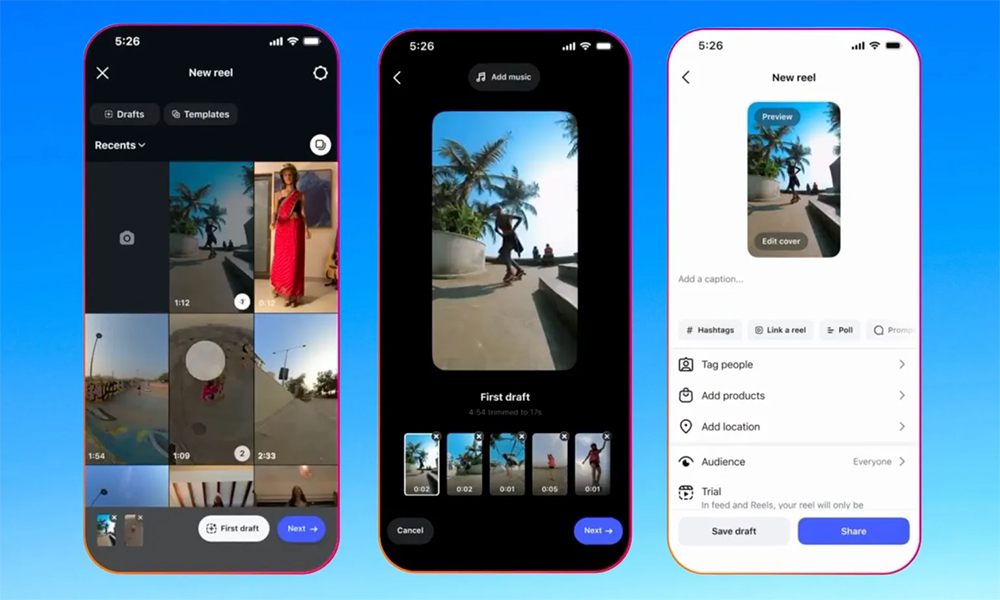
Notably, although First Draft can handle most of the initial editing work, creators do not lose control over their content as a result. Every adjustment made by the system can be modified or undone at any time, allowing users to reorder clips, adjust clip lengths, change transitions, and even add their preferred background music and creative elements. Instagram says the main purpose of this feature is to help creators get past the most tedious starting phase, reduce the editing pressure that comes with dealing with large amounts of footage, and also make creation more convenient for users with accessibility needs.

Compared to Edits, Instagram’s other standalone video tool, First Draft has a clearly different positioning. Edits focuses on professional-grade video production, offering precise timeline control, storyboard planning, and various advanced AI effects, making it suitable for creators who want a high degree of customization. First Draft, on the other hand, is directly integrated into Instagram’s Reels creation flow, requiring no additional downloads or app switching. It emphasizes quick generation and simplified operation, allowing everyday users to easily produce short-form video content with a certain level of quality.
However, Instagram has not yet clearly stated whether AI technology is used behind First Draft, so at this stage it is better to view it as a tool with intelligent automated editing capabilities rather than an AI-focused product. In recent years, Instagram has continued to roll out several new features designed to help creators improve efficiency, such as audio replacement and series content management services, showing that the platform is actively lowering the barrier to content creation and encouraging more users to enter the short-form video market. As for whether First Draft can truly become creators’ new favorite, the key still lies in how much creative autonomy users are willing to trade for a faster, more time-saving video production experience.
Source: KOCPC Chinese