


Although we may not be able to open up headphones to see their internal construction, the technology they contain often exceeds expectations. No matter which pair of headphones you pick, they all share one common core: the driver unit. Driver units vary in type, operating principle, and materials, and these differences directly affect how headphones sound. So, which type of driver unit is right for you?
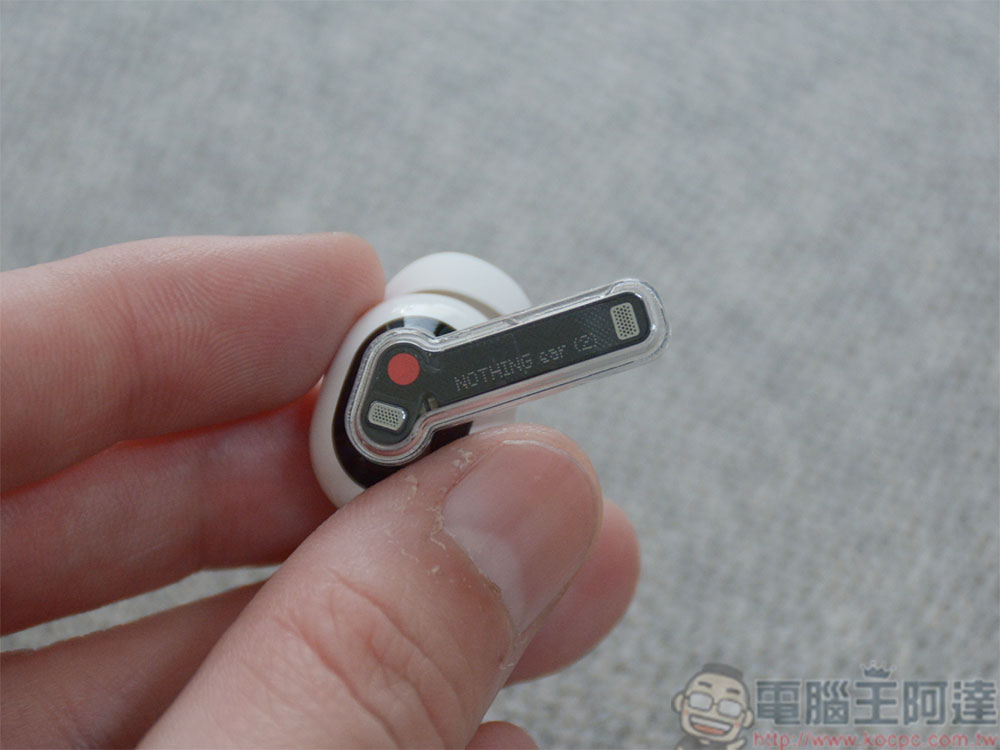
Understanding headphone drivers: the key factor that significantly affects wireless headphone audio performance.
What is a driver unit?
Driver units are essentially miniature speakers inside headphones. They generate rapid movement based on the electrical signals from the audio source, pushing air to create compression and rarefaction, which your ears and brain then interpret as sound. Developing driver units for wireless earbuds is no easy task—engineers must balance size, power consumption, manufacturing complexity, and cost simultaneously. Currently, there are four main types of driver units on the market: dynamic, balanced armature, planar magnetic, and micro-electromechanical systems (MEMS). Manufacturers are all working to push past technical limitations so that each type of driver can deliver its best possible sound quality.
Before comparing their pros and cons, let’s first look at the characteristics of each driver unit.
Dynamic driver
Dynamic drivers can be seen as miniature versions of traditional loudspeakers, consisting of a diaphragm, voice coil, and magnet. When an audio signal passes through the voice coil, it moves the diaphragm back and forth, pushing air to produce sound waves, while the suspension system is responsible for returning the diaphragm to its resting position. Dynamic drivers are currently the most common type of headphone driver, delivering a natural, balanced sound with good detail retrieval and full, powerful bass. However, their high-frequency extension is typically not as strong as other driver types, and they are more prone to distortion at higher volumes, which can make music sound slightly muddy.
Dynamic drivers cover the full frequency range, making them well suited for active noise cancellation technology. An extension of dynamic drivers is the bone conduction driver, which doesn’t transmit sound through the air but rather sends audio directly through skull vibrations. This design keeps the ears open and doesn’t block out ambient sounds. Shokz is the most well-known bone conduction brand, but other manufacturers also offer pure bone conduction or hybrid designs.

Moving-Iron Driver Unit (Balanced Armature)
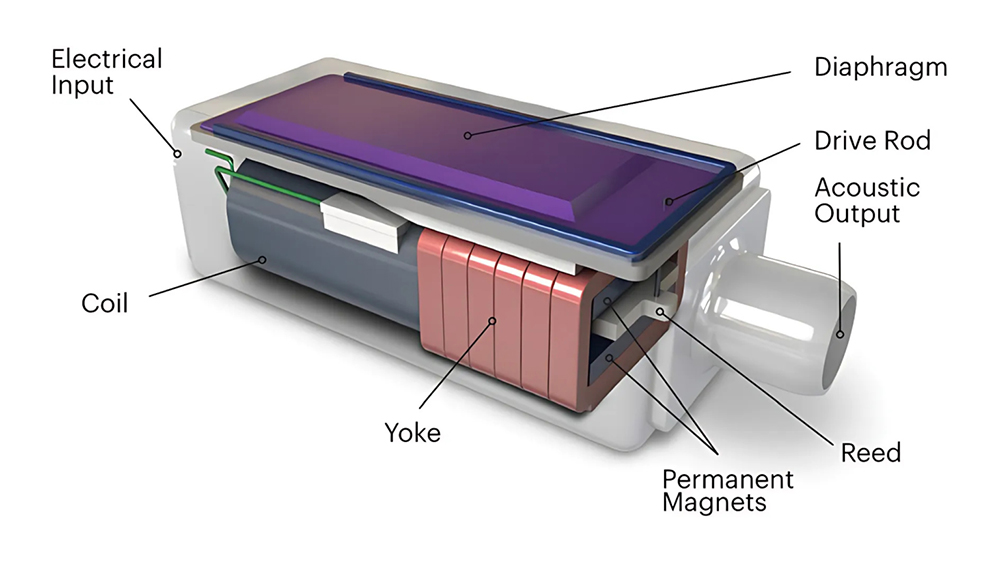
The balanced armature was invented by Hugh Knowles in the 1950s, originally for use in hearing aids. It consists of a rigid diaphragm, a miniature metal reed (armature), and a voice coil. The armature is suspended between two magnets. When an audio signal is applied to the voice coil, magnetic force drives the reed to vibrate, thereby producing sound.
Balanced armature drivers excel at high-frequency extension, delivering clear and detailed sound that suits a wide range of music genres. However, due to their small size, their bass response is typically not as strong as that of dynamic drivers. Many earphones adopt a hybrid “balanced armature + dynamic” design to compensate for the bass.
Planar magnetic driver
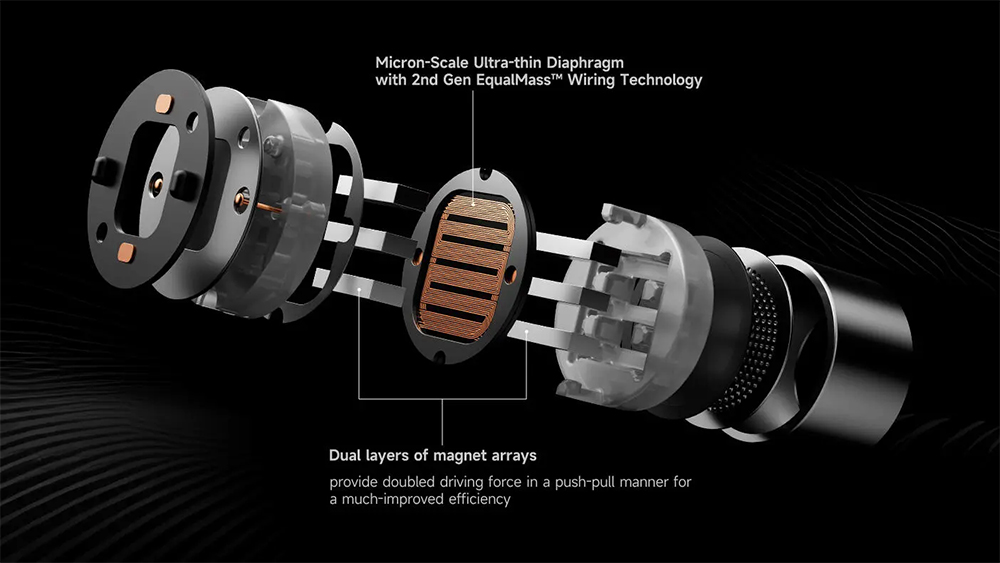
Planar magnetic drivers use a flat diaphragm with embedded conductive material. When an electrical signal passes through the conductor, the magnets drive the entire diaphragm uniformly, resulting in extremely low distortion and clean, transparent sound quality. Their bass performance is typically better than balanced armature drivers, but the downsides are larger size, heavier weight, and higher power consumption, which is why they are rarely found in mainstream wireless earphones.
Micro-Electro-Mechanical Systems (MEMS)
MEMS is the latest achievement in miniaturization technology. Its diaphragm is made of extremely thin piezoelectric material, which can deform directly with just an electrical signal to produce sound. MEMS performs excellently in high frequencies and is slightly weaker in low frequencies, but recent technological advances have enabled it to handle a more complete frequency range.
The key lies in “tuning.”
The driver unit is just the foundation; what truly determines headphone sound quality is how the manufacturer tunes them. Tuning involves the driver design, the shape of the acoustic chamber, and digital signal processing (DSP) algorithms. So, what exactly is “good-sounding” audio? Through extensive listening tests, Harman proposed the famous “Harman curve,” which represents the sound characteristics most people prefer. Many brands use this as a baseline for tuning, while others develop different target curves based on the needs of their own customer base.
For example, balanced armature manufacturer Knowles studied 200 Billboard hit songs across different hearing groups and proposed the “Knowles Preferred Listening Response Curve,” which emphasizes a high-frequency boost around 10kHz to give vocals and metal instruments a greater sense of air.
Future Trend: Hybrid Drive Unit
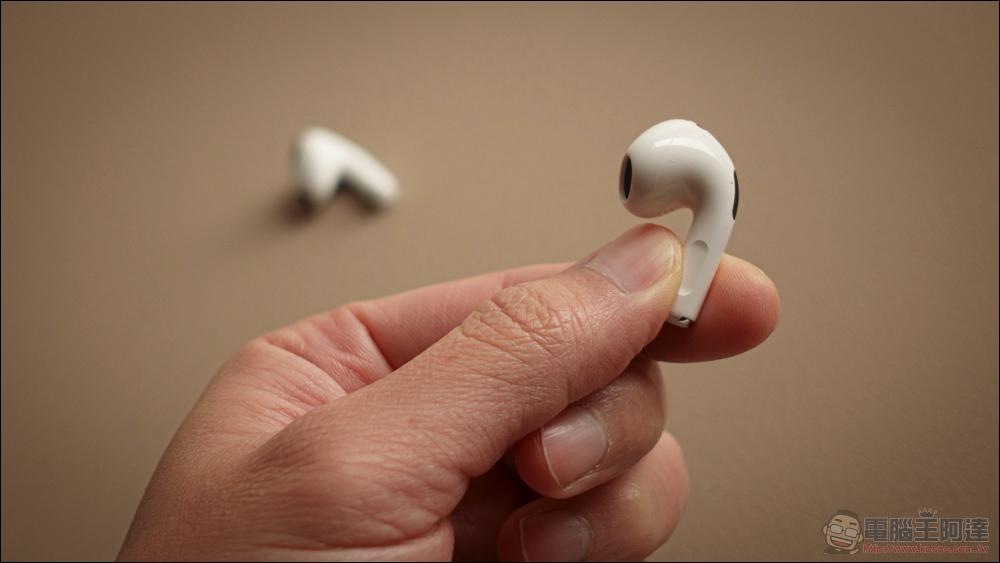
Each type of driver unit has its advocates, but more and more headphones are adopting hybrid designs, combining the strengths of different driver units. For example:
- Status Pro X, Baseus Inspire XC1, EarFun Air Pro 4 Plus: Balanced Armature + Dynamic
- Creative Aurvana Ace 3: MEMS + Dynamic Driver
- Moto Buds 2: Planar Magnetic + Dynamic
- Noble Audio FoKus Rex5: Dynamic + Planar Magnetic + Triple Balanced Armature (Extreme Spec Stacking)
Mainstream headphones still primarily use a single dynamic driver due to cost and battery life considerations, but high-end and audiophile products are gradually moving toward hybrid designs, which may become more widespread in the future.
Source: KOCPC Chinese