


Cloud storage service provider Backblaze Publicly available hard drive operational data has long been one of the most closely watched reliability reference points in the storage industry. In a peer-reviewed study recently published in IEEE Transactions on Cloud Computing, Essex University economist Christoph Siemroth and Sungkyunkwan University economist Yeomyung Park reanalyzed 12 years of Backblaze hard drive data using more rigorous statistical methods, covering 443,000 drives with more than 1.66 million cumulative drive-years of service, and produced a definitive brand reliability ranking.

Scholars analyze all years of Backblaze’s hard drive reliability data.
Backblaze publishes a hard drive failure rate report every quarter, but two research authors believe this statistical approach has a bias of “mixing new and old drives.” The reason is that the four major brands had different peak installation periods: HGST’s new drive installation peak was in 2014, Seagate dominated the installation market from 2015 to 2020, while Toshiba and Western Digital reached the top of new drive installations in 2023 and 2024 respectively. In other words, the essence of the raw annualized failure rate data is that it compares Seagate and HGST drives that have been in service for many years with Toshiba and Western Digital drives that were installed much more recently, which naturally makes brands with more new drives appear more reliable.
To solve this problem, the two researchers used duration regression models to statistically control for hard drive age, capacity, form factor, and operating temperature, allowing hard drives from different brands to be compared under the same conditions. In addition, about 147,000 hard drives in the sample (31%) left the dataset without experiencing failure, mostly because they were replaced and removed during data center capacity upgrades. The researchers also incorporated this factor into the model.
Research results show that after controlling for variables such as service life, capacity, form factor, and operating temperature, HGST hard drives had the lowest failure rate, at approximately 41% of Seagate’s; Western Digital came in at about 52% of Seagate’s; and Toshiba ranked last with a relative failure rate of 107%. However, HGST, which took the reliability crown, can no longer be purchased as new products, as Western Digital gradually discontinued its product lines after acquiring the brand in 2012.
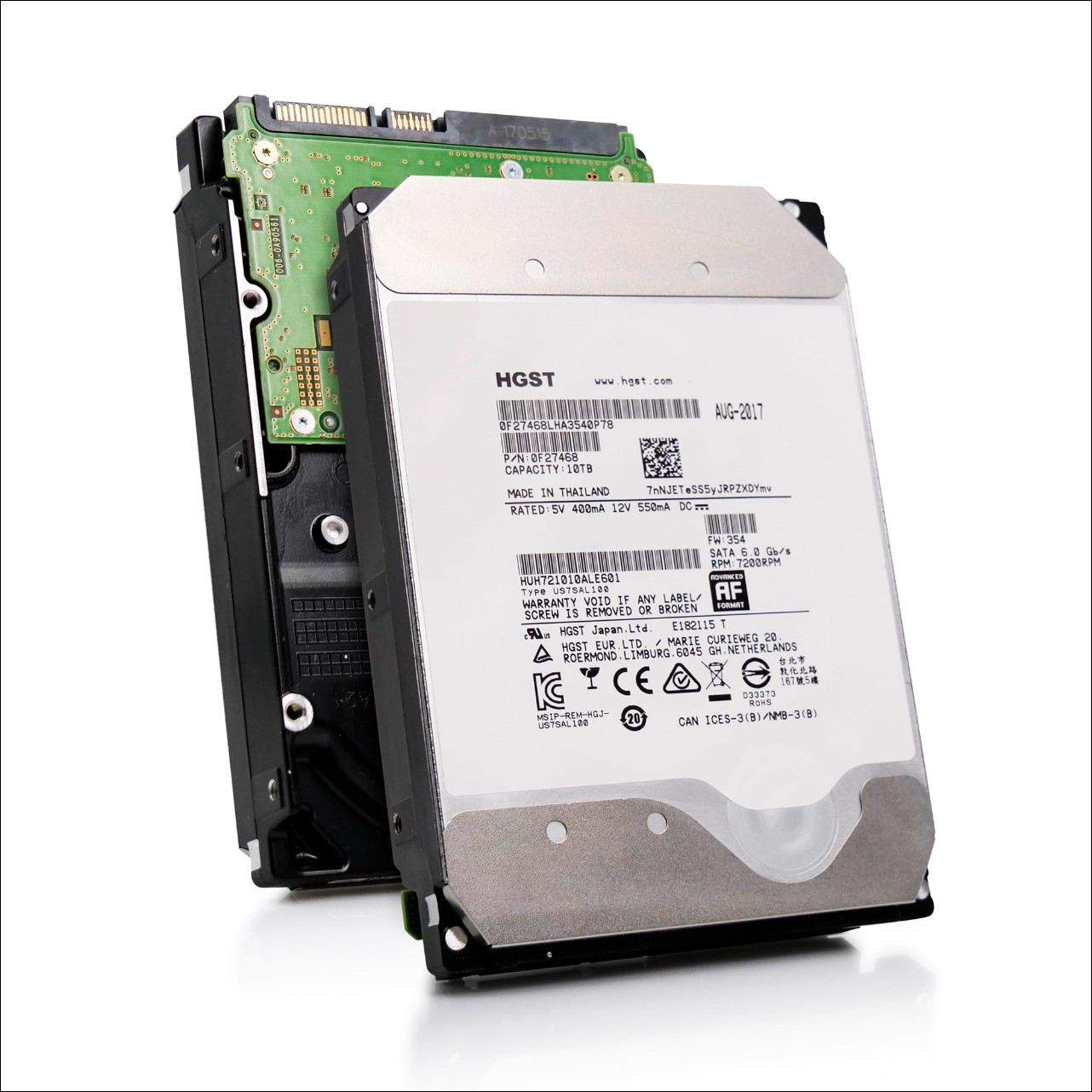
Brand reliability ranking: HGST is the best, Toshiba is last.
Under conditions where all variables are controlled, the relative failure rates of the four major brands rank as follows:
- HGSTThe failure rate is only 41% of Seagate’s, with the highest reliability.
- Western Digital (WD)The failure rate is approximately 52% of Seagate’s, ranking second.
- Seagate: as a baseline comparison target
- Toshiba:The failure rate is 107% of Seagate’s, ranking last.
The study authors noted that HGST, a brand under Western Digital, had failure rates closest to Western Digital’s own, possibly due to technology sharing between the two. After Western Digital acquired HGST in 2012, it gradually integrated its technology and product lines, which may explain why the two brands’ reliability performance is so similar.
Seagate’s performance shows an interesting characteristic: in the new drive stage, Seagate had the highest failure rate among the four brands, but as service age increased, the failure rate remained stable with no clear upward trend. Backblaze’s own analysis of failed drives previously also showed that most failures occur within the first 3 years of service.
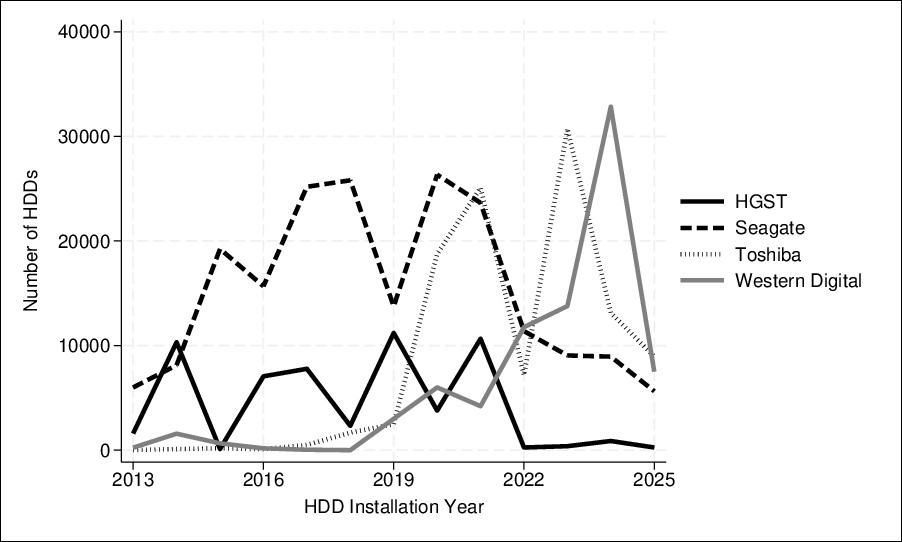
Toshiba hard drives’ “five-year cliff”: failure rate surges after 60 months of service.
One of the most striking findings in this study is that after Toshiba drives exceeded 60 months (5 years) of service, the monthly failure rate surged to more than four times the previous level. This cliff-like spike in failure rate was not observed at any service stage for other brands in the dataset.
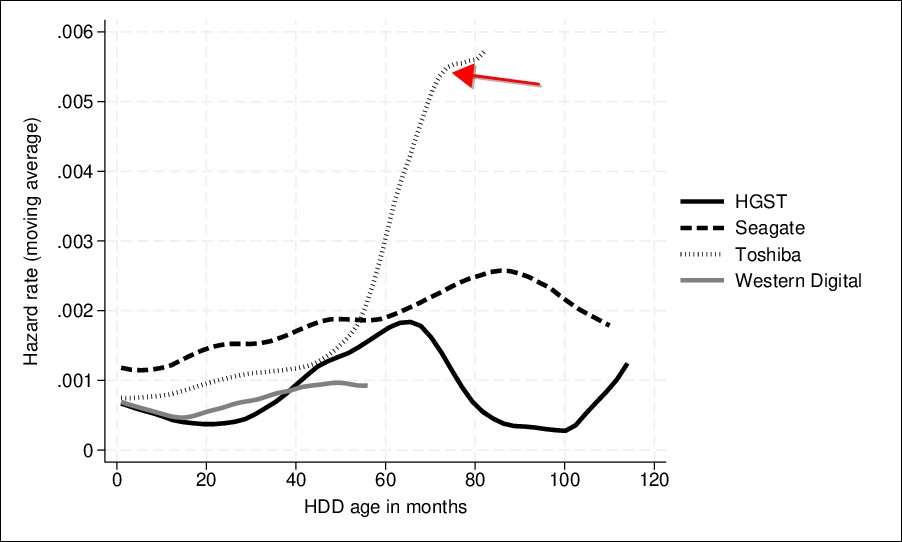
Specifically, in the 50-to-100-month service window, Toshiba drives showed a monthly failure rate of 5 to 6 per thousand, while the other three brands remained largely below 2.5 per thousand. This means that during the same service period, Toshiba drives were more than twice as likely to fail as the other brands. This finding has practical implications for businesses and consumers who rely on Toshiba drives over the long term. Even if a Toshiba drive survives its initial three-year “break-in period,” it is not a reason to let your guard down—the real test comes after five years of service.
Temperature and Capacity: Two Major Physical Factors Affecting Failure Rate
The study’s model calculations also revealed the quantitative impact of temperature and capacity on hard disk reliability.
- Temperature effectFor every 1°C increase in average hard drive operating temperature, the failure rate rises by 2.1%. Calculated using the compound effect, a 10°C temperature increase results in an overall failure rate increase of approximately 23%. This means that cooling management in data centers has a direct and significant impact on hard drive lifespan.
- Capacity effectFor every 1TB increase in hard drive capacity, the failure rate drops by approximately 3.4%. The author attributes this on one hand to the helium-sealed packaging technology commonly used in large-capacity hard drives (which reduces disk rotation resistance and internal vibration), and on the other hand to the more advanced head manufacturing processes used in larger-capacity models.
The discovery of these two factors has practical value: for data centers that need to purchase large numbers of hard drives, deploying drives in high-temperature environments will significantly increase the risk of long-term failure, while investing in larger-capacity hard drives can improve storage density and may also lead to better long-term reliability.
Research limitation: data from enterprise-grade hard drives may not necessarily apply to consumer-grade drives.
This study has several important limitations that readers should keep in mind when considering the findings:
- Sample natureAll samples are enterprise-grade hard drives deployed in Backblaze data centers, so the reliability ranking may not apply to consumer-grade drives. Enterprise and consumer hard drives differ fundamentally in design, manufacturing process, and workload.
- Insufficient workload data.Backblaze has not recorded comparable workload data for drives of each brand, so it cannot rule out the effect of differences in read/write stress on failure rates across brands.
- Long-term reliability unknown.Only 0.52% of the hard drives in the sample had been in service for more than 10 years, so the study’s findings reflect short- to medium-term reliability rather than long-term lifespan beyond a decade.
- Does not cover all brands.The dataset only includes four manufacturers: HGST, Seagate, Toshiba, and Western Digital. Other brands (such as Samsung’s consumer-grade products) are outside the scope of this analysis.
Backblaze full fleet status: annualized failure rate 1.36%
As background reference, Backblaze’s release in February 2026Latest Annual ReportIt showed that the annualized failure rate for its entire fleet of hard drives in 2025 was 1.36%, continuing a downward trend from previous years. As of the end of 2025, Backblaze was monitoring a total of 342,000 hard drives for data storage. However, behind the overall improvement in these figures lies a trend of high-capacity drives gradually replacing older, lower-capacity models, which echoes the study’s conclusion that “the larger the capacity, the lower the failure rate.”
Furthermore, even within the same brand, performance can vary greatly between different models. For example, in Backblaze’s Q4 2025 data, an HGST 8TB model (HUH728080ALE600) that had been in service for about 7.5 years had an annualized failure rate as high as 10.29%, while the same brand’s 12TB model (HUH721212ALE600) had only 0.61%. After investigating, Backblaze concluded that vibration was the main cause of the high failure rate, not a manufacturing quality issue.
This study provides the most comprehensive quantitative analysis of hard drive reliability to date. For the average consumer, the most practical advice might be: avoid keeping drives in high-temperature environments for long periods, choose larger-capacity models as they tend to be more reliable, and if you have a Toshiba drive that’s been in service for more than five years, it’s best to plan your backups in advance.
Source: KOCPC Chinese