


September 25, 2025Google Announced the official update of its Gemini 2.5 Flash and Gemini 2.5 Flash-Lite model. This upgrade brings several key improvements, not only inResponse precision and speedIt has greatly improved, while also significantly lowering computing and usage costs, and is now freely available on platforms like Google AI Studio and Vertex AI.
The positioning of Gemini 2.5 Flash and Flash-Lite
Gemini 2.5 Flash is a Lightweight and high-performance AI modelIts biggest feature is that even in the free version of Gemini, users can enjoy the model’s computing power, providing a more accessible AI experience with a lower entry barrier. In comparison, Gemini 2.5 Flash-Lite is one focused on Reduce latency The high-speed model is especially suitable for scenarios requiring real-time responses, such as customer service, interactive applications, or high-frequency input/output tasks.
Gemini 2.5 Flash just got a few new updates:
You’ll see enhanced step-by-step help for homework, better-organized responses, and improvements in image understanding. Here’s a breakdown of what’s new 🧵 pic.twitter.com/Pzv2mYNwKB
— Google Gemini App (@GeminiApp) September 25, 2025
Google is atOfficial blogIt points out that the positioning of these two models is not about replacing each other, but rather providing options for different usage needs: Flash focuses on “comprehensive precision and functionality,” while Flash-Lite emphasizes “ultra-fast response.”
Performance improvement and test data.
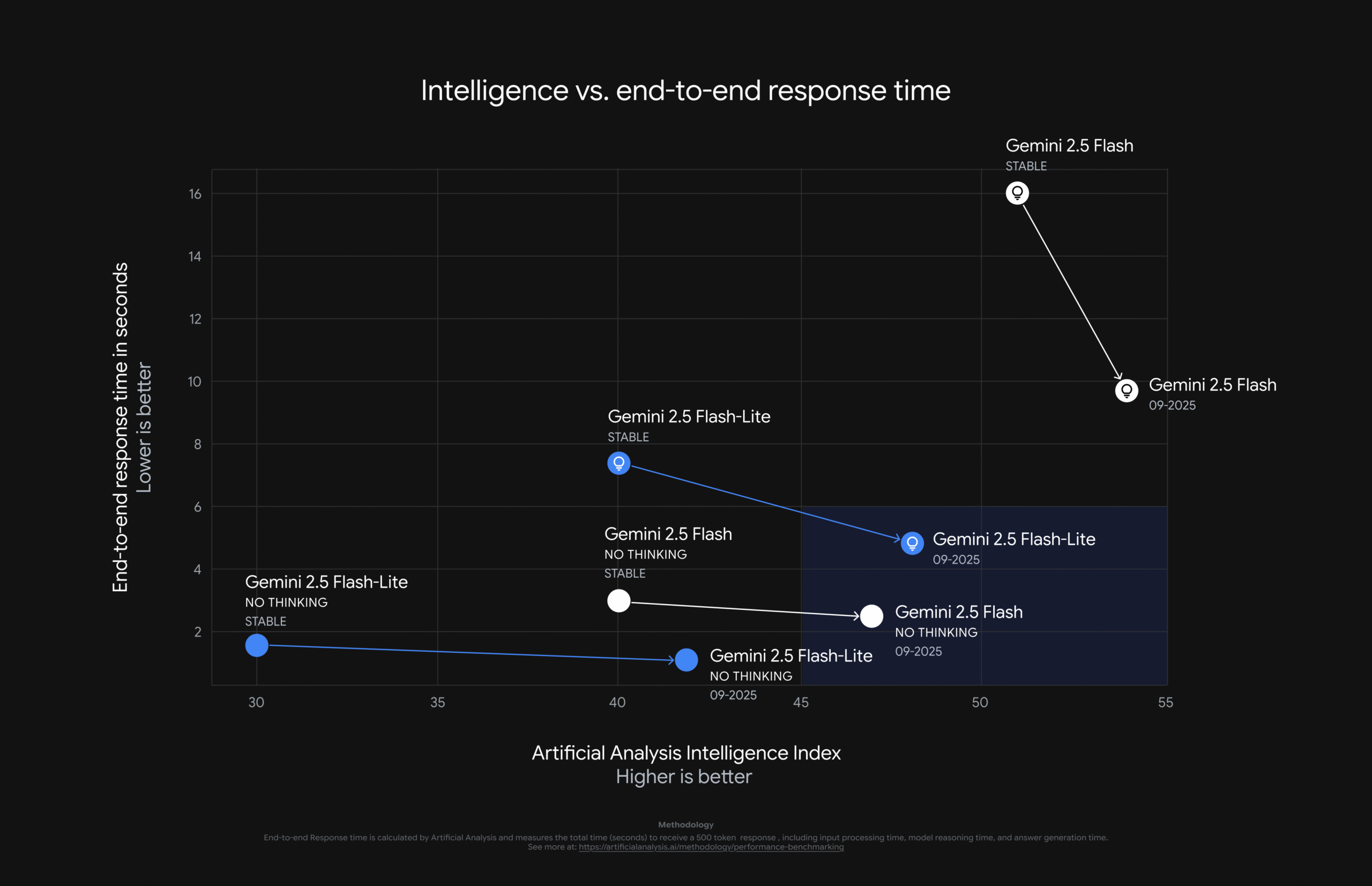
According to comparative data published by Google, both Gemini 2.5 Flash (white data) and Flash-Lite (blue data) have shown significant improvements in the two metrics of “response accuracy” and “response speed” after the update.
-
Response accuracy: After the update, it can more accurately understand and generate content, avoiding errors or deviations.
-
Response speedModel response time shortened, making interactions more immediate and fluid.
Another noteworthy statistic is Reduction in output word countSince the Gemini series APIs are billed based on output token count, reducing the token count means lower usage costs:
-
Gemini 2.5 Flash: Reduced Output Word Count 24%。
-
Gemini 2.5 Flash-Lite: Reduced Output Word Count 50%。
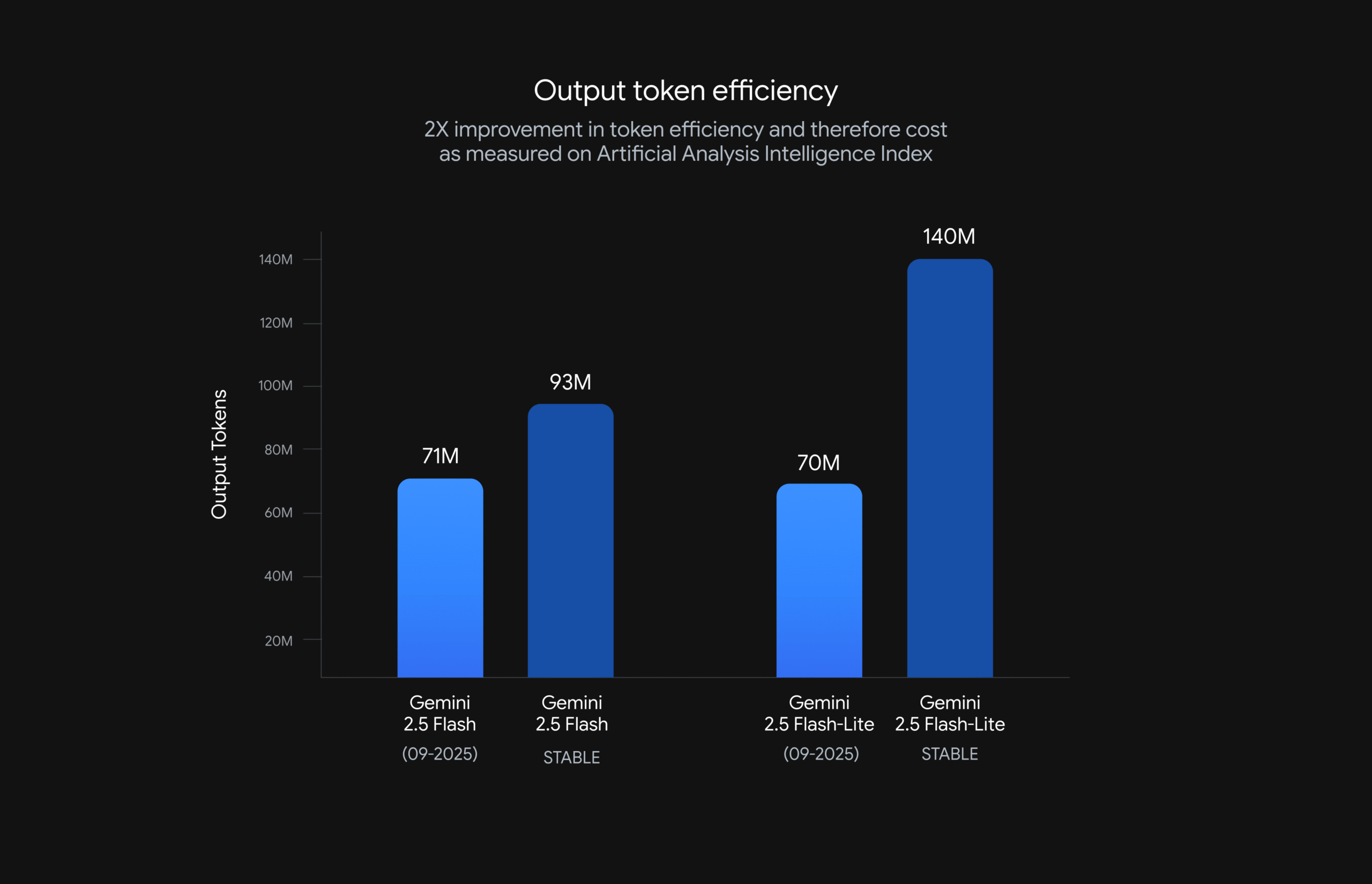
This means that for the same tasks, developers and enterprises can get faster and more accurate responses while reducing expenditures, greatly improving overall cost-effectiveness.
Improvements in actual functionality
In addition to performance and cost optimization, Google also emphasized multiple functional improvements in Gemini 2.5 Flash:
-
Clearer teaching ability
When handling education- or learning-related tasks, the model can explain the problem-solving process more explicitly “step by step,” rather than merely providing the final answer. This makes Gemini more suitable as a learning aid tool. -
Structured output of complex information
For scenarios that require consolidating large amounts of or complex information, the model can now transform content into List, table and other more intuitive formats, making it easier for users to quickly understand. -
Improving image recognition accuracy
In image analysis, the updated model demonstrates higher accuracy, bringing more reliable results for developers who require multimodal applications (text + image).
Revolutionizing the API Experience: The “-latest” Alias
Another update that the developer community is paying close attention to is Google introducing in the Gemini series API… “-latest” alias。
Previously, every time a model was updated, developers had to manually change the version number in the source code, for example from ‘gemini-flash-2.5’ to ‘gemini-flash-2.6’. Now, simply adding ‘-latest’ after the model name, such as ‘gemini-flash-latest’, automatically points to the latest version.
User Feedback and Challenges: The Problem of Interrupted Responses
However, the Gemini series is not entirely without challenges. In Google communities and developer forums, there is no shortage of criticism regarding Response Interrupted The complaints. Many users report that, compared with competitors such as Claude or GPT-4, Gemini’s responses are more likely to stop abruptly during the generation process, leading to a poor experience.
On the well-known tech community Hacker News, a user said bluntly:
「Gemini 的回應雖然在內容上優於 Claude 或 GPT-4,但回應中斷的次數實在太多。我寧願使用『稍微遜色但能完整回應的模型』,也不會選擇『表現更好卻經常中斷的模型』。若這個問題無法解決,無論 Gemini 的基準測試多麼亮眼,仍會讓人覺得它『有缺陷』。」
This reflects that AI models not only need to excel in benchmark tests, but also need to demonstrate stability in real-world application scenarios. For developers and enterprises, “uninterrupted, complete responses” often hold more practical value than “speed and accuracy.”
Currently, Google’s positioning in the AI model space is quite clear: with Gemini Ultra As a high-end flagship, meeting professional and enterprise needs; with Gemini Pro/Flash/Flash-Lite Permeate into broader application scenarios.
This round of Flash and Flash-Lite upgrades highlights Google’s strategy across three major dimensions:
-
Cost controlBy reducing the number of output words, API usage becomes more cost-effective.
-
Developer-friendlyUse ‘-latest’ to simplify maintenance and reduce adoption and update costs.
-
Diverse choicesOffers models with two different orientations—high precision and high speed—to meet diverse application scenarios.
However, while competing with OpenAI’s GPT series and Anthropic’s Claude series, Google must confront its stability issues. Otherwise, even with advantages in performance or price, it may still lose market reputation due to a poor user experience.
Source: KOCPC Chinese